Agentic WordPress: what changes when your site becomes a set of tools
There is a quieter shift underneath the AI noise, and it has nothing to do with better writing. It is that WordPress sites are becoming addressable — a set of typed capabilities a machine can discover and call, rather than a set of screens a human must click. Once that is true of your sites, the way you work on them changes shape.
A site is agentic when three things are true. First, its capabilities are discoverable — an agent can ask what the site can do rather than guess. Second, those capabilities are typed — each has a schema, so calls either validate or fail cleanly. Third, actions are governed — scopes, approvals and a log, so an agent's power is bounded and reviewable.
None of that is about intelligence. It is plumbing. But it is the plumbing that decides whether an AI can do real work on your site or just talk about it.
What stops being work
The first thing agencies notice is that a whole class of tasks — the ones you could never justify billing properly — collapse:
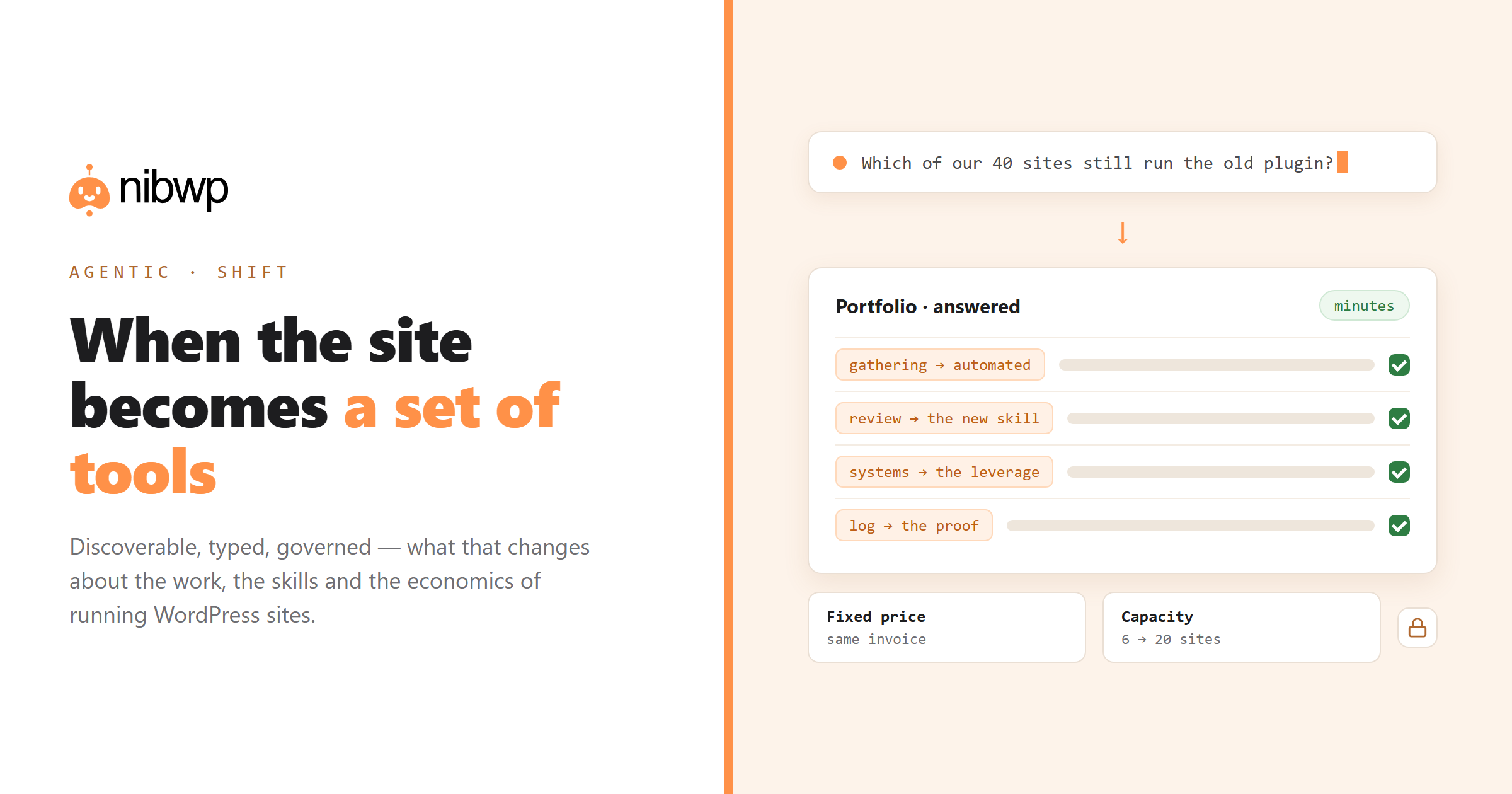
- Gathering. The first two hours of every maintenance month, spent collecting update states, security posture, performance and broken links, become minutes.
- Backfilling. Alt text, meta descriptions, missing fields across hundreds of records. Previously a quote nobody accepted; now a review session.
- Mechanical building. Section after section of a page that follows the same pattern, in the same design system.
- Bookkeeping. Directory listings, product imports, taxonomy cleanup, redirect maps — jobs that are pure consistency.
- Knowing.
What becomes work instead
The work does not disappear; it moves up a level. Three things get more valuable, not less:
- Specification. Describing an outcome precisely is now the skill. A vague brief produces a vague page — faster than before, but still vague.
- Review. You are approving plans and checking output rather than typing it. The person who is good at spotting what is wrong in ten seconds becomes your most valuable reviewer.
- System design. Design tokens, naming conventions, content models, procedures. Agents amplify whatever system you have; if the system is inconsistent, you get inconsistency at speed.
That last point is the one most teams underestimate. An agentic workflow is a mirror: shops with a real design system and documented conventions get dramatic leverage; shops where every site is bespoke get faster chaos.
How the economics move
The uncomfortable question is whether faster delivery means lower prices. It does not have to, and the reason is that clients never bought hours — they bought outcomes. What changes is your cost of delivering the outcome.
- Fixed-price work gets more profitable. Same deliverable, fewer hours, same invoice. This is the simplest path and the one most agencies take first.
- Care plans get better margins and better service. The gathering is automated, so the same fee buys the client more attention on the things that matter.
- Previously unsellable work becomes sellable. Portfolio-wide audits, content backfills, migrations that used to be quoted at a price nobody paid.
- Capacity per person rises. One person running six sites becomes one person running twenty — if the system is good enough to keep quality steady.
The pricing conversation is worth having explicitly with your team: how to bill for AI-assisted work without the discount spiral.
The real risks (not the ones in the headlines)
The risk is rarely a rogue agent deleting a database — approval gates and scopes handle that. The risks that actually bite are subtler:
- Speed without review. Approving plans quickly because they are usually fine is how the one that was not fine gets through.
- Convention drift. If two people give the agent different conventions, you get two conventions in the codebase. Write them down once, share them.
- Losing the why. When work is fast, teams stop recording why a decision was made. Six months later nobody knows.
- Client trust. Clients are fine with AI doing the work; they are not fine with finding out later. Say it up front, show the audit log, make it a selling point.
How to become agentic without a big-bang migration
The transition is incremental and reversible, which is the good news:
- Connect one site read-only and use it for questions for a week. No risk, immediate value, and you learn how the model reasons about your sites.
- Move one repeated job — the audit, the backfill — into a written procedure and run it on three sites.
- Standardise one thing: your class naming, your content model, or your build checklist. The leverage compounds.
- Grant write scope on a low-stakes site, keep approvals on, and read the audit log afterwards.
- Roll the procedure across the portfolio only once it has survived three sites unchanged.
Worked examples of those procedures, prompts included, live in the solutions library; the team-level version is in one AI workflow for every client build.
FAQ
A site whose capabilities are discoverable, typed and governed — so an AI agent can find out what the site can do, call it safely, and leave a record. It is about plumbing and permissions more than model intelligence.
Does an agentic workflow mean charging clients less?
No. Clients buy outcomes, not hours. Most agencies keep fixed prices and take the margin, then sell work that was previously unquotable — portfolio audits, backfills, migrations.
What skills matter most in an agentic workflow?
Specification, review and system design. Describing outcomes precisely, spotting bad output fast, and maintaining conventions the agent can follow consistently.
Is this only for agencies?
No, but agencies feel it first because they repeat the same work across many sites. Solo site owners get the same benefit on a smaller surface — audits, content, bulk edits.
What is the biggest risk of going agentic?
Approving plans without reading them. The technical guardrails handle catastrophic failure; the everyday risk is speed eroding review discipline.
How long does the transition take?
A week to get value read-only, a month to move a repeated job into a written procedure, a quarter to roll it across a portfolio. It is incremental and reversible at every step.