How much does AI WordPress automation cost? Real numbers
Direct costs are small and easy to look up. The number that decides it is the comparison: a 400-page meta backfill is ~15 hours by hand and under an hour with an agent.
What happens when AI breaks your site? Snapshots, drafts and undo
Four of five failures are human, not model. What each layer prevents, the six-step recovery playbook, and how to handle the client conversation.
Translate a WordPress site with AI: the honest workflow
Translation quality isn't the failure — the plumbing is. Architecture, exclusions before languages, hreflang, linked drafts, glossary enforcement, and what humans keep.
Clean up a WordPress database with AI: revisions, orphans, spam
The value is the audit, not the delete: what accumulated, where it came from, how confident the removal is — then a safe order, a verified backup, and a check afterwards.
AI image alt text for WordPress: backfill the whole media library
The most common accessibility failure and the most boring to fix. A context-aware prompt, per-type handling, batch review — and a monthly habit so it stays fixed.
Bulk edit WordPress posts with AI: categories, meta and content in one pass
Between useless bulk actions and unforgiving SQL: express the set in plain English, review old → new, apply in batches — with a snapshot as the undo.
Write blog posts with AI directly in WordPress (no copy-paste)
The pasting is the slow part. Drafts created in WordPress with real internal links and meta set, batch prompts for series, and the refresh prompt that beats new posts.
How do AI agents log into WordPress? Tokens, scopes and application passwords
An agent authenticates as a user and inherits its ceiling. Application passwords, scopes, the four gates before your database, and the leak playbook.
Does WordPress have AI built in? What core gives you, and what it doesn't
Core has no model, no chatbot, no agent — but it does have the plumbing AI needs. What's actually in core, what plugins add, and why core probably won't ship an agent.
Free vs paid WordPress MCP: what you get at each level
The connection and core tools are usually free; integrations, validated builder output and team features are where paid starts. Four questions that decide which you need.
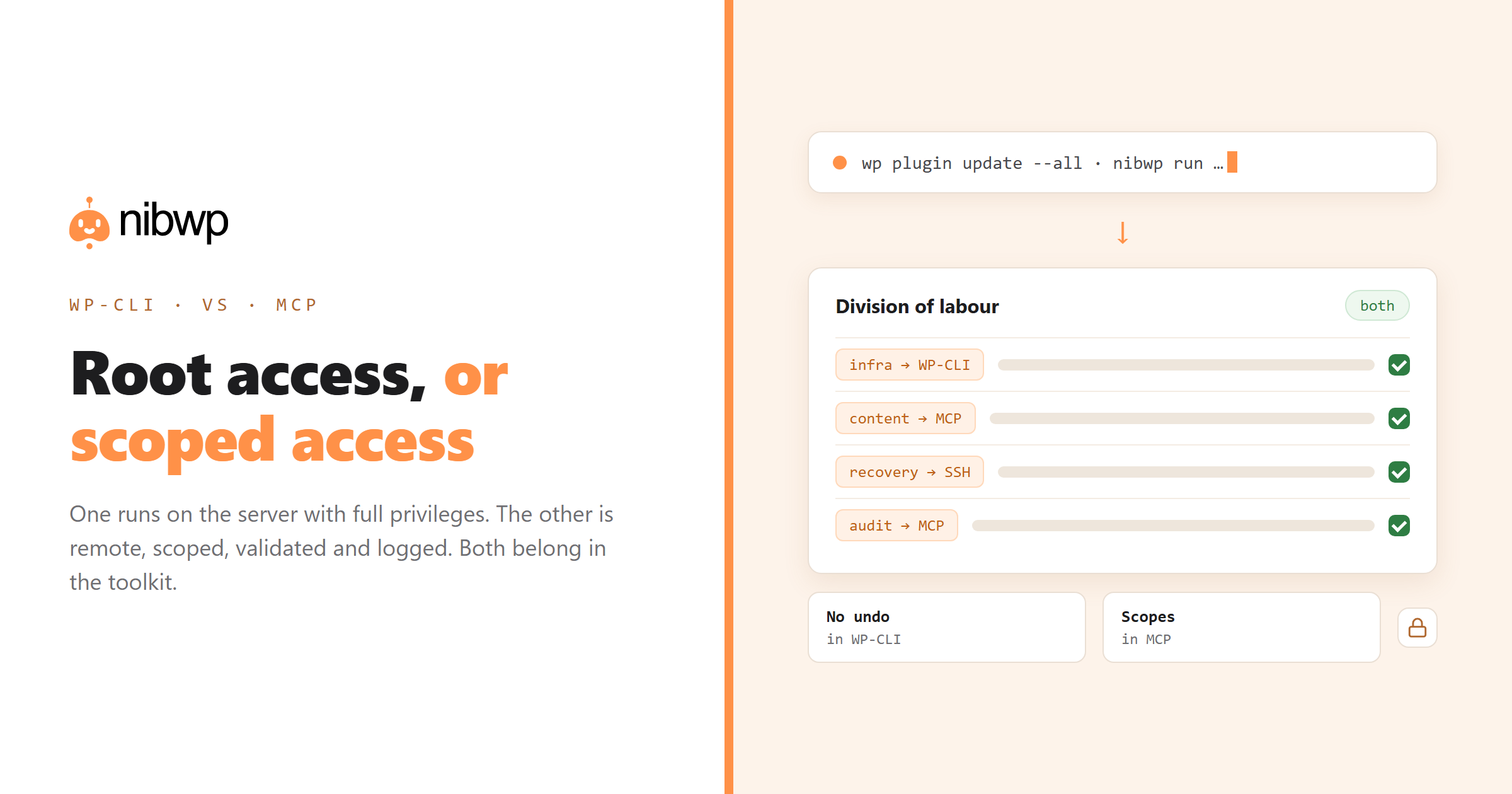
WP-CLI vs MCP: scripting WordPress in the AI era
WP-CLI assumes a trusted operator; MCP assumes the caller might be wrong. Where each wins, and the infrastructure-vs-content split that works in practice.
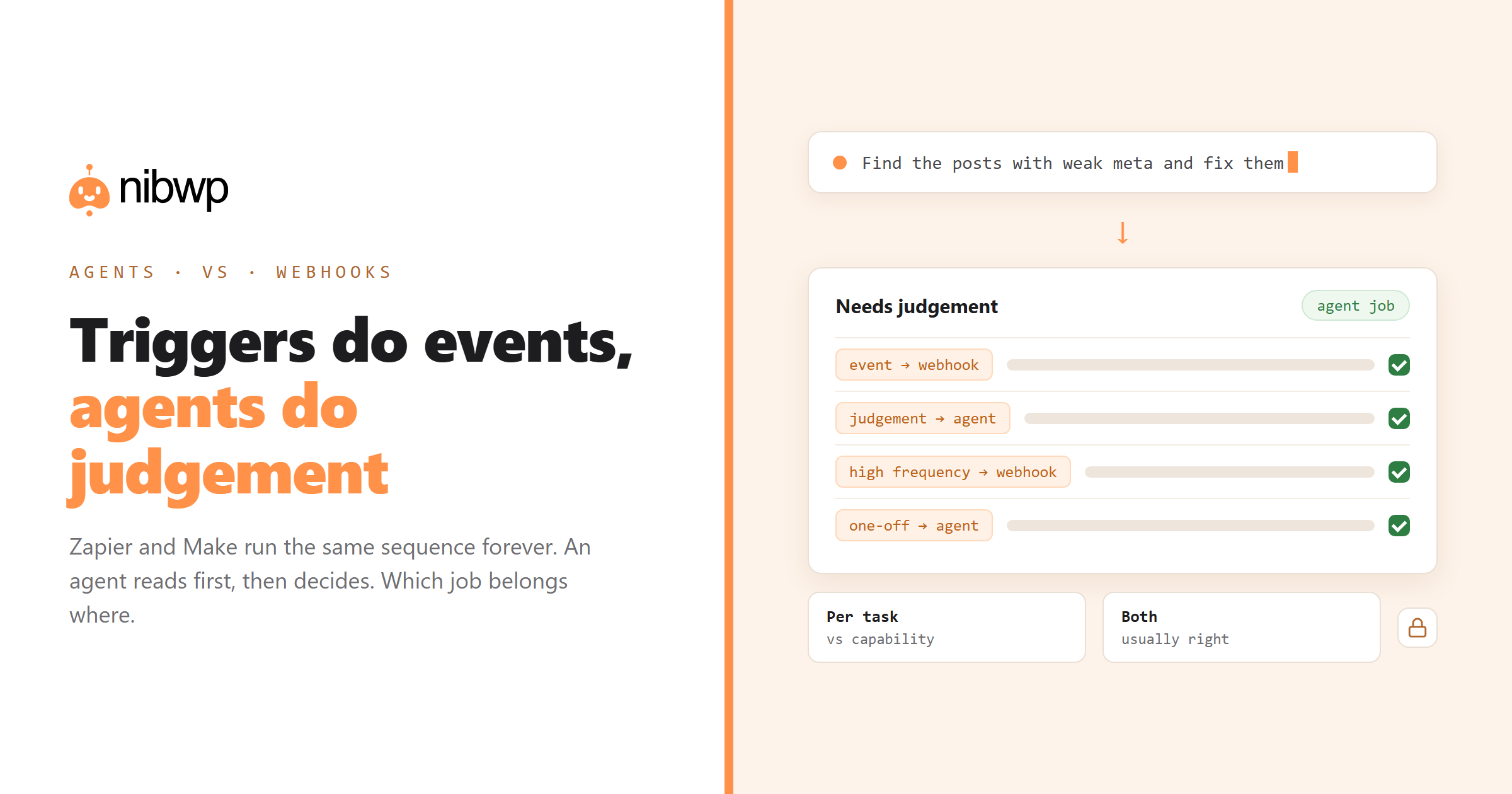
AI WordPress automation vs Zapier and Make: when typed tools beat webhooks
Webhooks are deterministic; agents exercise judgement. Which jobs belong to each, how the costs differ, and the one signal that a Zap should become an agent job.
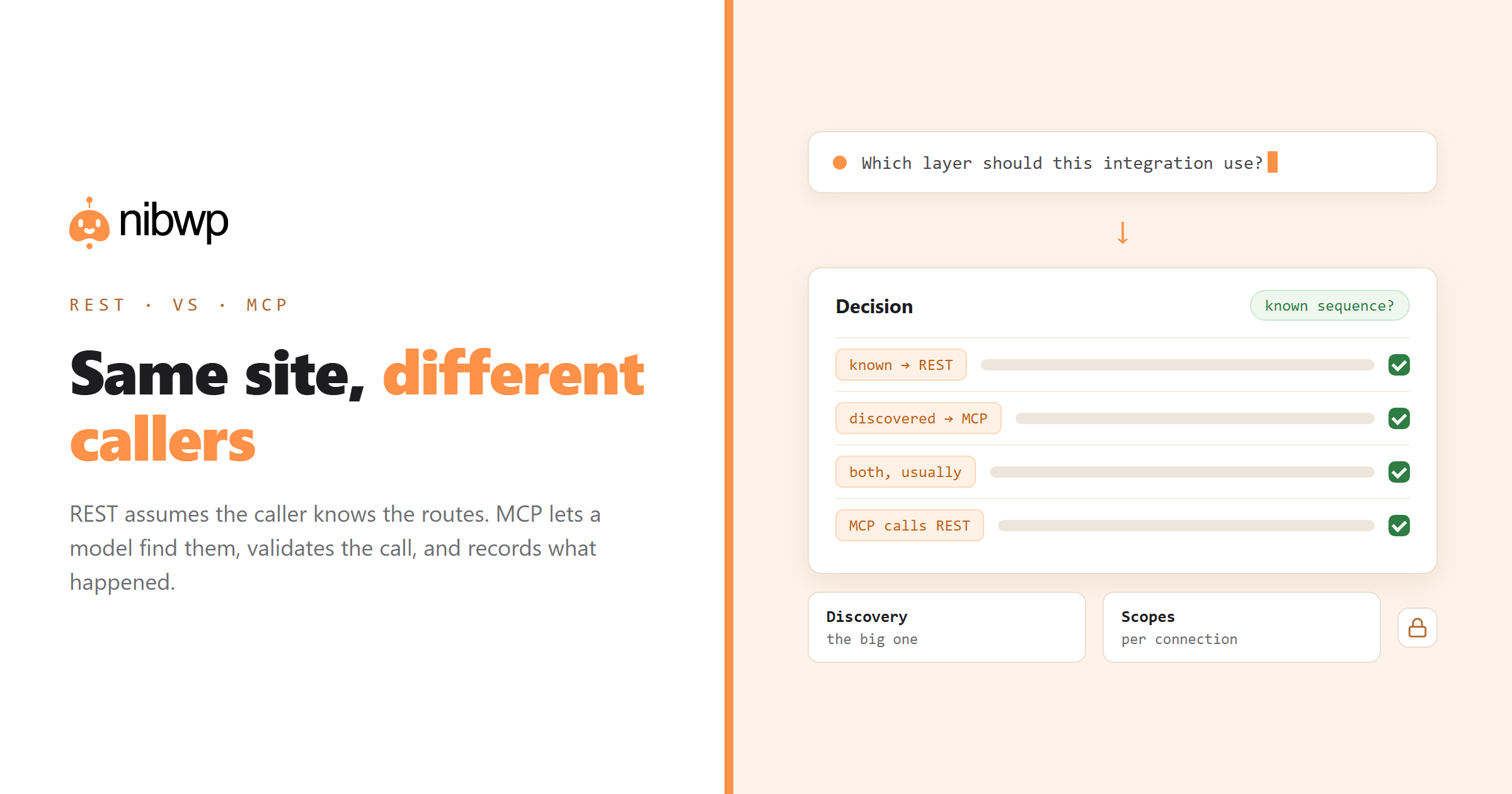
WordPress REST API vs MCP: which should your AI use?
MCP doesn't replace REST — it calls it. What the extra layer adds (discovery, semantic typing, governance), and the rule for choosing between them.
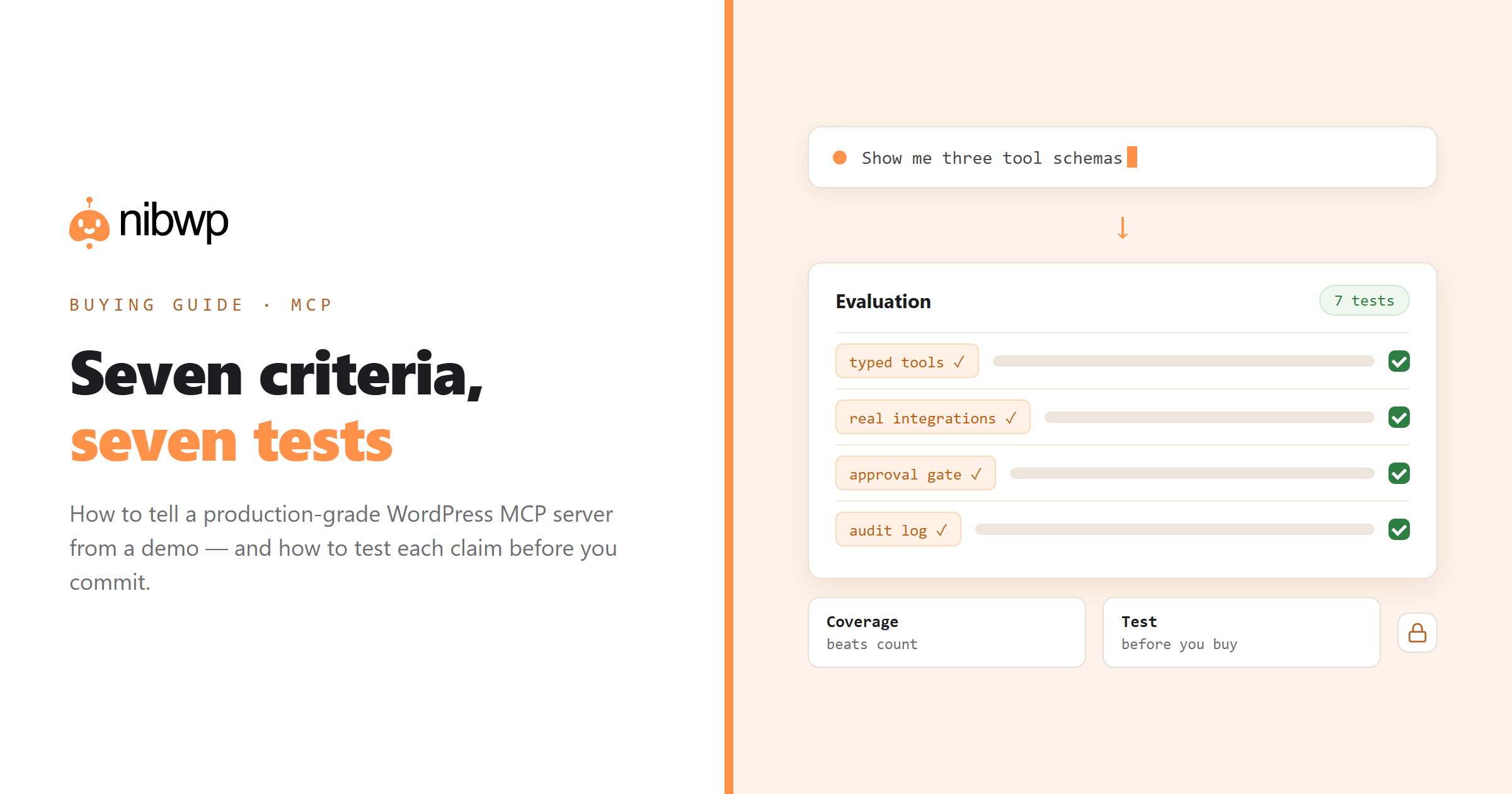
Best WordPress MCP plugin: the 7 things that actually matter
A buying guide, not a ranking: seven criteria with a test for each — typed tools, real plugin integrations, approval gate, audit log, scopes, builder-native output, client-agnostic.
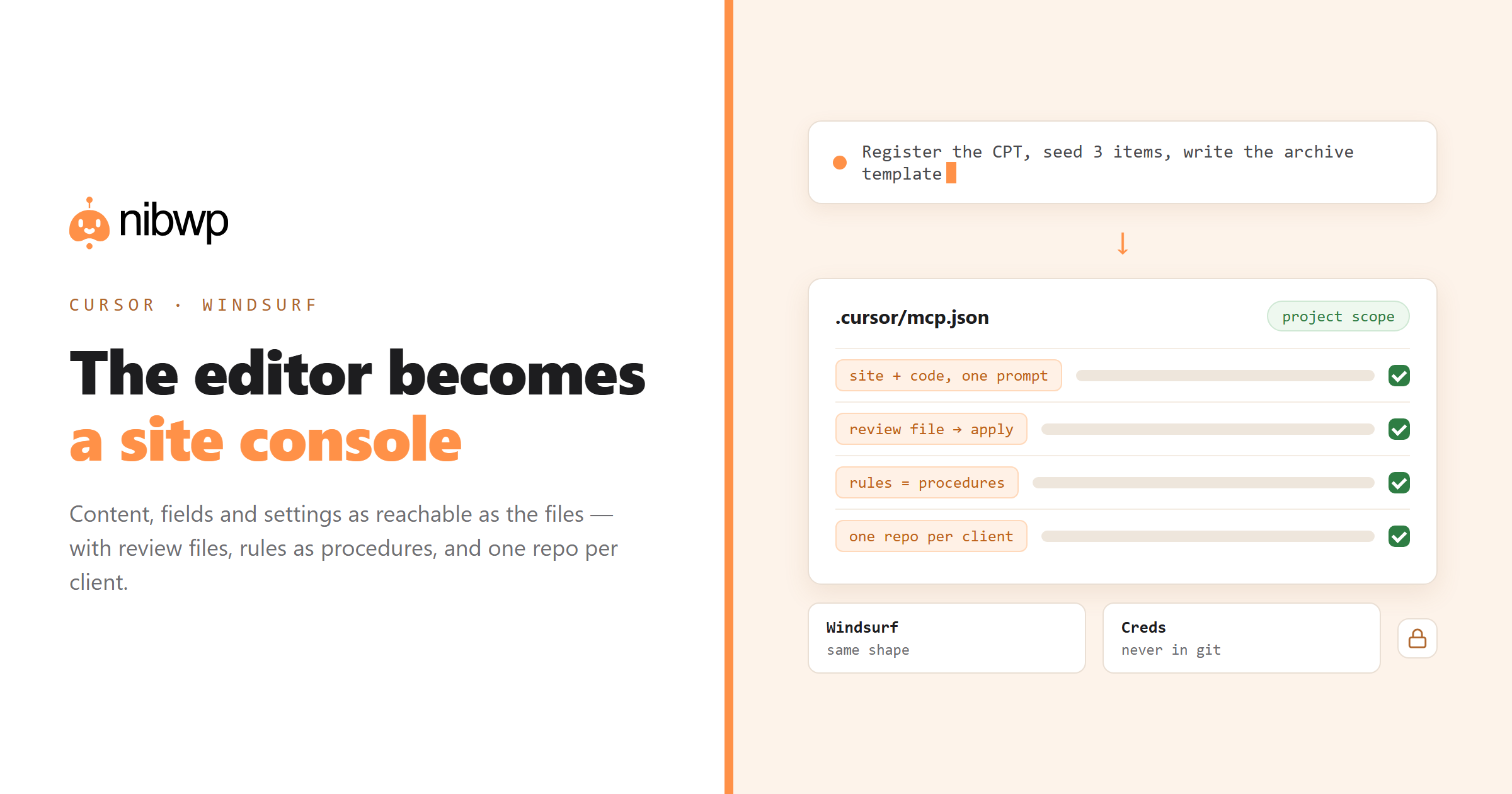
Use Cursor to manage a WordPress site (not just its code)
Cursor plus MCP turns an editor into a site console: template and data in one prompt, review files for bulk work, rules as procedures, one repo per client.
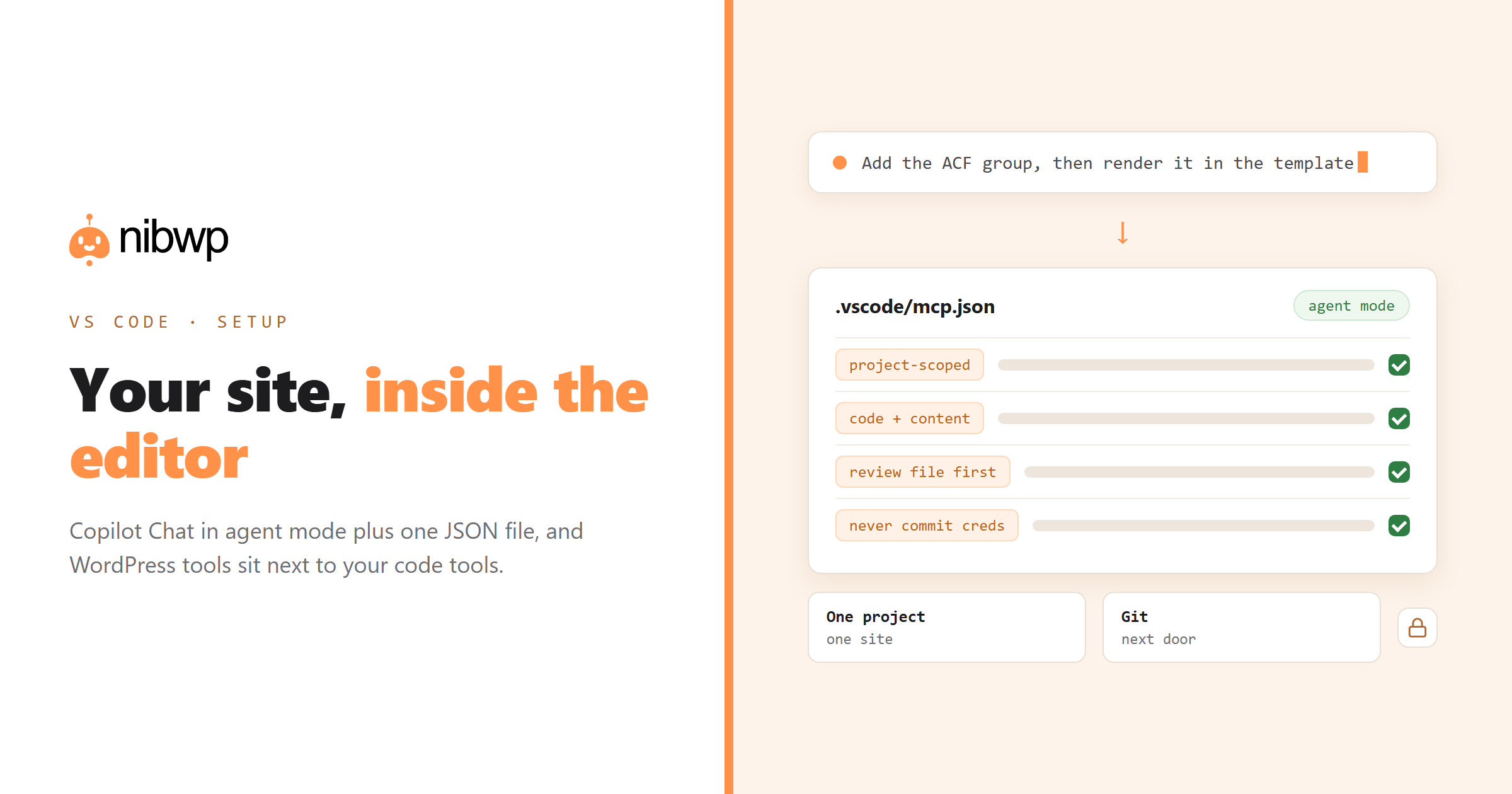
VS Code + WordPress MCP: your site inside Copilot Chat
Site tools next to code tools. The config, the workflows that genuinely belong in an editor, and the one mistake to avoid (committing credentials).
Gemini + WordPress via MCP: setup and first prompts
Gemini speaks MCP too. The config block, the verification prompt, the first jobs worth running — and the differences that actually matter in practice.
Claude + WordPress: the complete setup (desktop, claude.ai and Claude Code)
Three Claude surfaces, three configs, one server. How to connect each, how to verify the connection is real, and which one to reach for per job.
How to connect ChatGPT to WordPress with MCP
Five minutes from ChatGPT to real WordPress writes: connector setup, verification prompt, the ChatGPT-specific gotchas, and the safety defaults to keep on.
The WordPress AI glossary: MCP, abilities, agents, skills — every term defined
Plain-English definitions for every term in the WordPress AI stack, plus the four confusing pairs — Claude Skills vs Pro Skills, REST vs MCP, plugin vs server, automation vs agent.
Agentic WordPress: what changes when your site becomes a set of tools
Sites are becoming addressable, not just editable. What stops being work, what becomes work, how pricing shifts — and the incremental path to get there.
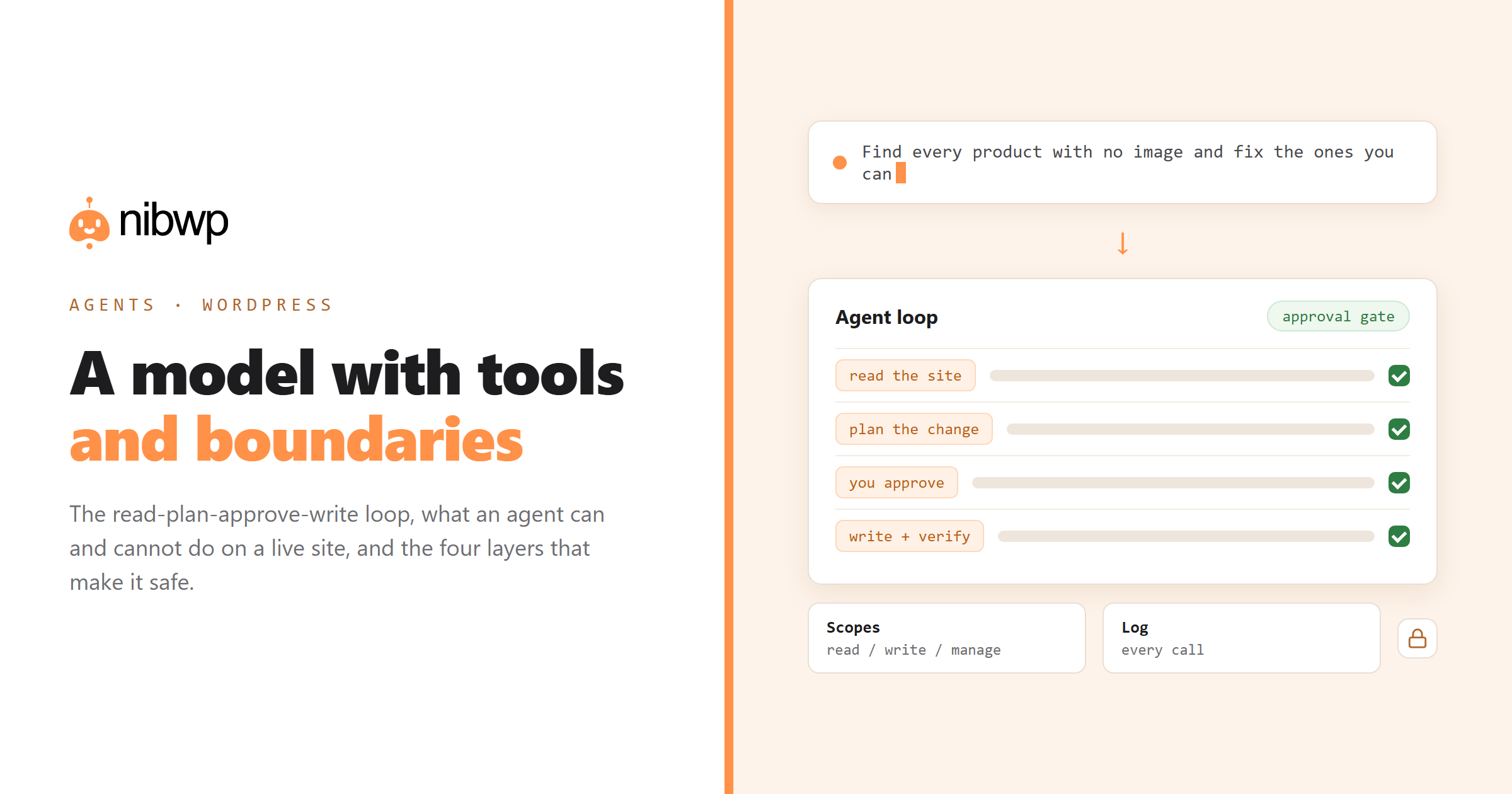
WordPress AI agent: what it is, what it can do, how to run one safely
An agent is a model with tools and boundaries. What it can genuinely do on WordPress, what it can't, the permission model that makes it safe, and the first three jobs to give it.
AI for WordPress in 2026: what actually works (and what's hype)
Three layers, not one: content AI, builder AI, agent AI. What each actually delivers in 2026, which claims to ignore, and the four-part stack that pays for itself.
What is MCP in WordPress? The Model Context Protocol, explained
MCP is USB for AI: your site exposes typed tools, any AI client can call them. What that means in WordPress, what it lets you do, and where the safety boundaries sit.
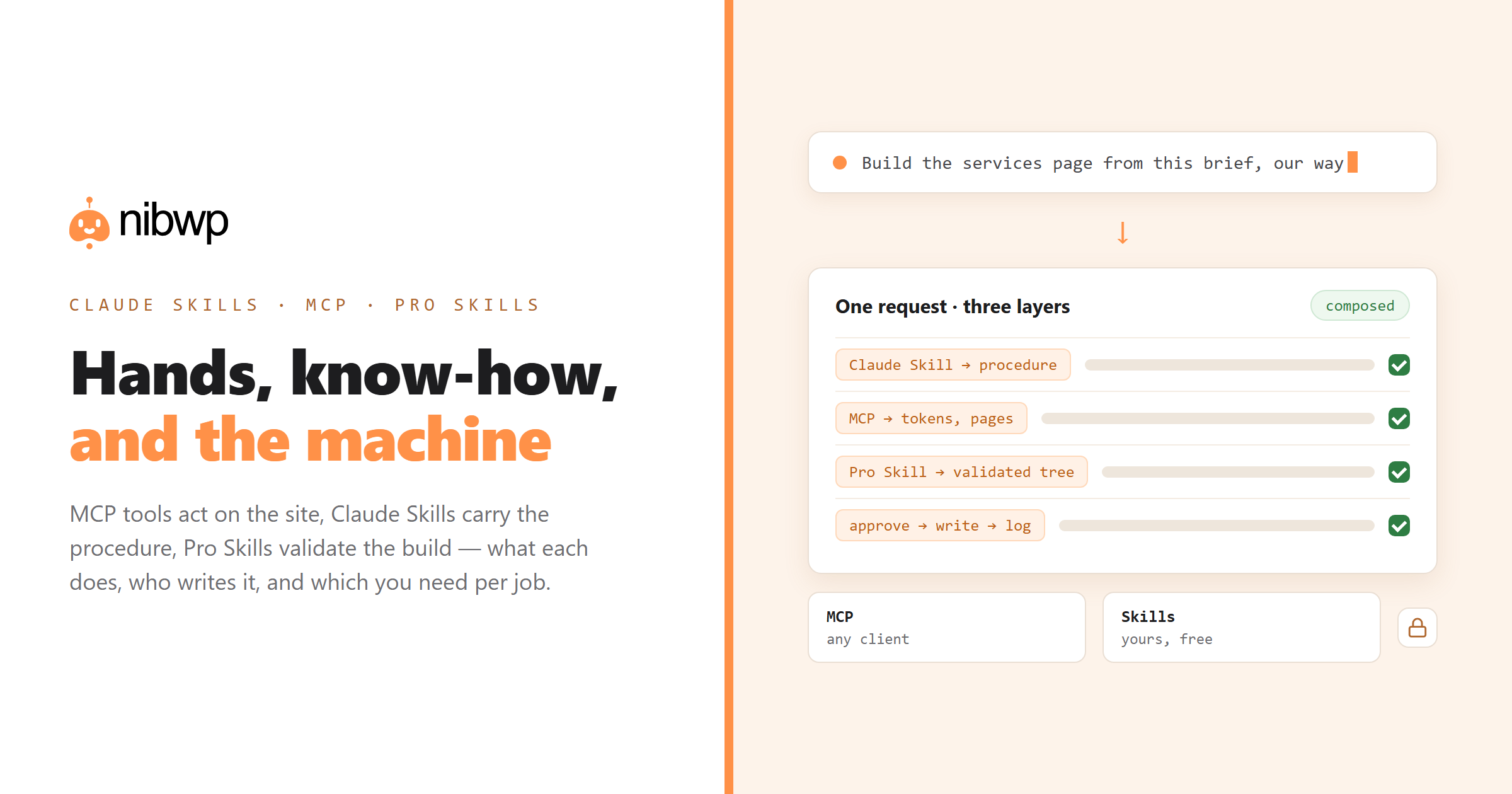
Claude Skills vs MCP tools vs Pro Skills: which one do you need for WordPress?
Hands, know-how, specialist machines: how Claude Skills, MCP tools and NibWP Pro Skills differ, how they compose, and which combination each WordPress job actually needs.
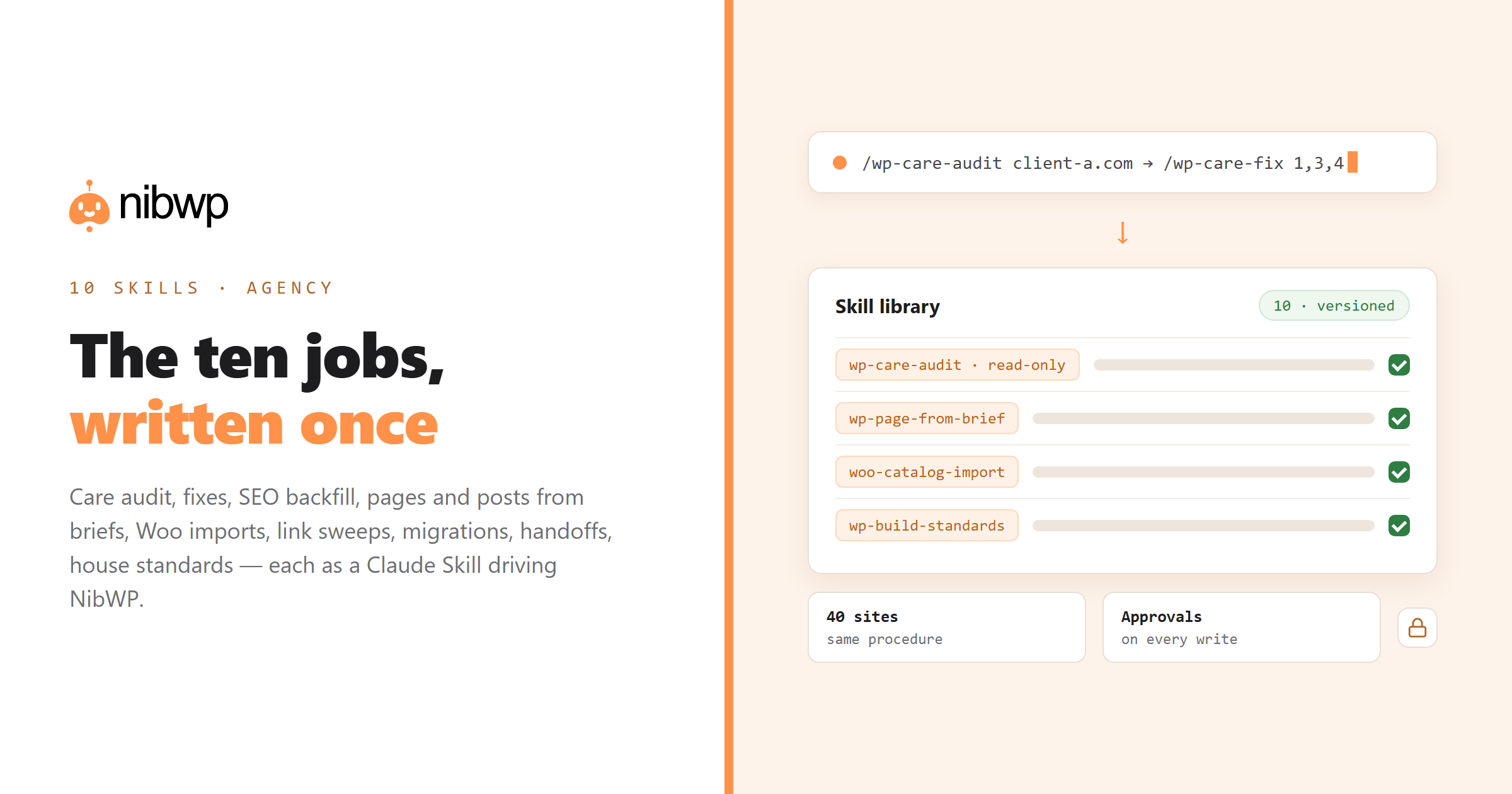
10 Claude Skills every WordPress agency should install (and what each one automates)
Ten SKILL.md starters for agency work — audit, fix, SEO backfill, page/content from brief, Woo import, link sweep, migration, handoff doc, house standards — with frontmatter and the NibWP tools each drives.
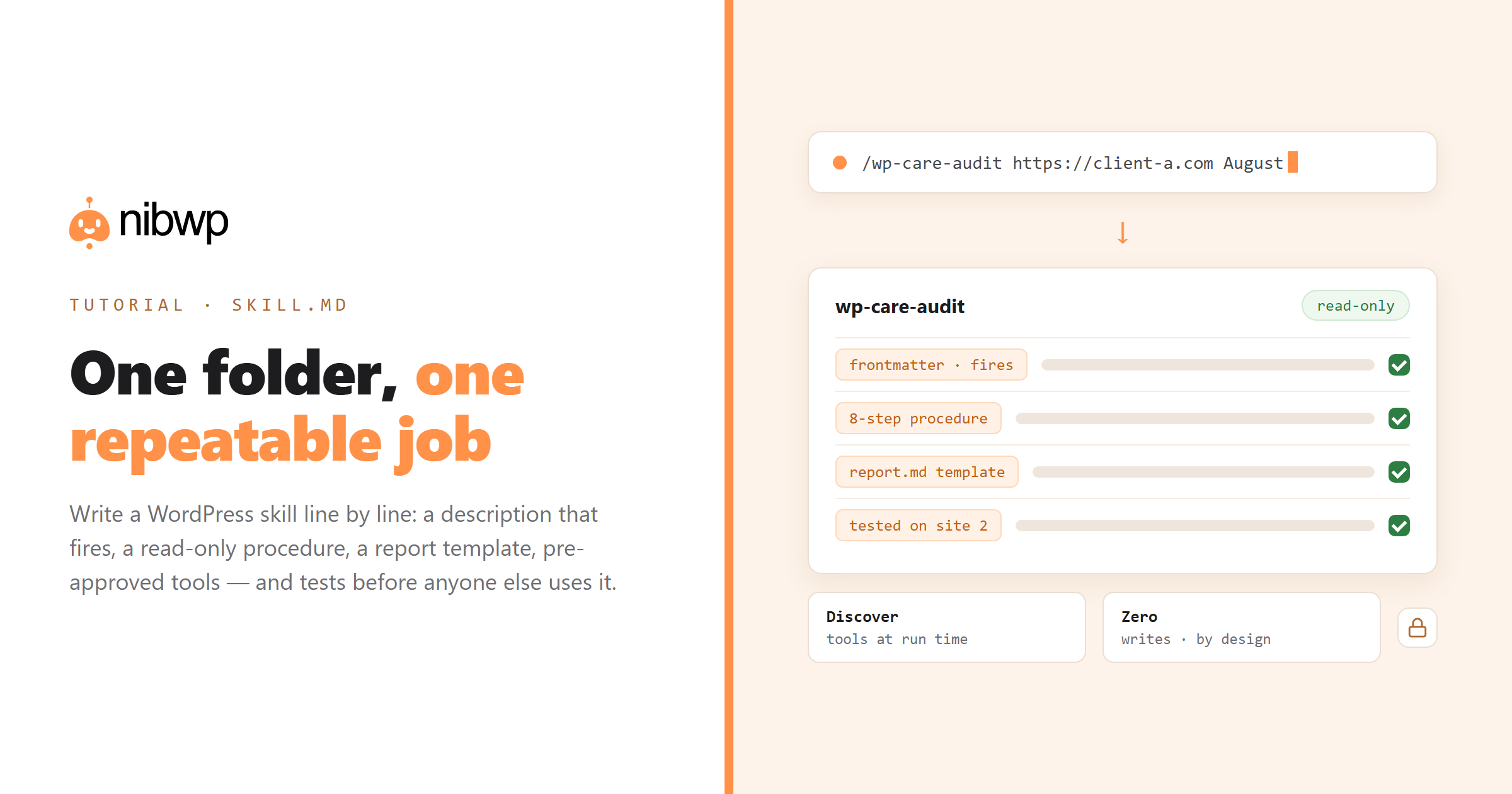
Write your own Claude Skill for WordPress: a step-by-step SKILL.md tutorial
From empty folder to hardened, shareable skill: a care-plan audit SKILL.md written line by line — description that fires, read-only procedure, report template, allowed-tools, tests.
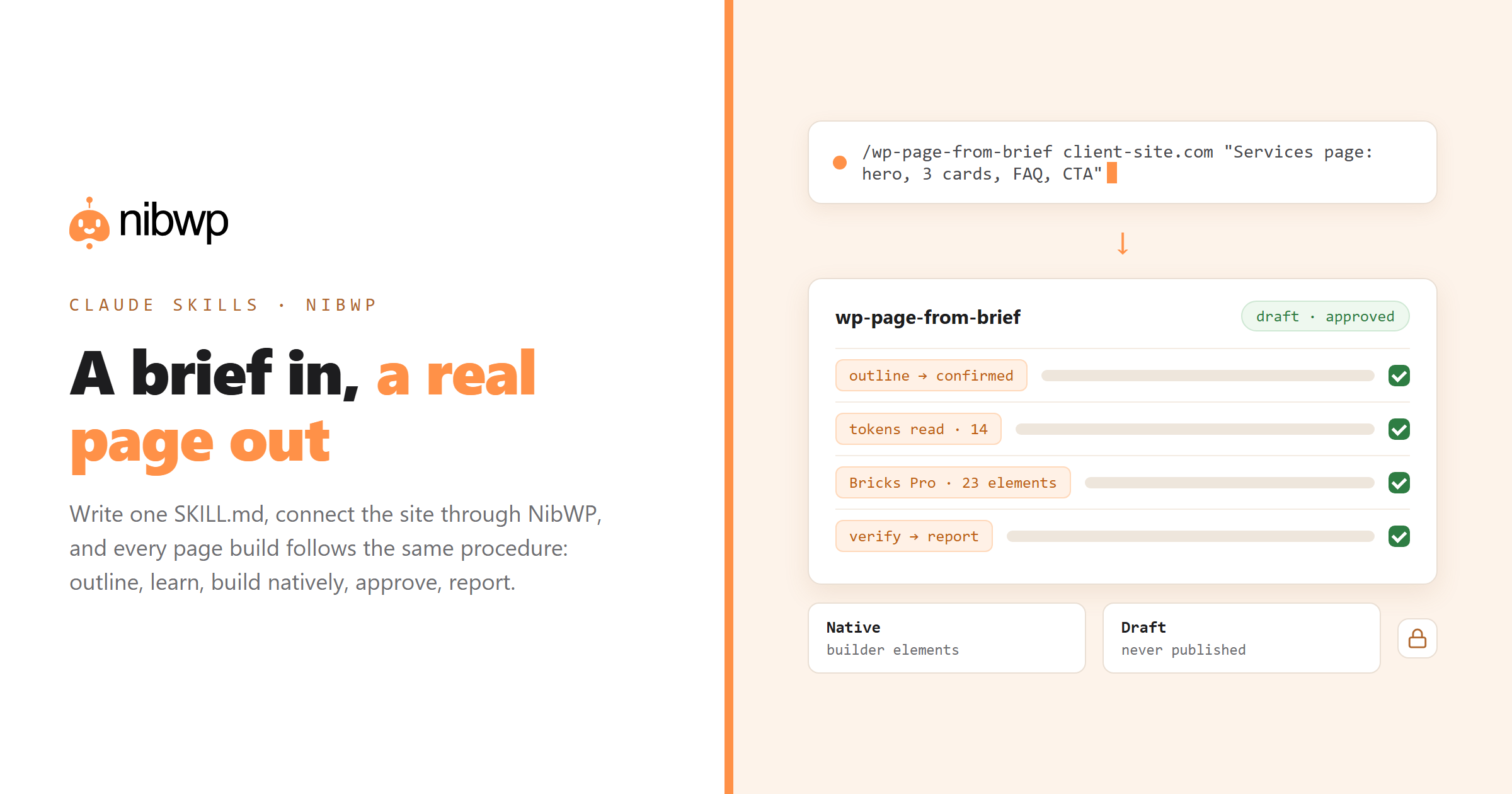
How to use Claude Skills with NibWP to build WordPress pages from a brief
A complete SKILL.md that turns a brief into a native Bricks/Etch page through NibWP: outline first, learn the site, route through the Pro Skill, draft, verify, report.
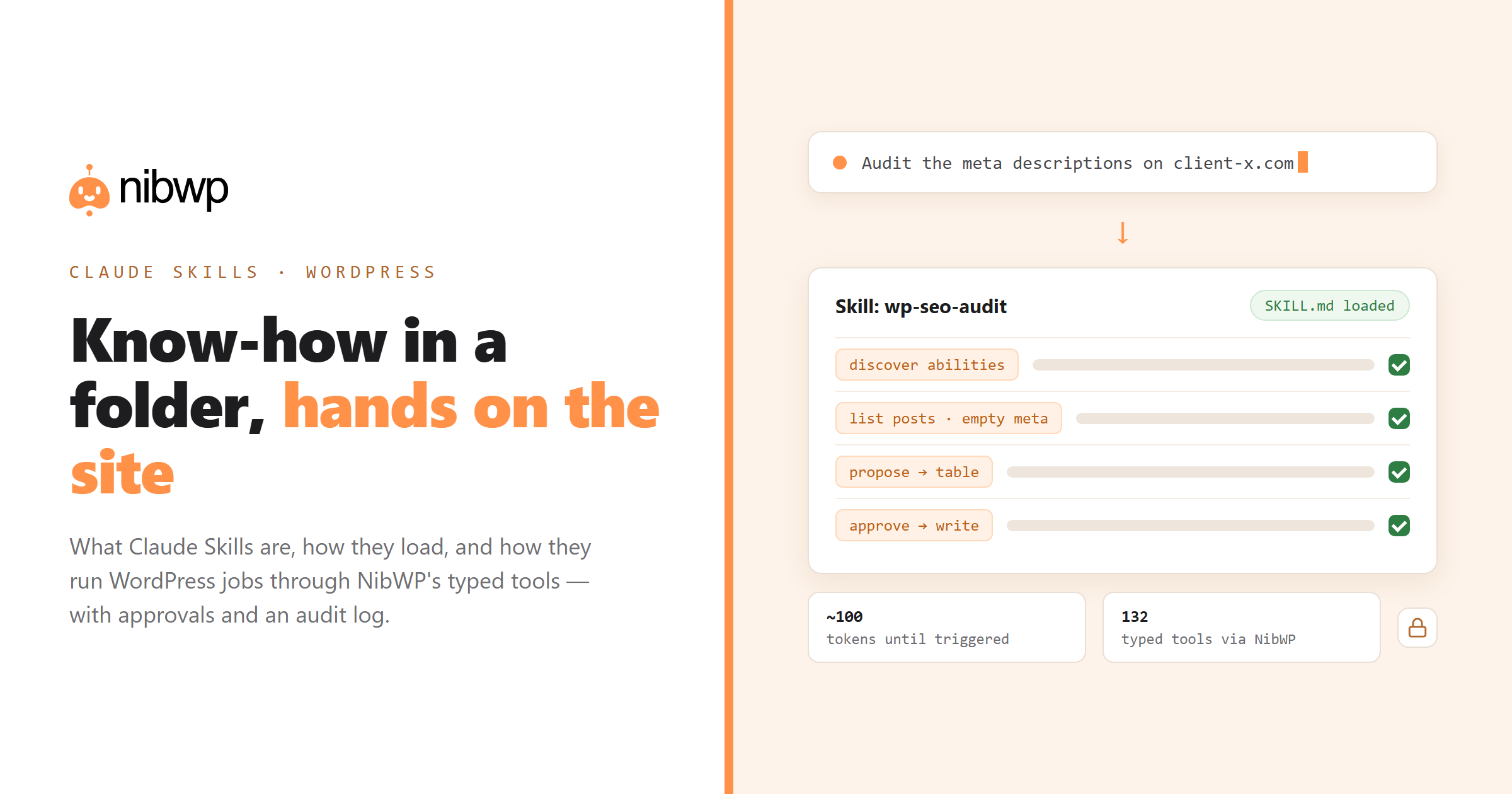
What are Claude Skills, and how do they work with WordPress?
Skills are know-how, MCP is hands. What a Claude Skill actually is, how it loads, where it runs, and how it operates a WordPress site through NibWP with approvals and an audit log.
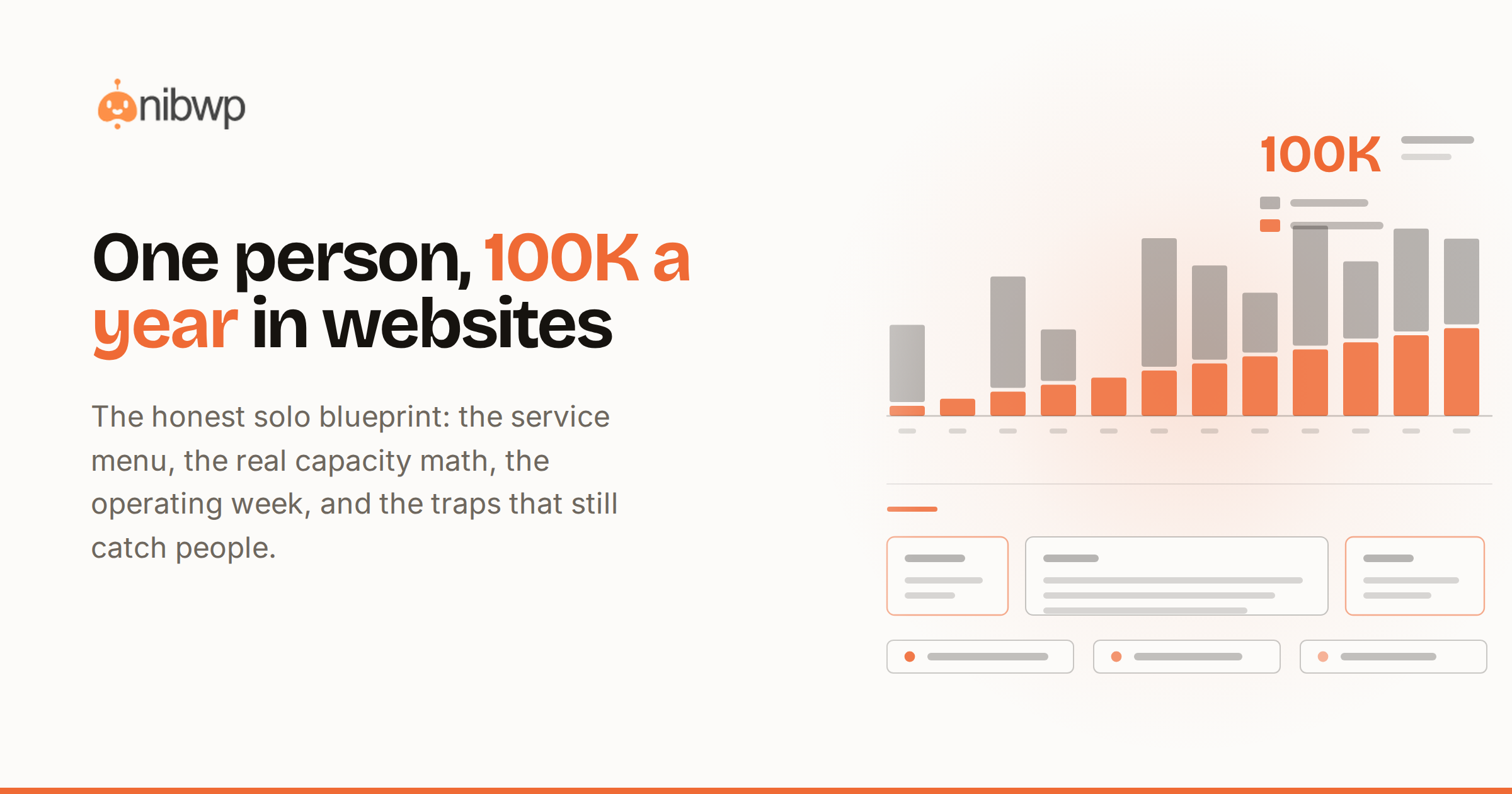
One person, 100K a year in websites: the AI-era solo agency
A menu that adds to 100K, capacity math without fantasy, the operating week, and the three-layer system that makes one disciplined person enough.
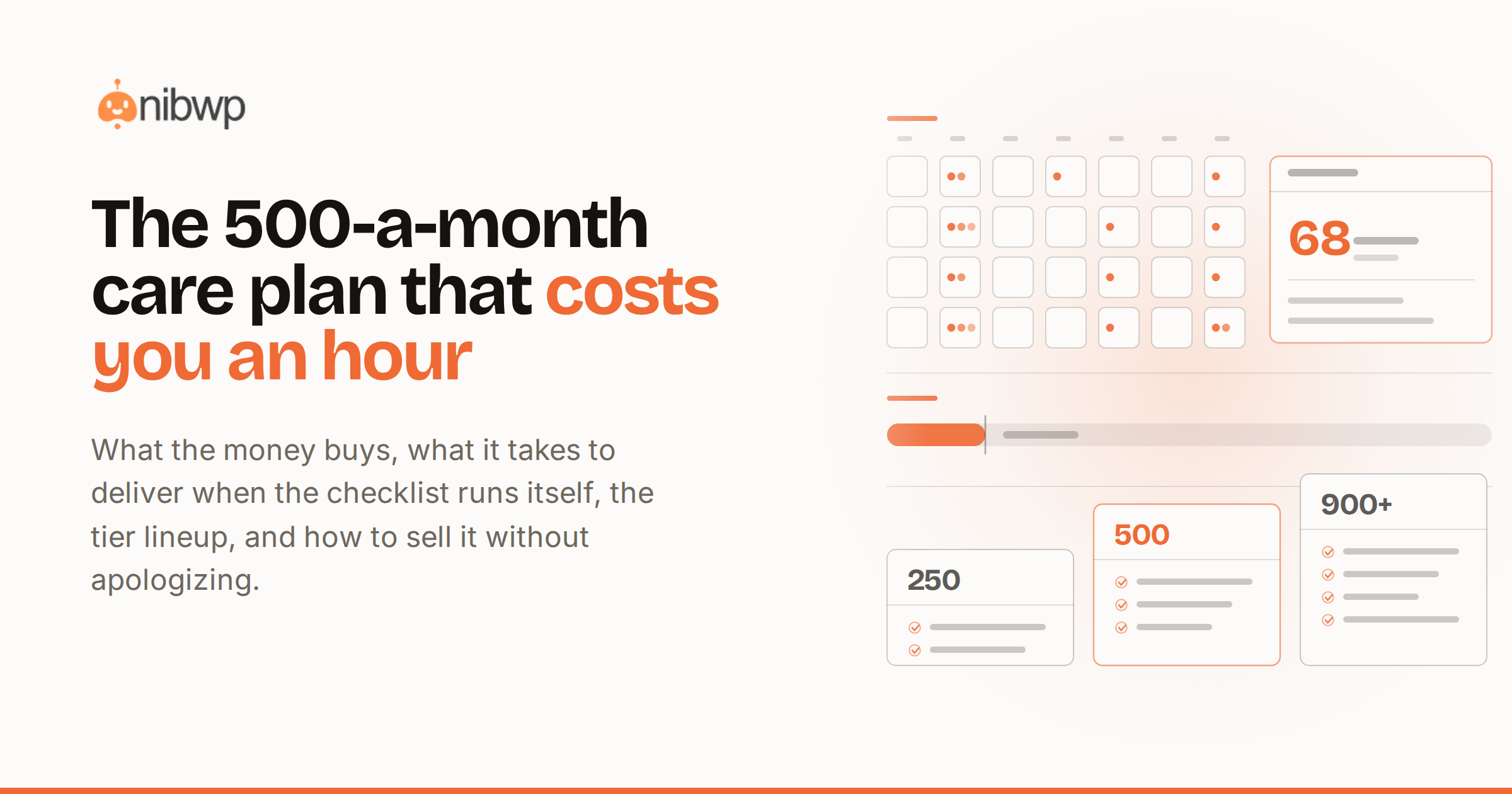
The 500-a-month care plan that costs you an hour
More checks than hand delivery, an hour of human judgment, evidence in every report — the care plan that's honest on both sides of the invoice.
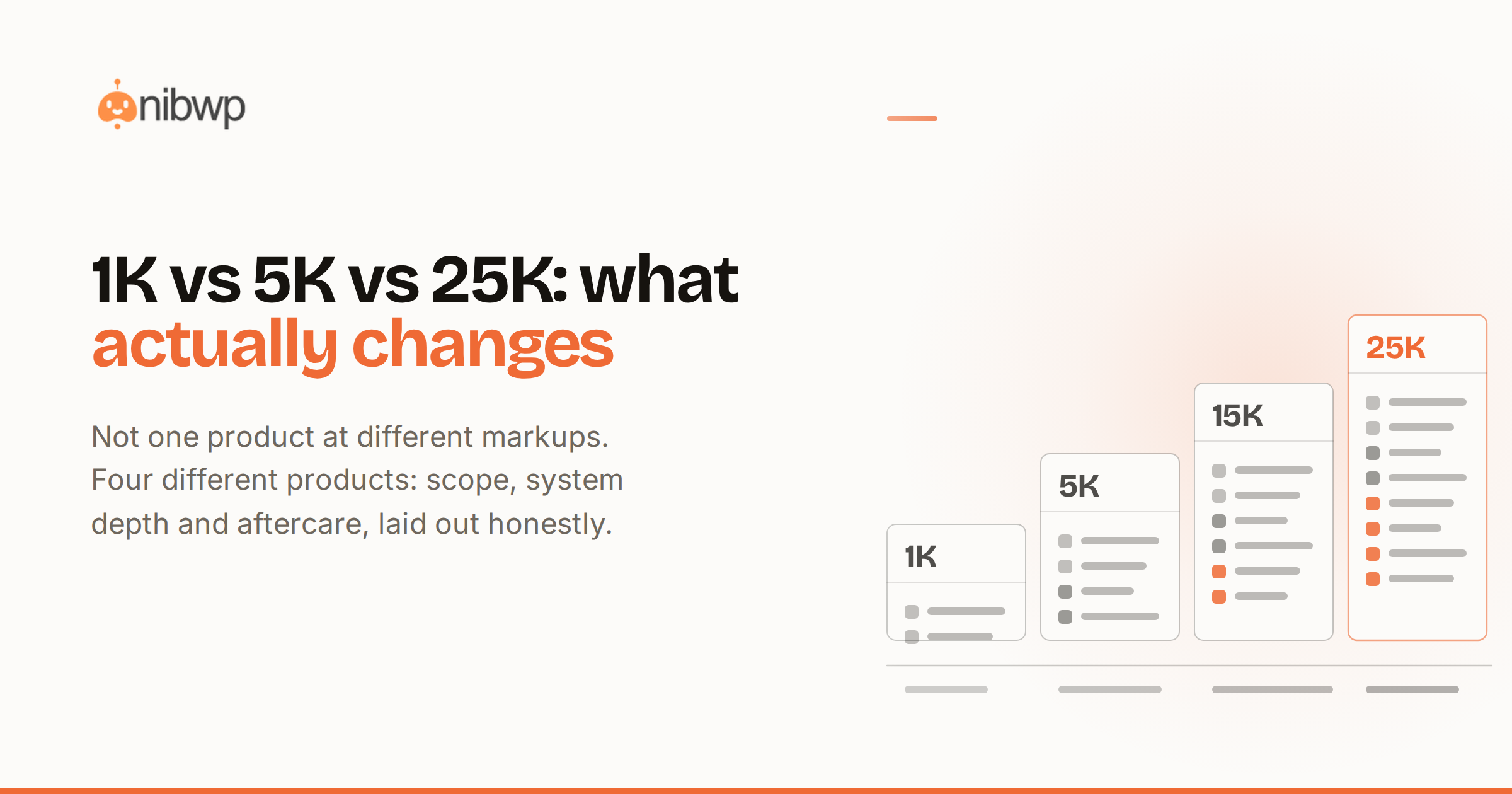
1K vs 5K vs 25K websites: what actually changes at each price
Presence, persuasion, transformation, operation — the price ladder decoded: real scopes, AI-era delivery hours, and the proof to demand at each tier.
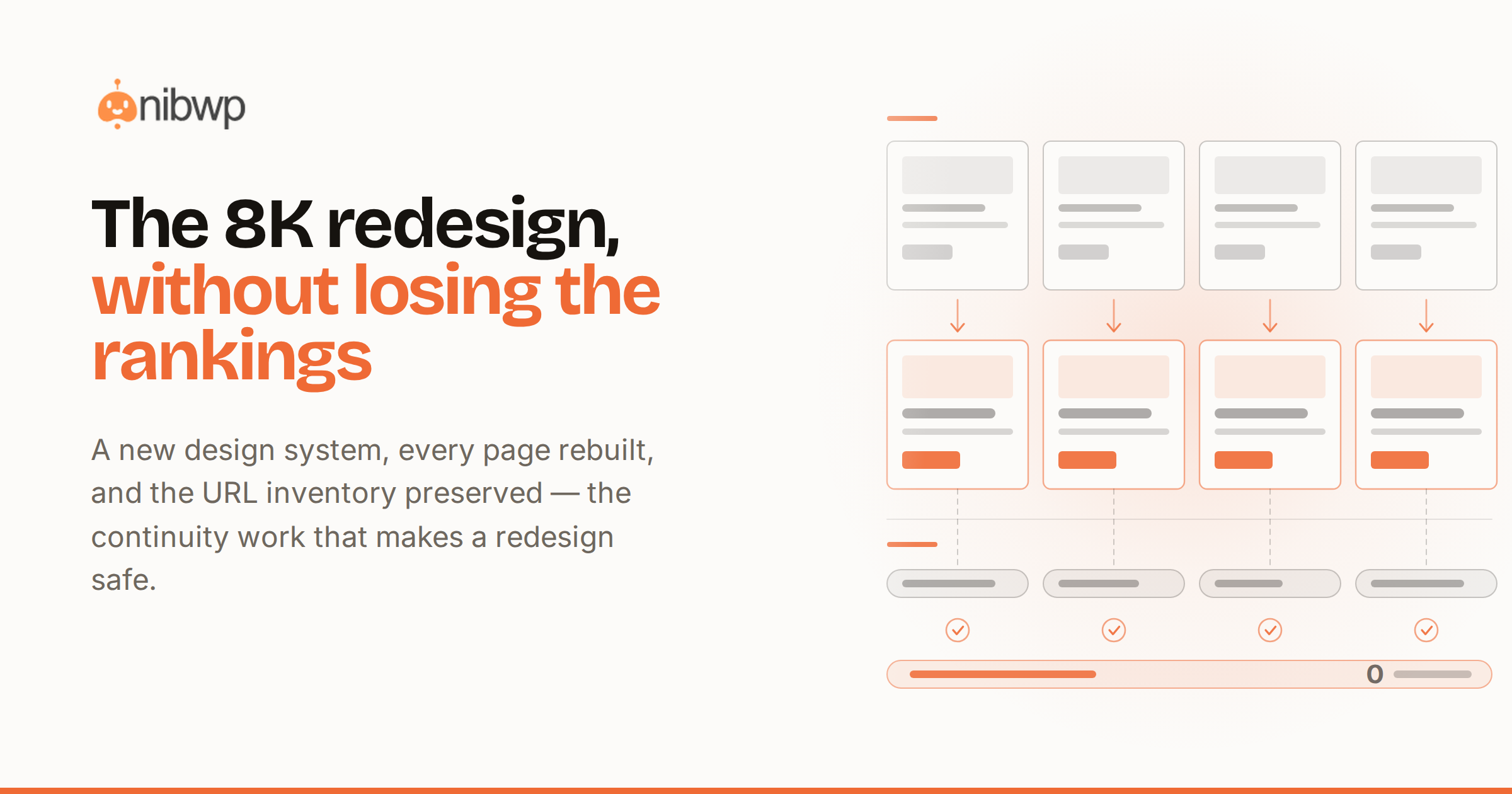
The 8K redesign: rebuild any site from its own screenshots
The site is its own spec: rebuild from rendered pages onto a new token system, art-direct the twelve pages that matter, template the rest.
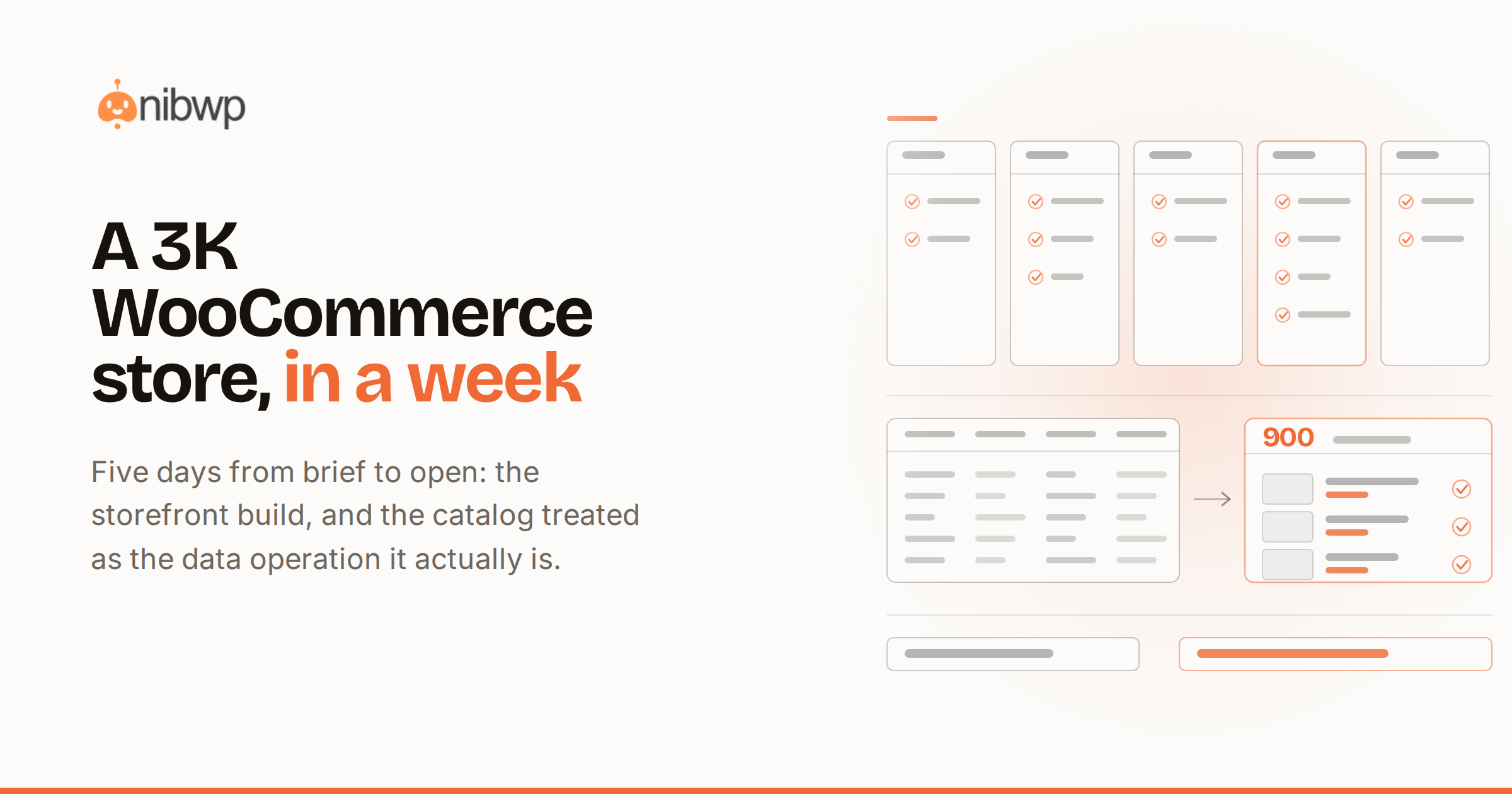
A 3K WooCommerce store in a week, product data included
The store setup is easy; the product data was the swamp. Reviewed import batches drain it — 35 hand hours down to 14, one week door to door.
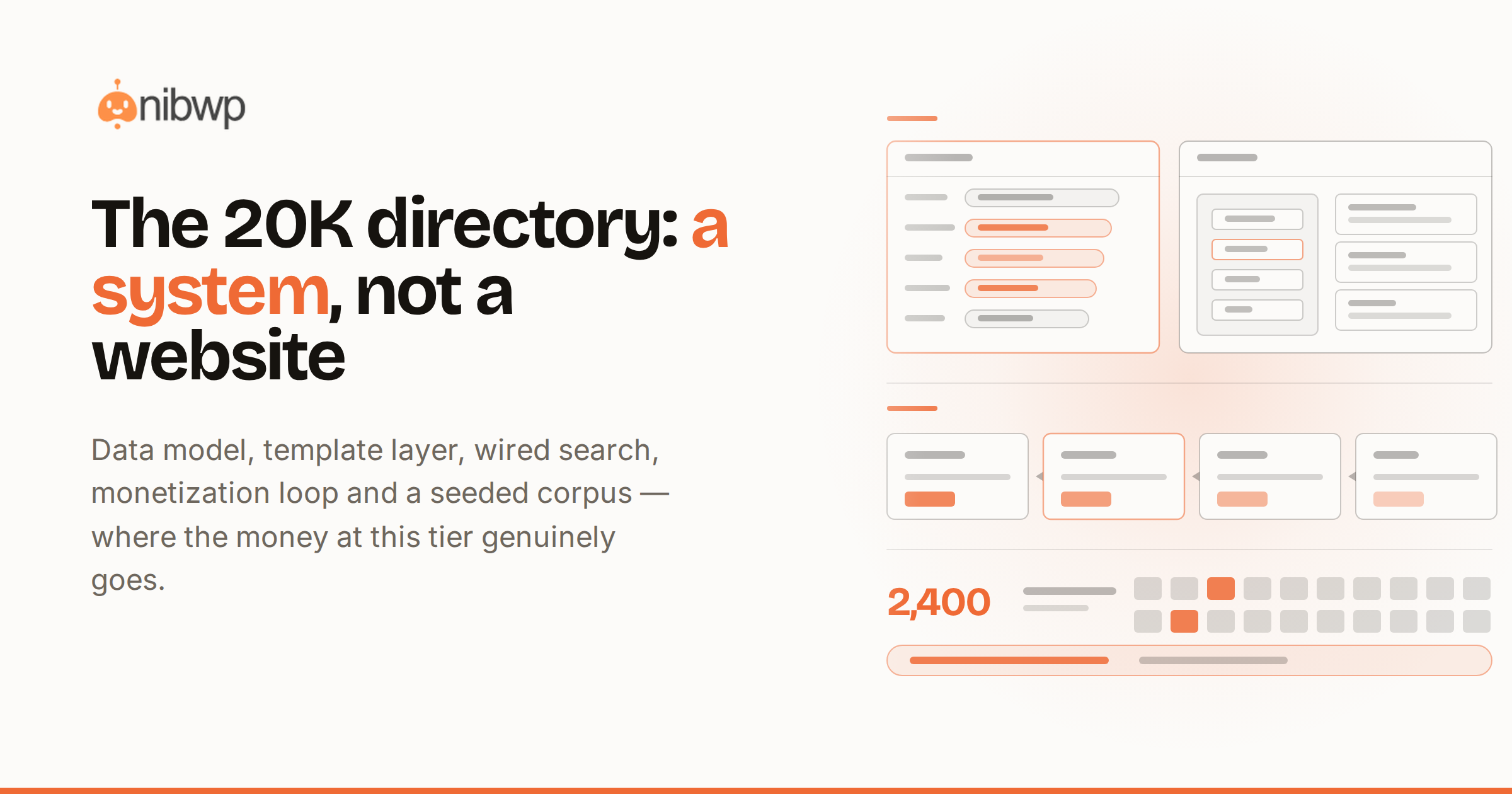
How to build a 20K directory site with Voxel and AI
Model, templates, corpus, money loop — the five-system 20K project delivered in three weeks, with the recurring plan directories genuinely need.
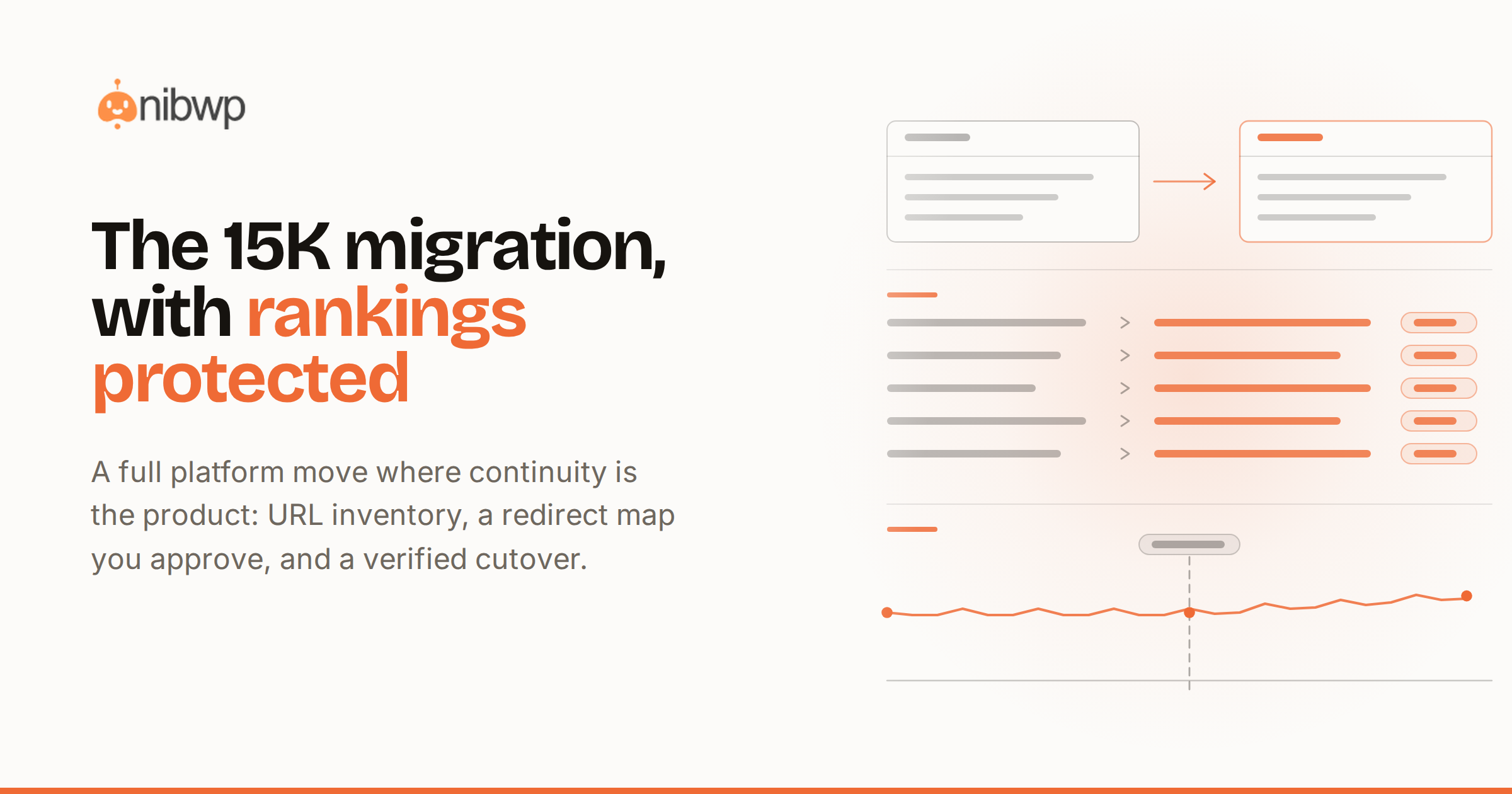
The 15K website migration one person can now deliver
Five stages, each ending in proof: inventory, move, rebuild, redirect map, watch window — the team-month migration as a person-fortnight.
What a 2K landing page looks like when AI builds it in a day
Hour by hour: brief at 9:00, native sections by lunch, live by 17:00 with a report — the smallest, sharpest ticket on the agency rate card.
How to convert a 10K site template with AI
Tokens first, sections once, pages by composition — the conversion pipeline that turns a shelved 10K template into a library that prints margin.
How to create a 5K website using NibWP
Scope, day-by-day build with real prompts, the hours ledger and the margin math — the bread-and-butter agency project, delivered the NibWP way.
How to bill clients for AI-assisted work (without the discount spiral)
Price the outcome, not the hours: four billing models, the client script for “but AI did the work”, and the audit log as your accountability proof.
Convert a screenshot to Bricks elements your team can edit
Real Bricks elements, global classes written the way Bricks stores them, validated nesting, query loops for repeating content — approved before saving.
How to fix 404s and redirects after a WordPress migration
Crawl the dead URLs, map old to new, approve one redirect plan, fix internal links at the source, verify — one session, not a lost week.
Which AI clients work with WordPress MCP? Claude Code, Cursor, ChatGPT and Windsurf
Claude Code, Claude Desktop, Cursor, Windsurf, ChatGPT — what each client is best at on a WordPress site, and the one-endpoint setup they share.
WordPress MCP not working? Every connection error, decoded
The real troubleshooting map: disabled Application Passwords, missing HTTPS, security-plugin 403s, domain locks, cache poisoning and missing tools.
How to build a Voxel directory site with AI
Model the listings, generate the templates — cards, archives, wired search with map — and bulk-import the content, approvals throughout.
Build a whole site in EtchWP with AI, from one brief
Tokens, validated components, pages composed from the library, dynamic loops — the full EtchWP site build, three small approvals at a time.
Can AI build and run a Divi site? What works today
The honest map: what AI runs on Divi today (content, SEO, maintenance, Woo), the native-module limit, and the migration path for pages that matter.
How to build a Kadence site with AI, from brief to launch
The full arc — global styles, pages as real Kadence blocks, Elements for site chrome, content pass and pre-launch checklist, all behind approvals.
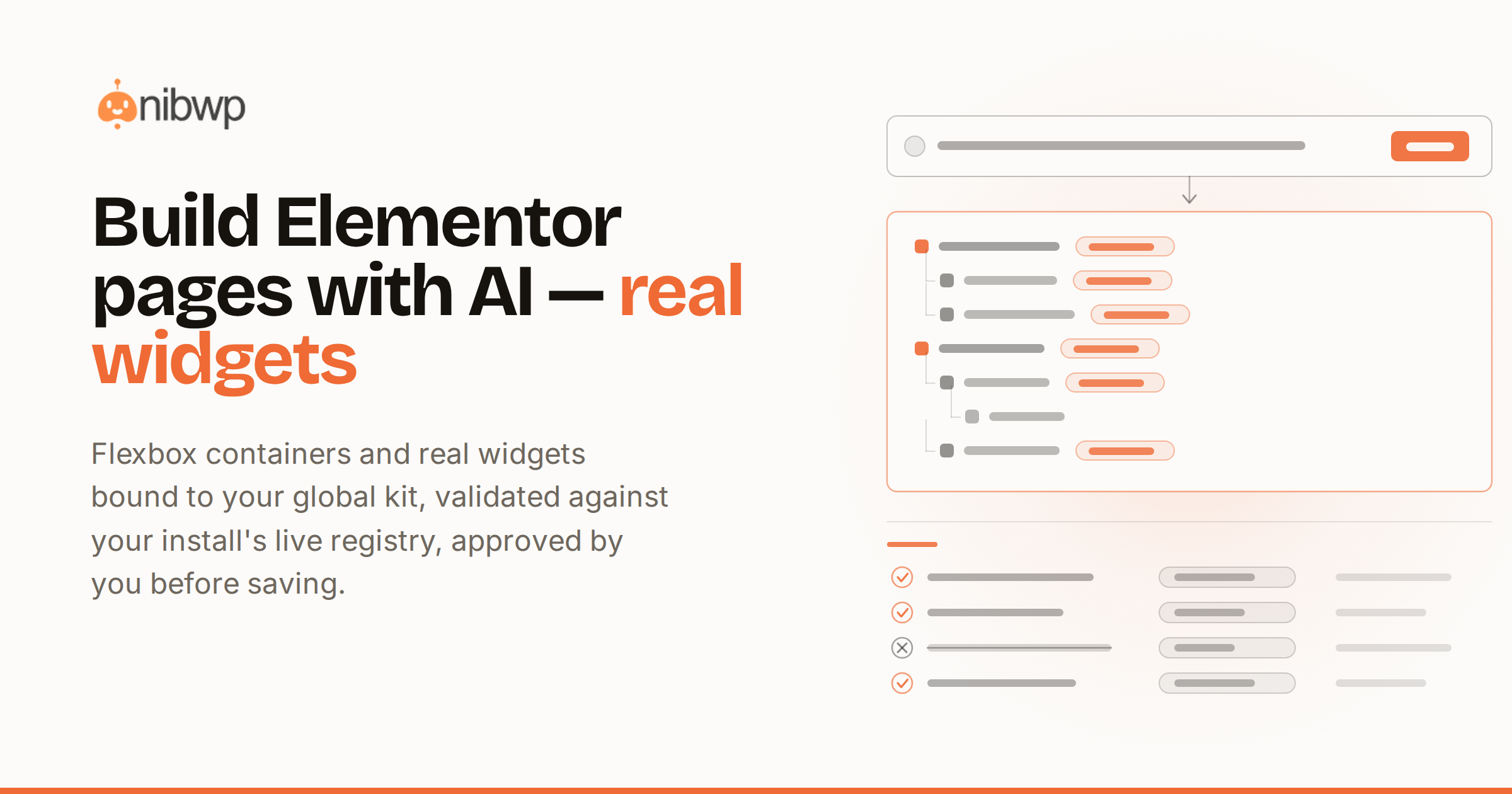
How to build Elementor pages with AI — real widgets, not HTML dumps
From a one-line brief to a real Elementor page — flexbox containers, kit-bound widgets, registry validation and an approval before anything is saved.
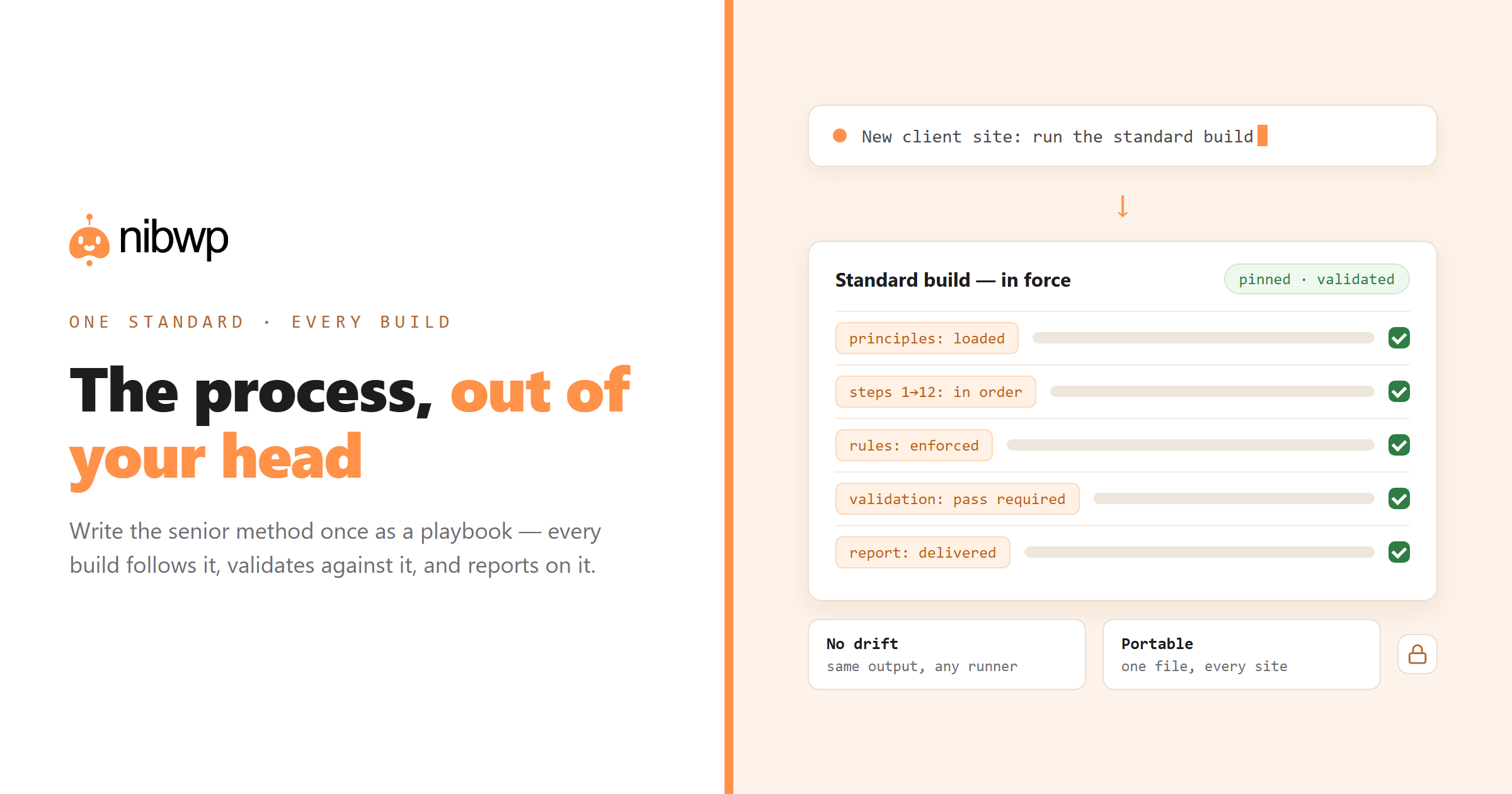
How to standardize the way your agency builds every client site
Move the senior process out of one head and into playbooks the AI must follow — same standard, every build, every teammate, every site.
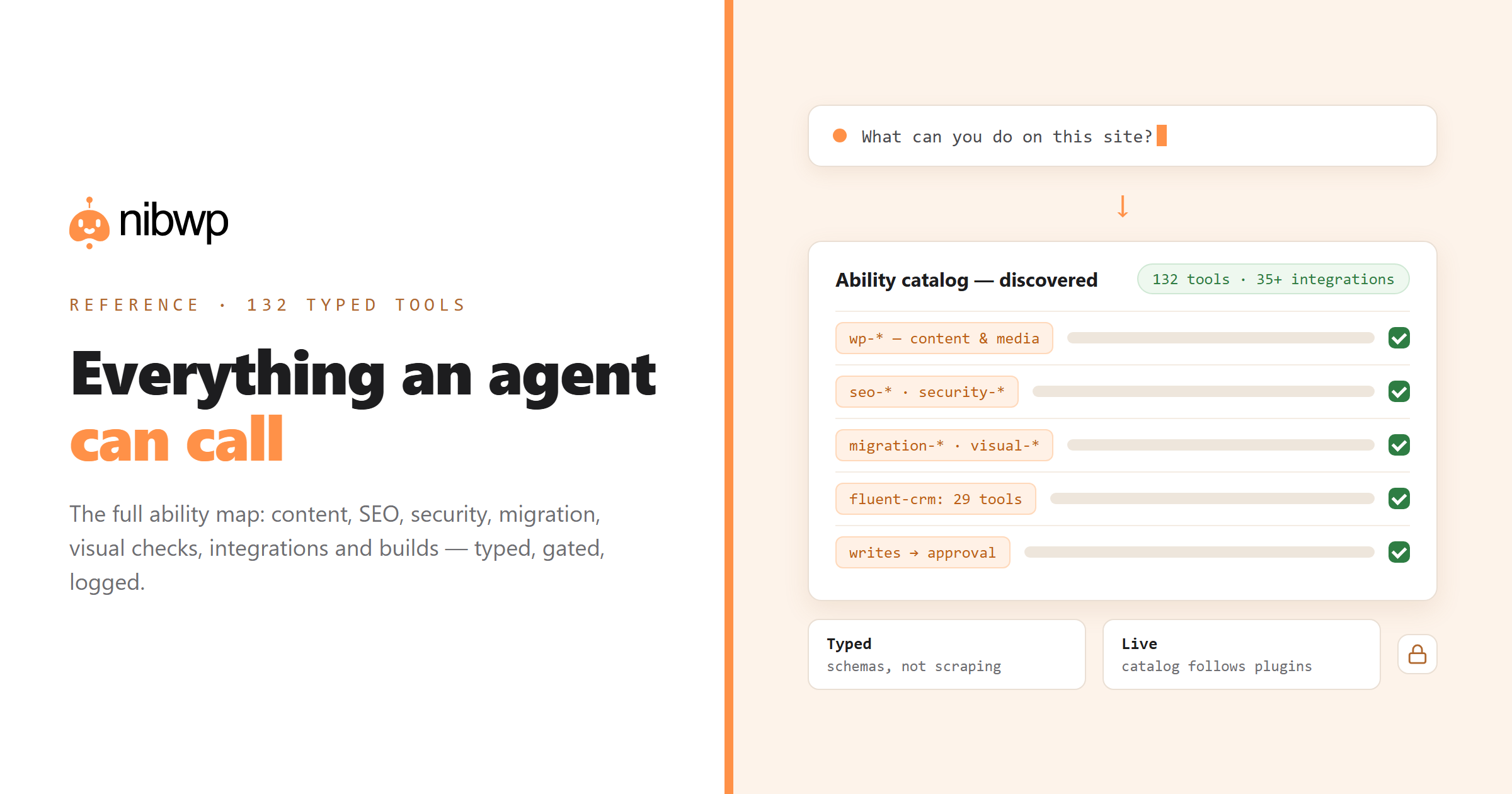
Every WordPress ability an AI agent can call through MCP (full list)
The full map of typed MCP tools an AI agent can call on a WordPress site — content, SEO, security, migration, visual checks, integrations and builds.
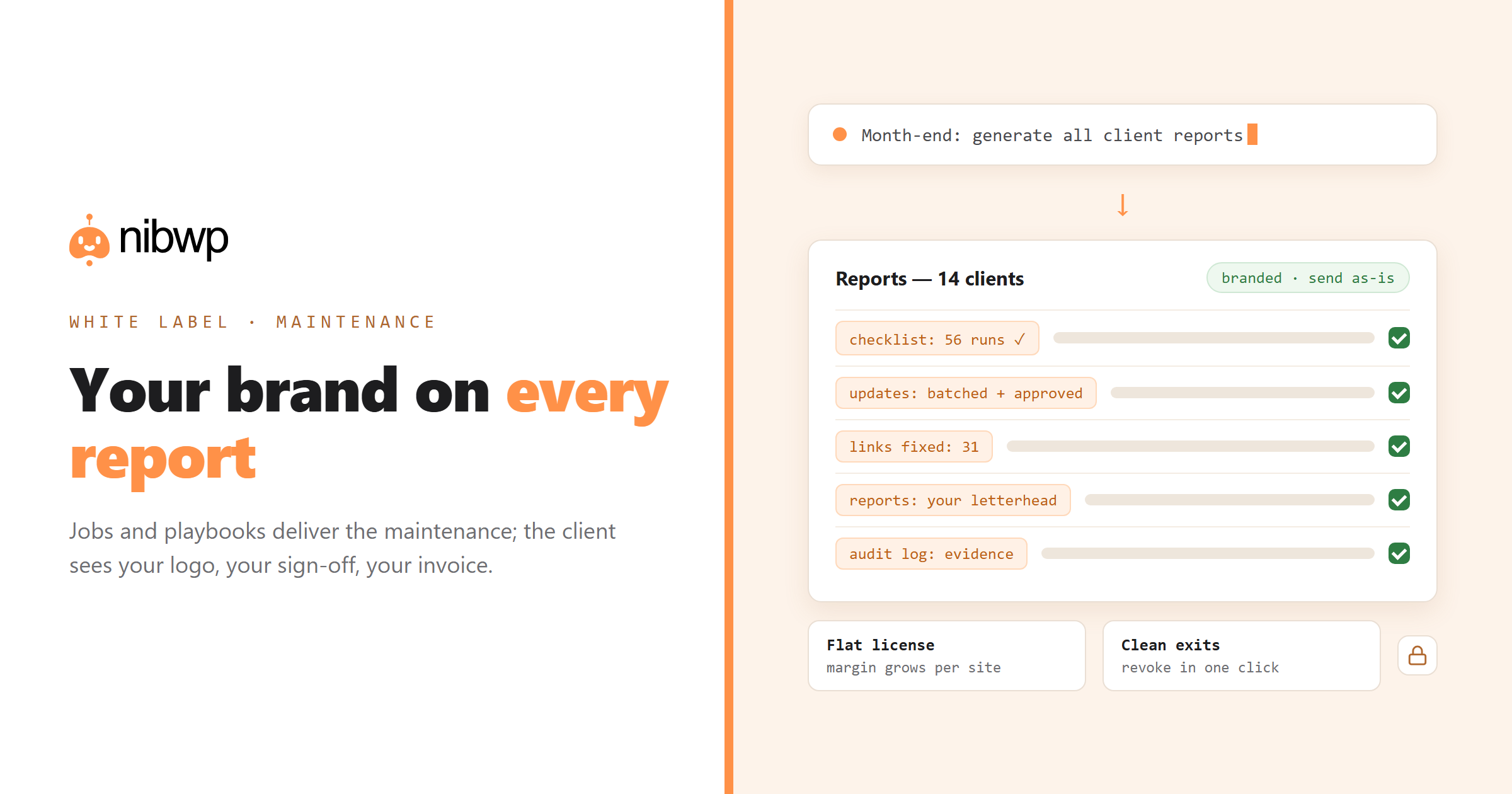
How to offer white-label WordPress maintenance under your own brand
Package maintenance under your brand and run delivery on autopilot — jobs and playbooks do the checklist, your team does the approvals.
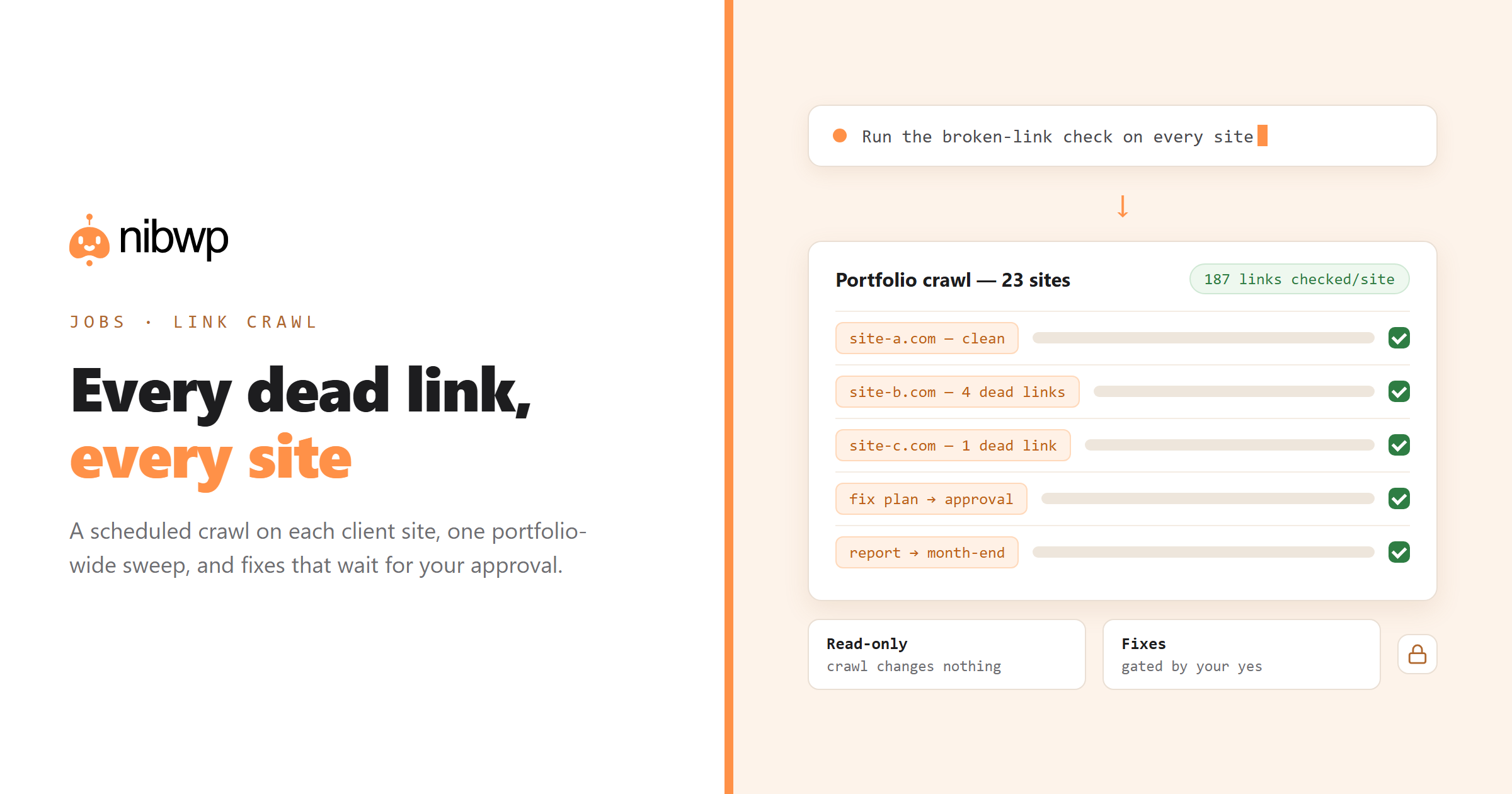
How to find broken links across every client WordPress site at once
A scheduled crawl on every site, one portfolio-wide sweep, approval-gated fixes, and a report that turns link rot into a billable care-plan line.
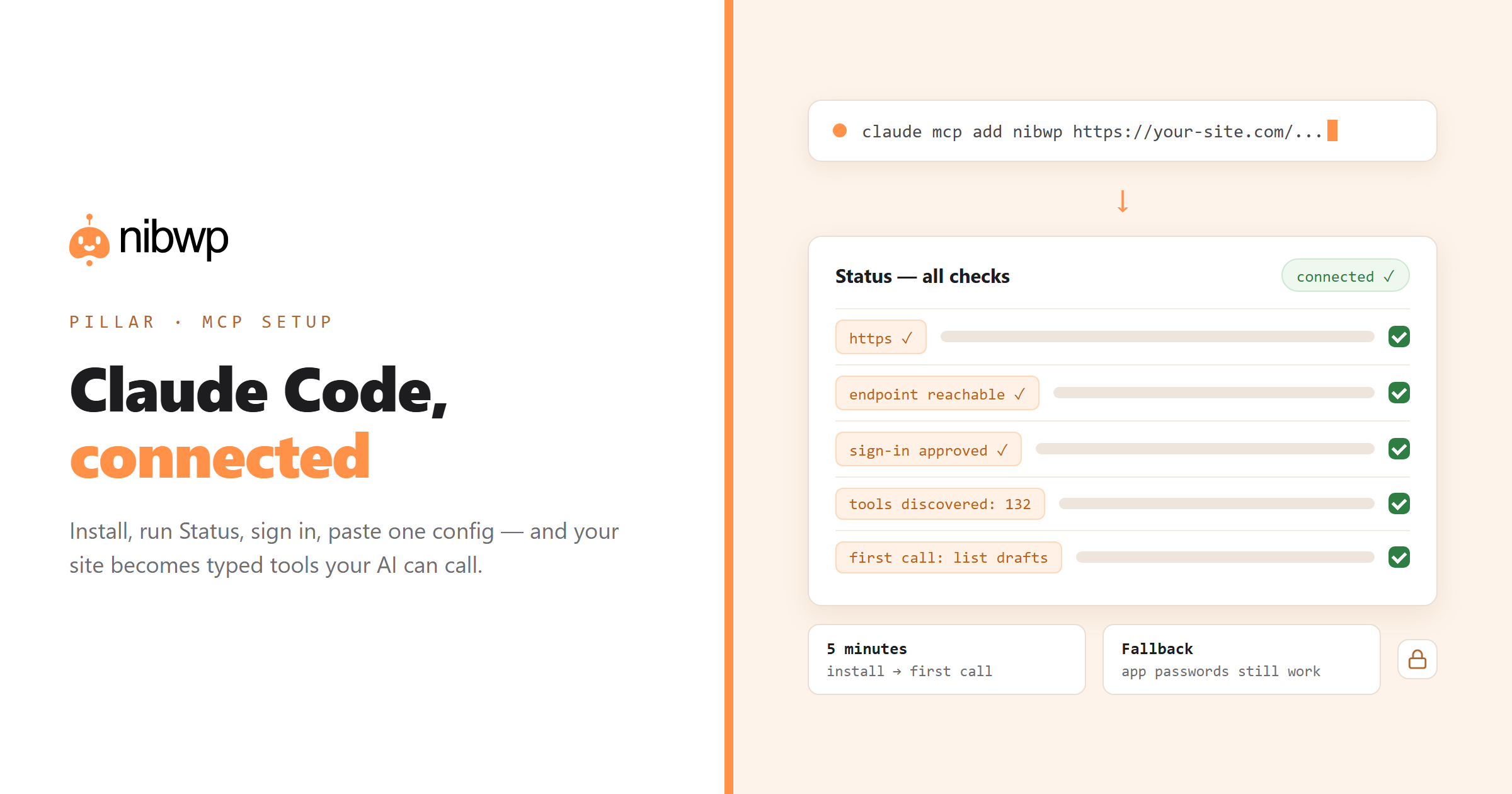
How to connect Claude Code to WordPress with an MCP server, step by step
The five-minute setup for Claude Code, Claude Desktop, Cursor, ChatGPT and Windsurf — plus the real failure modes and how Status diagnoses them.
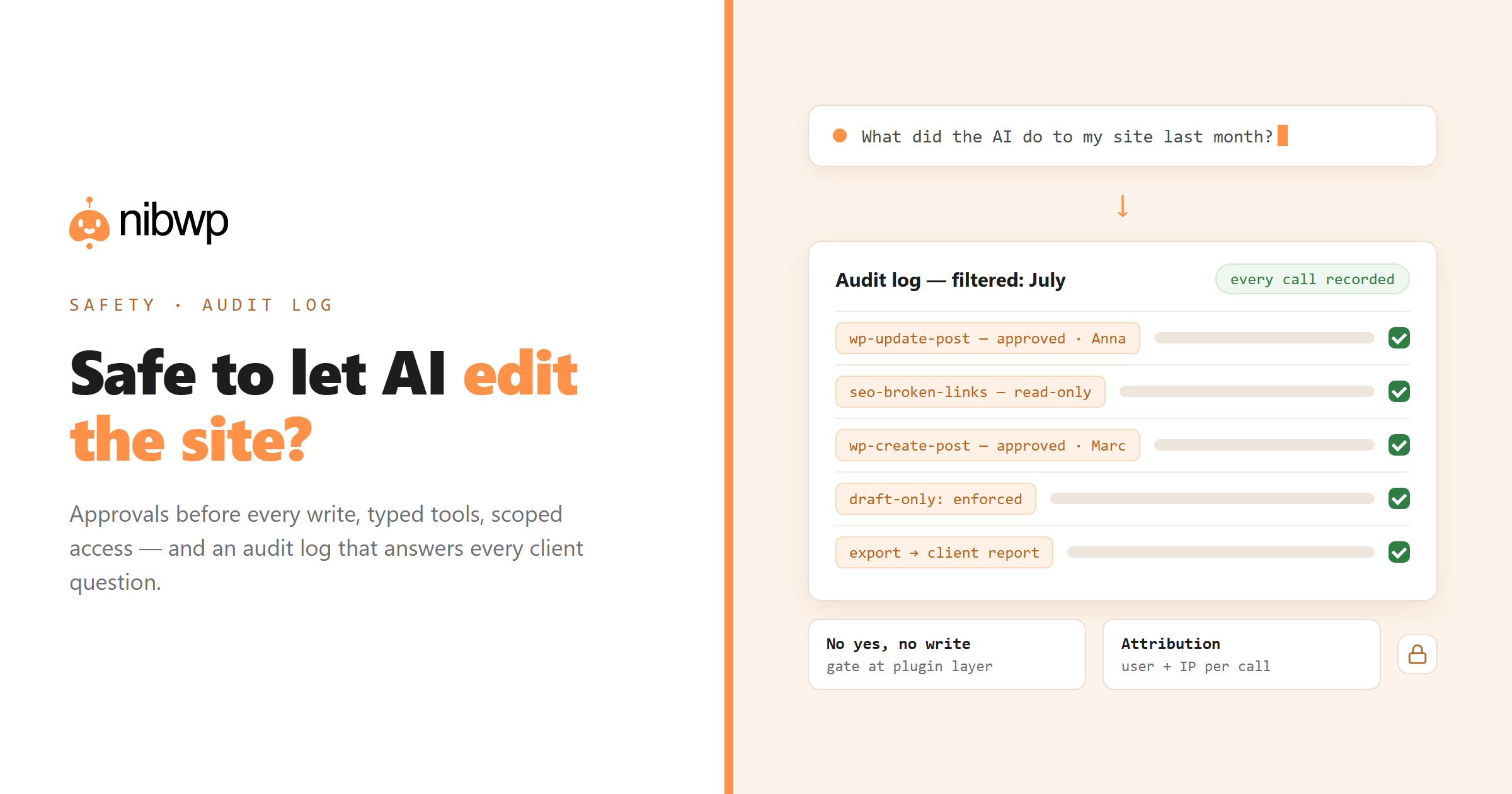
Is it safe to let AI edit a client's WordPress site? Audit logs + approvals
The answer we give clients: the realiztic failure modes, the five structural controls, and the audit log that turns trust into a record.
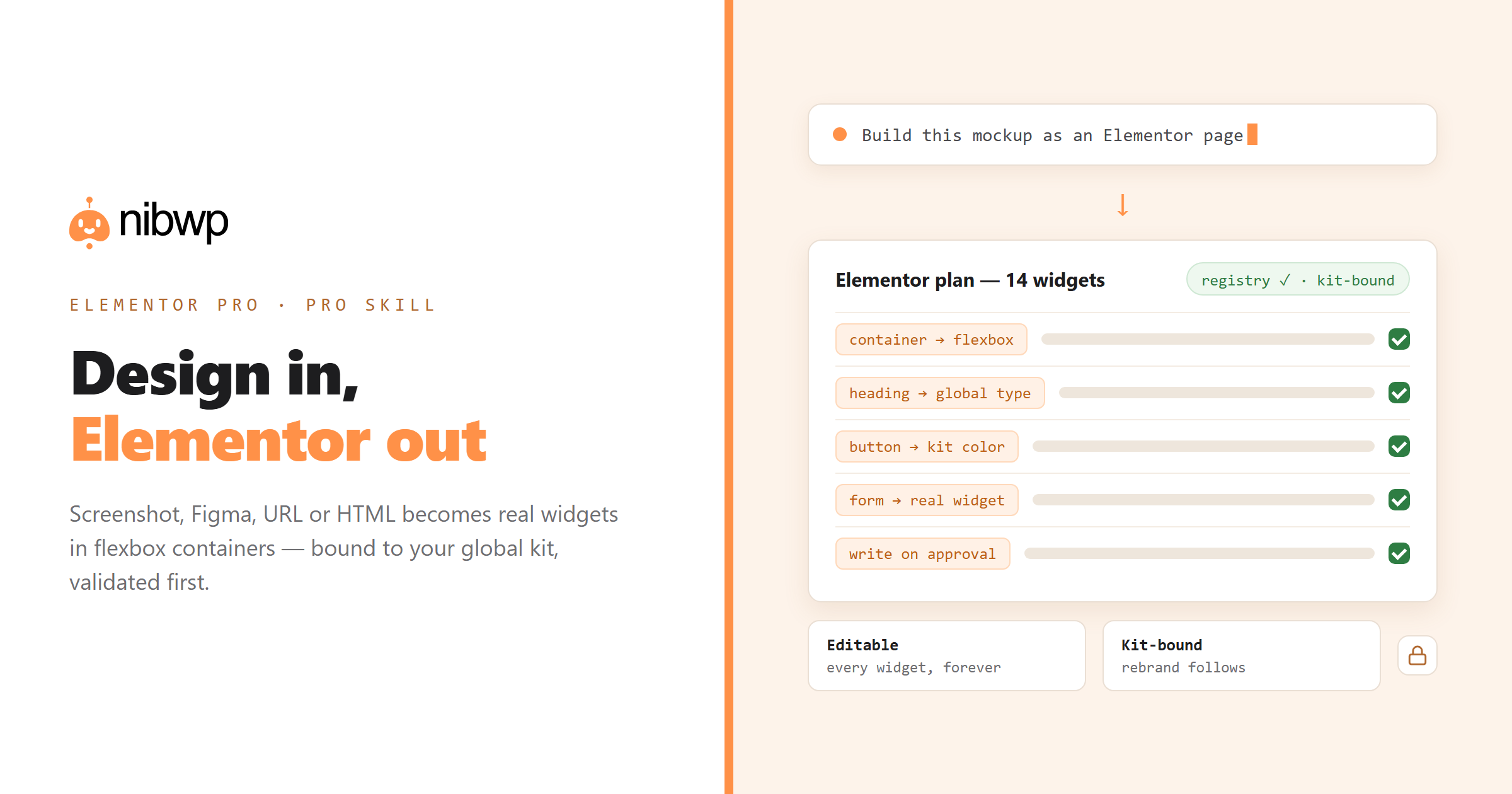
How to convert a design into an editable Elementor page — no code
Screenshot, Figma, URL or HTML into real Elementor widgets — flexbox containers, global-kit bindings, validated against your live widget registry.
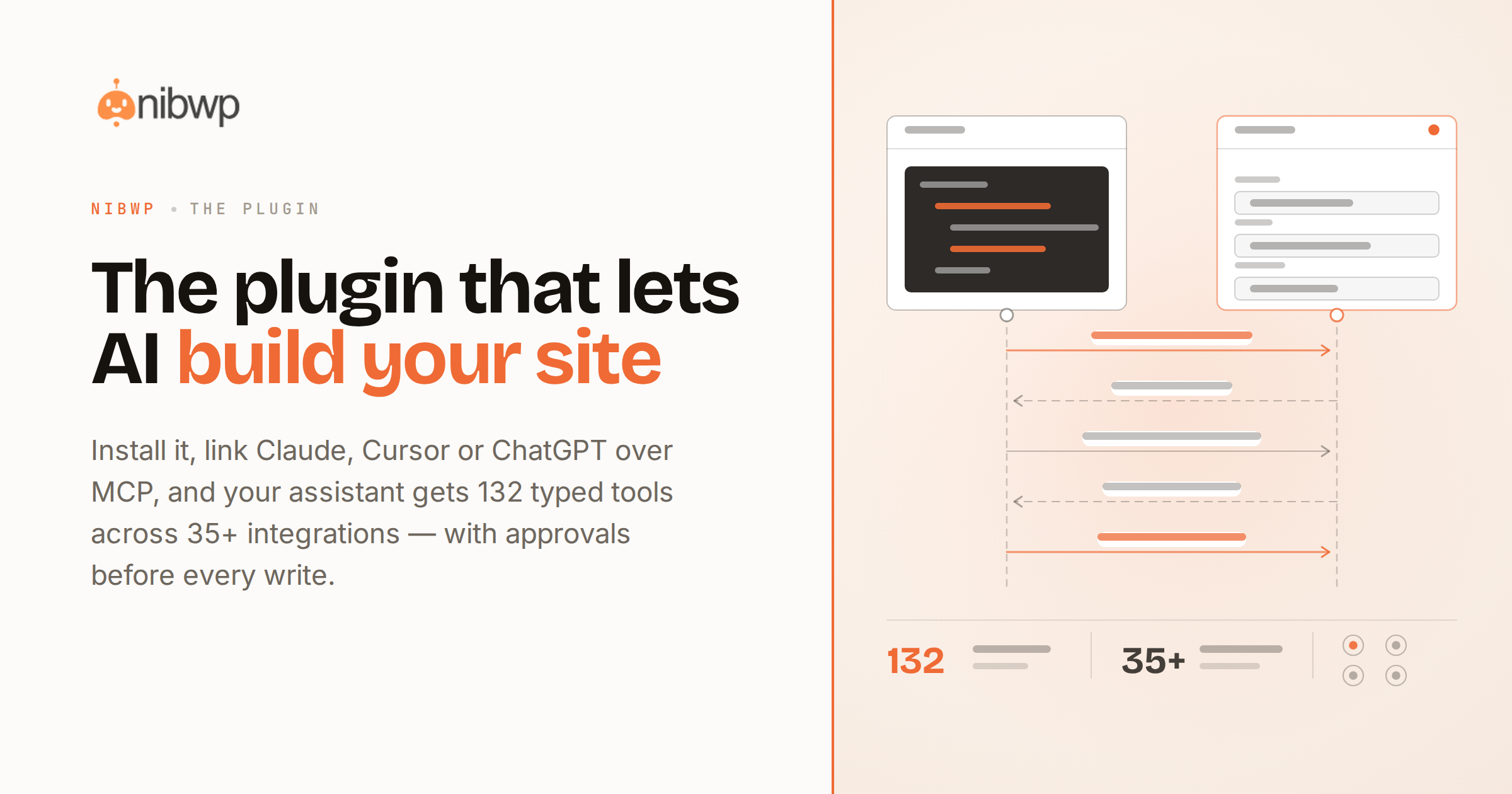
The WordPress plugin that lets Claude, Cursor and ChatGPT build sites
The plugin to connect AI to WordPress: Claude, Cursor and ChatGPT get 132 typed tools across 35+ integrations — building and managing your site with approvals and logs.
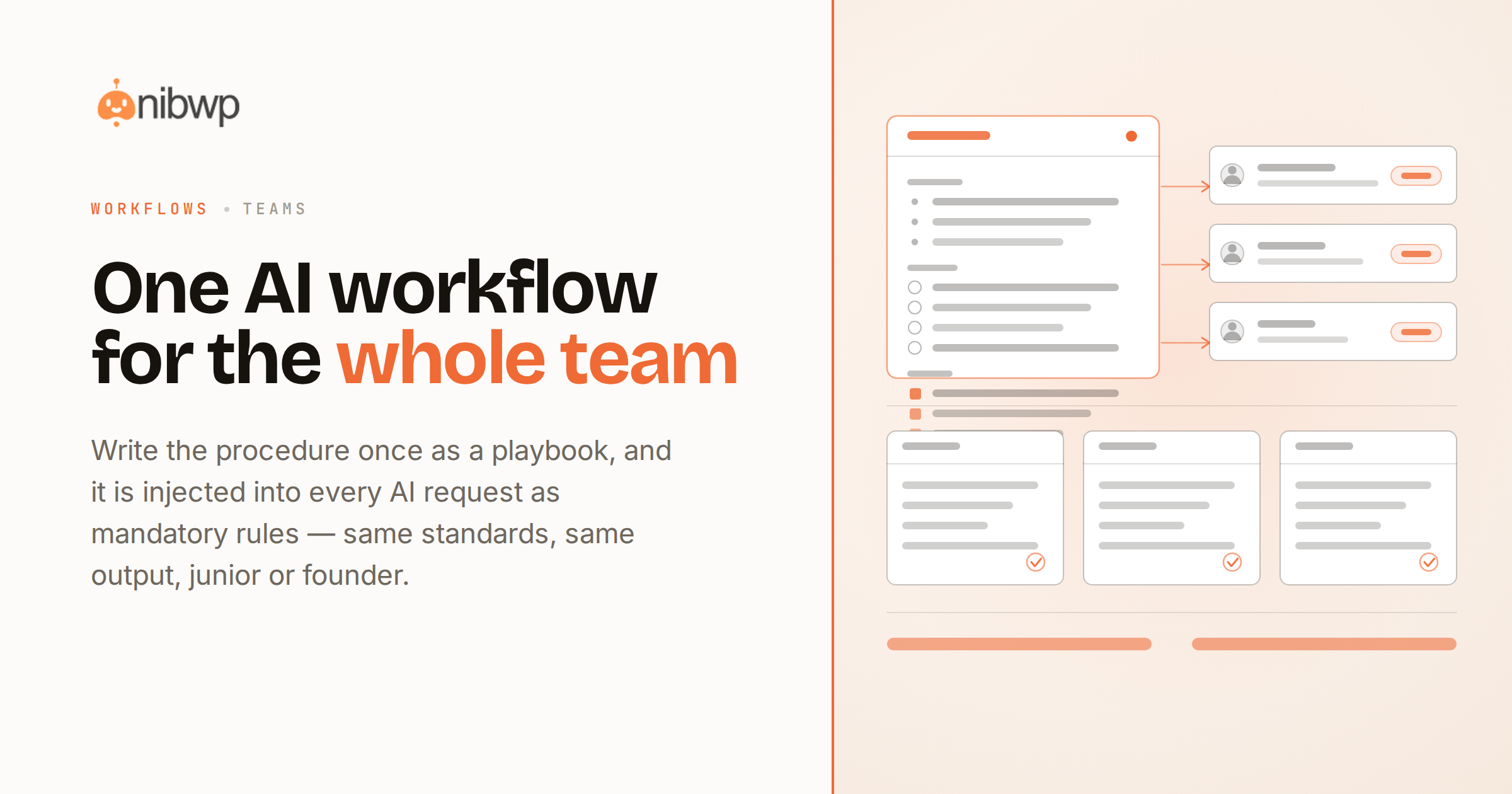
Give your whole team one AI workflow for every client build
An AI WordPress workflow for teams: encode your build process once as a playbook and every request follows it — same standards, same output, junior or founder.
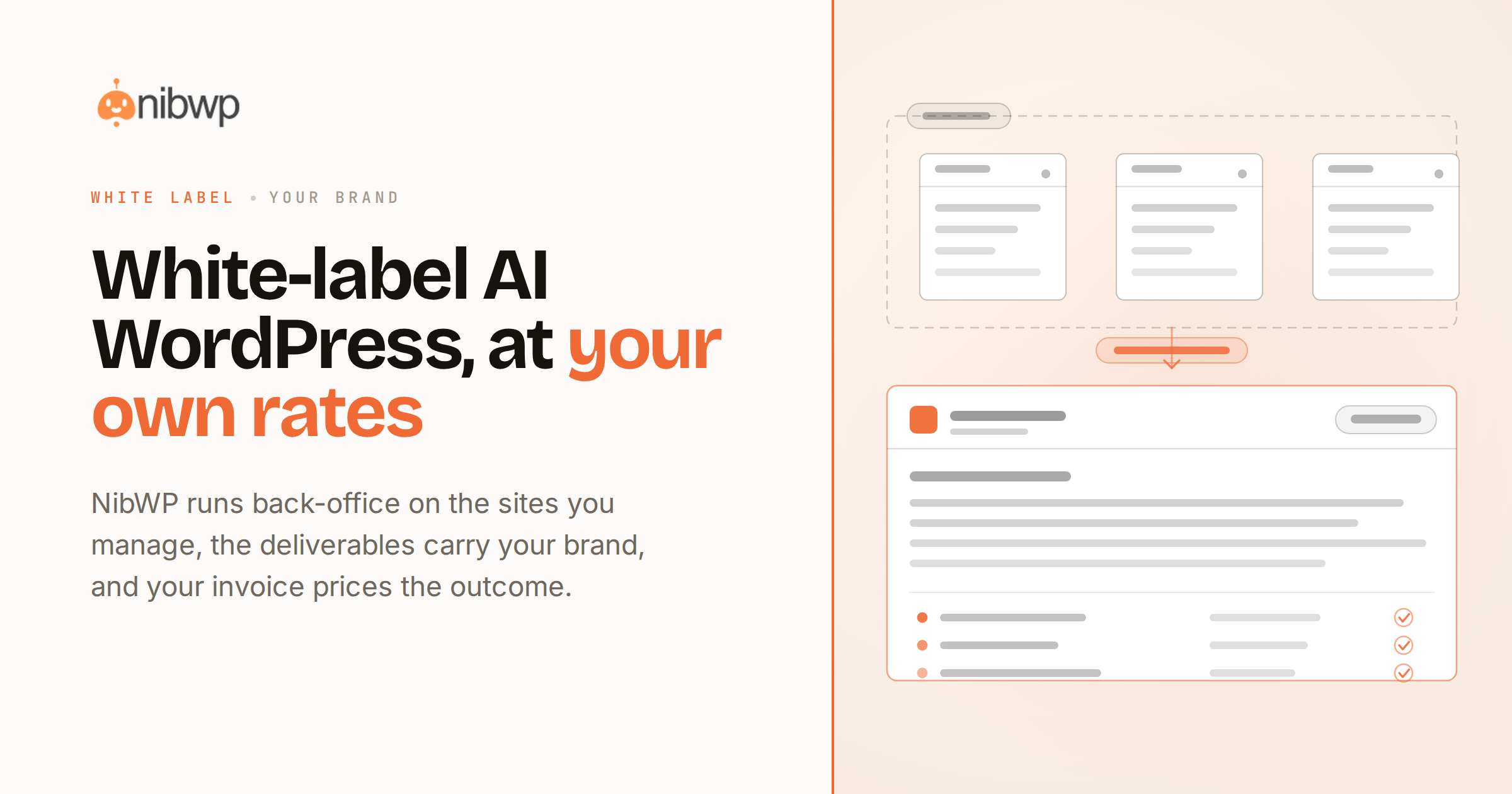
White-label AI WordPress services and charge your own rates
White-label AI WordPress services: NibWP runs back-office on your clients' sites — your brand on the reports, your rates on the invoice, the AI never in the room.
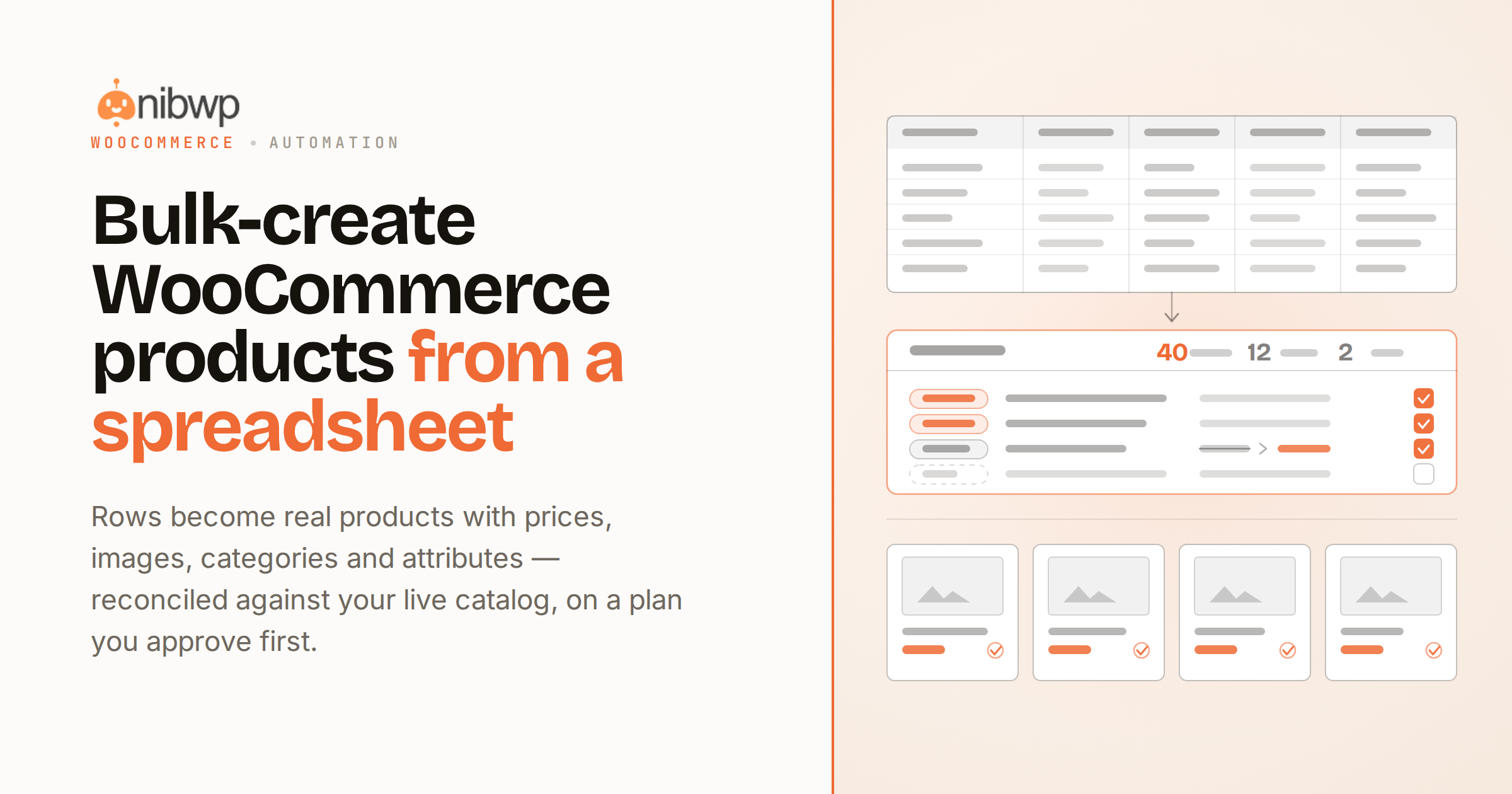
Bulk-create WooCommerce products from a spreadsheet, automatically
Bulk create WooCommerce products from a spreadsheet, feed or photo folder: real products with prices, images and categories — planned, approved, written to your store.
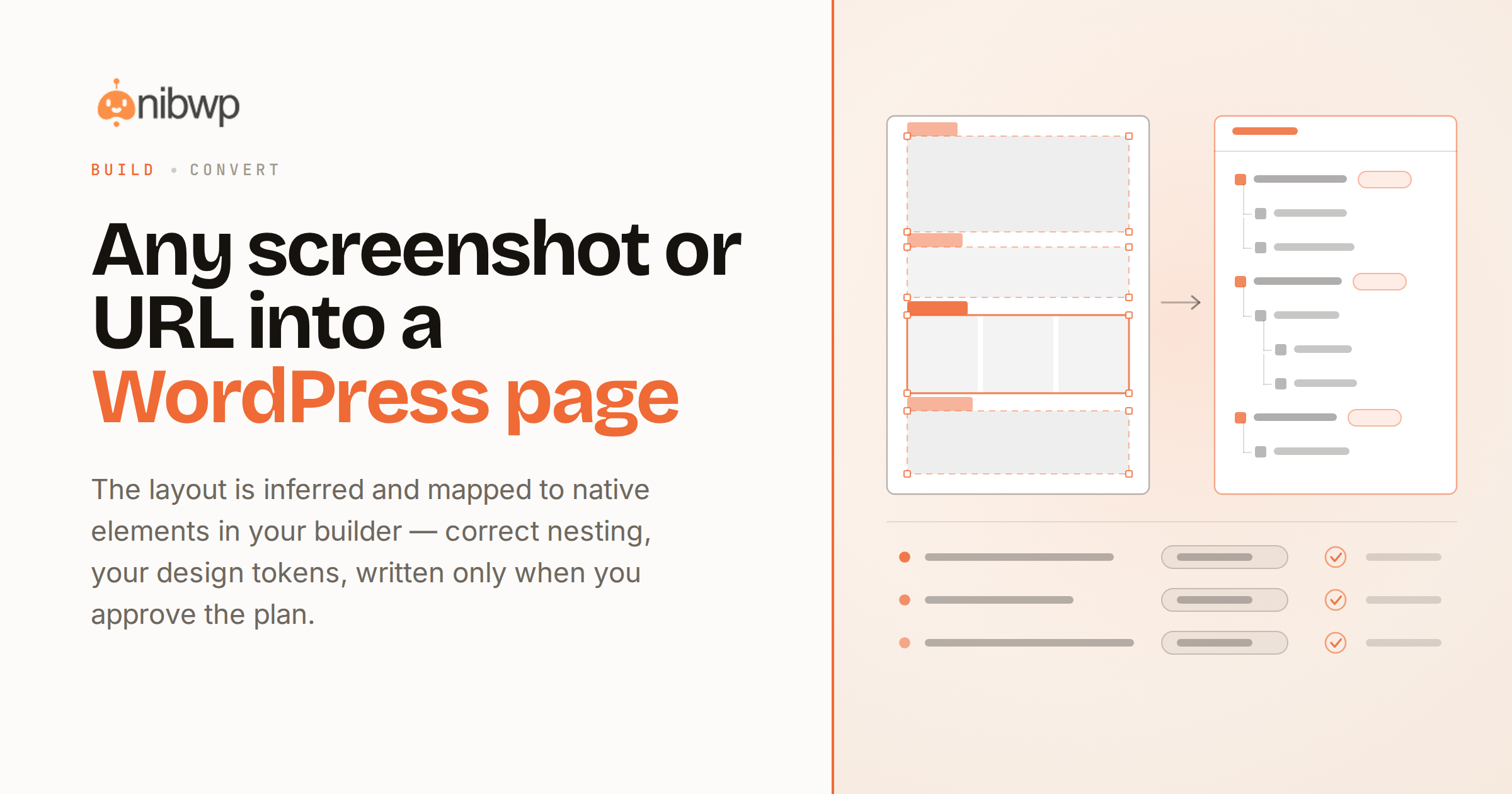
Turn any screenshot or URL into a WordPress page in minutes
Screenshot to WordPress page in minutes: NibWP turns any screenshot or URL into native, editable pages in Elementor, Bricks, Kadence or Etch — validated, approved by you.
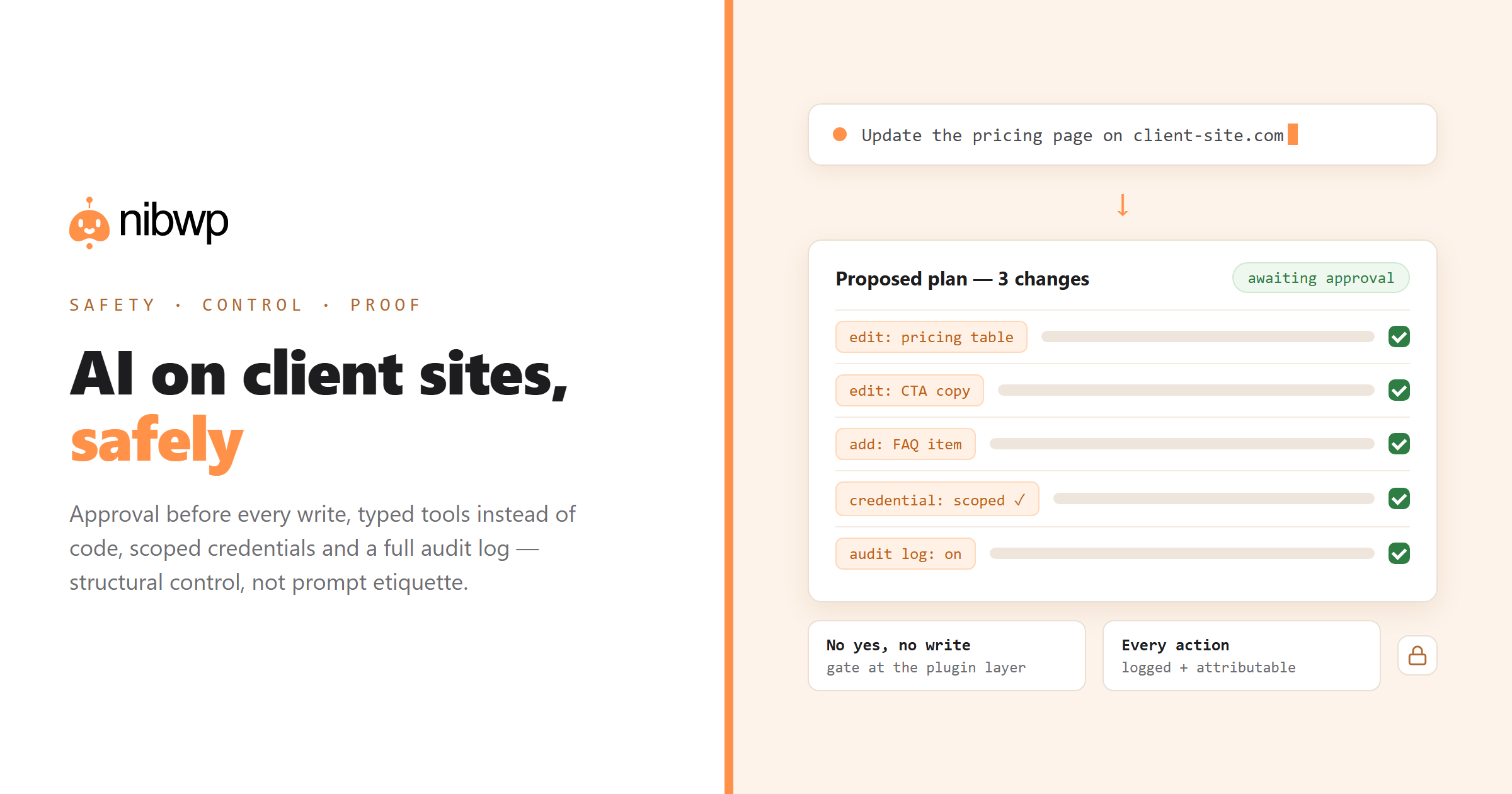
The safe way to put AI to work on client WordPress sites
Safe AI for client WordPress sites: approval before every write, typed tools instead of arbitrary code, scoped credentials, audit logs — control you can show a client.
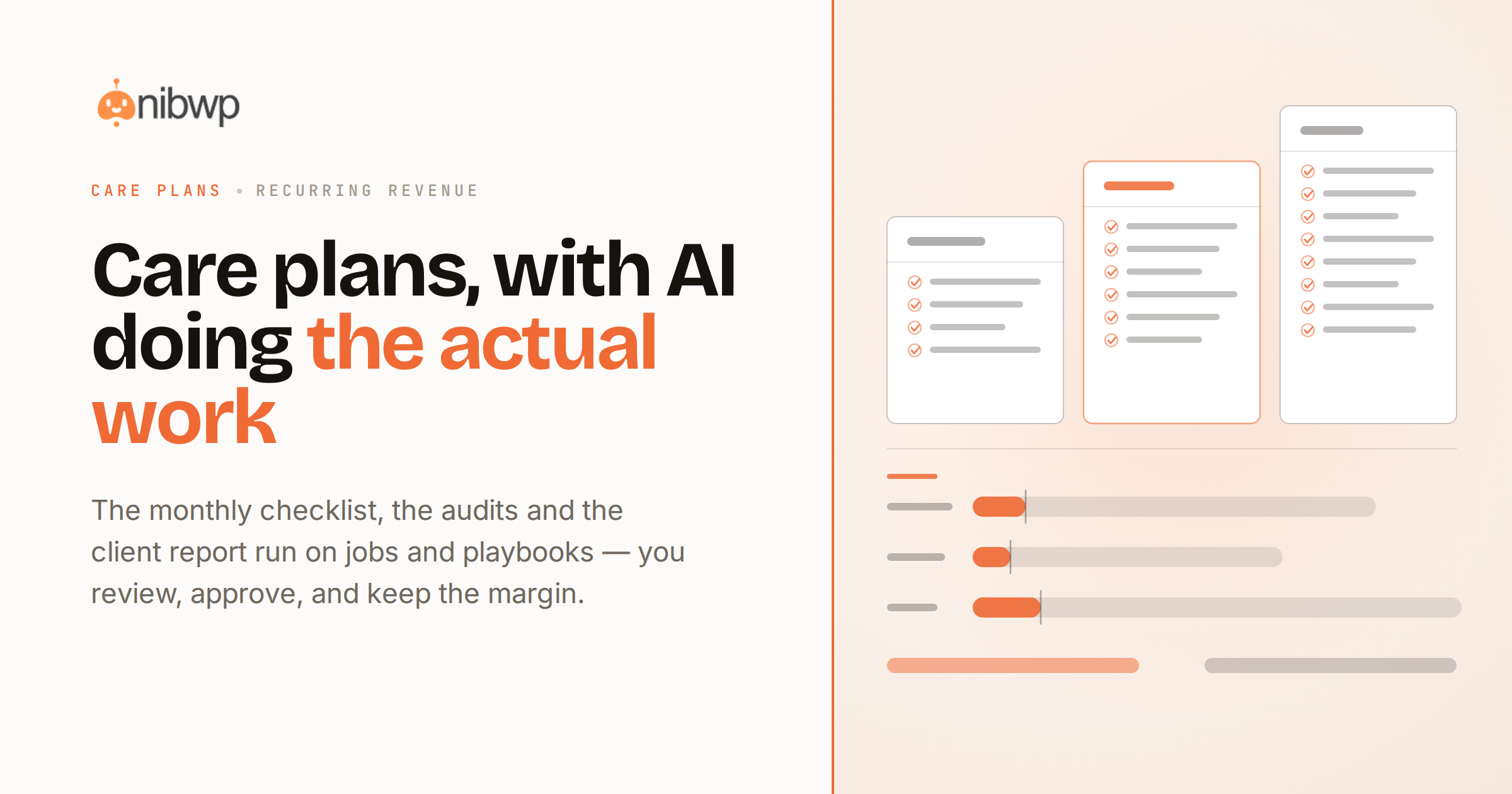
Sell WordPress care plans with AI doing the actual work
AI-powered WordPress care plans: the monthly checklist, audits and client report run on jobs and playbooks — you keep the approvals, the margin and the renewals.
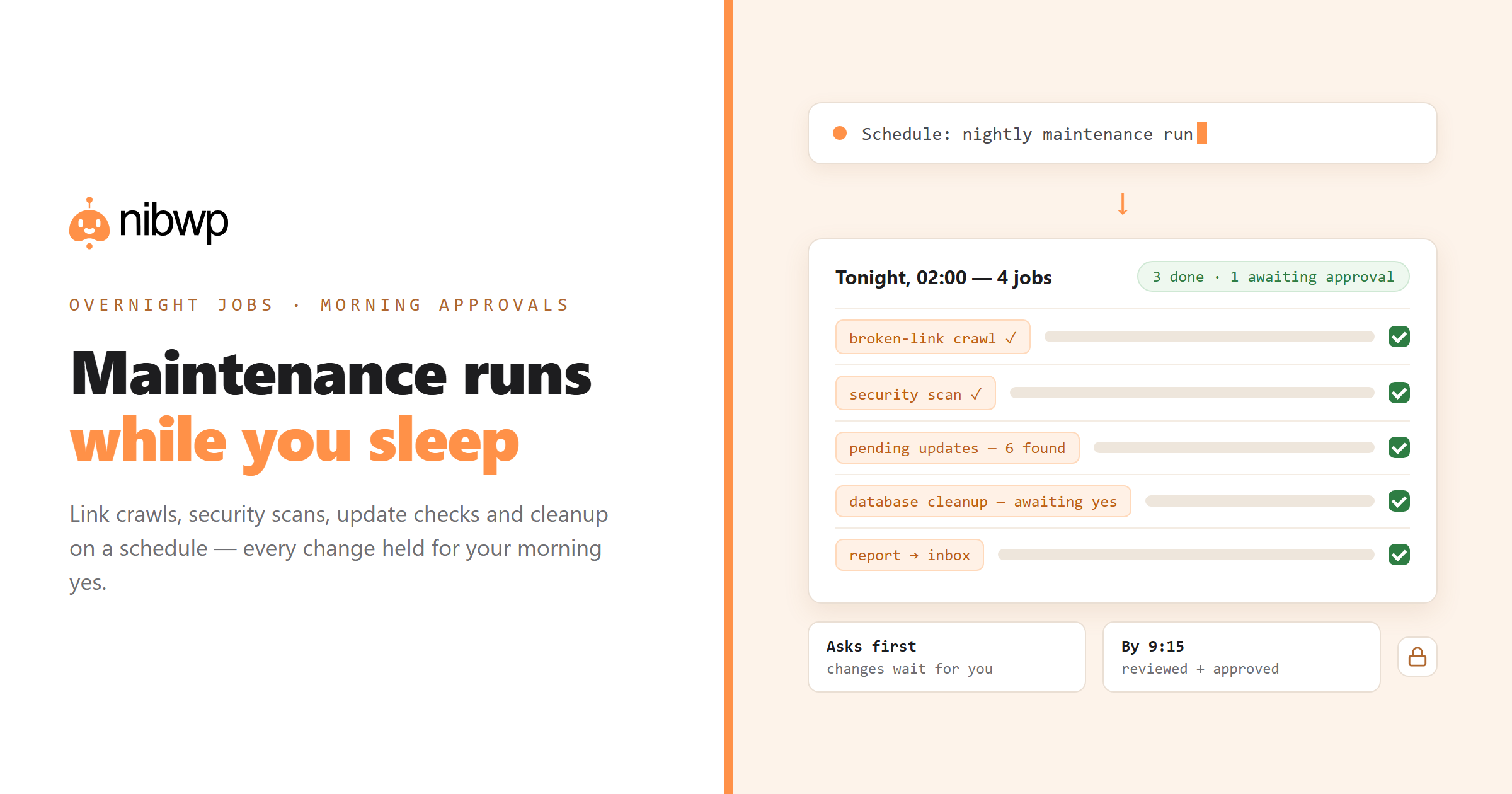
Let AI handle WordPress maintenance while you sleep
Automated AI WordPress maintenance: scheduled jobs crawl links, scan security, collect updates and clean the database overnight — and ask before changing anything.
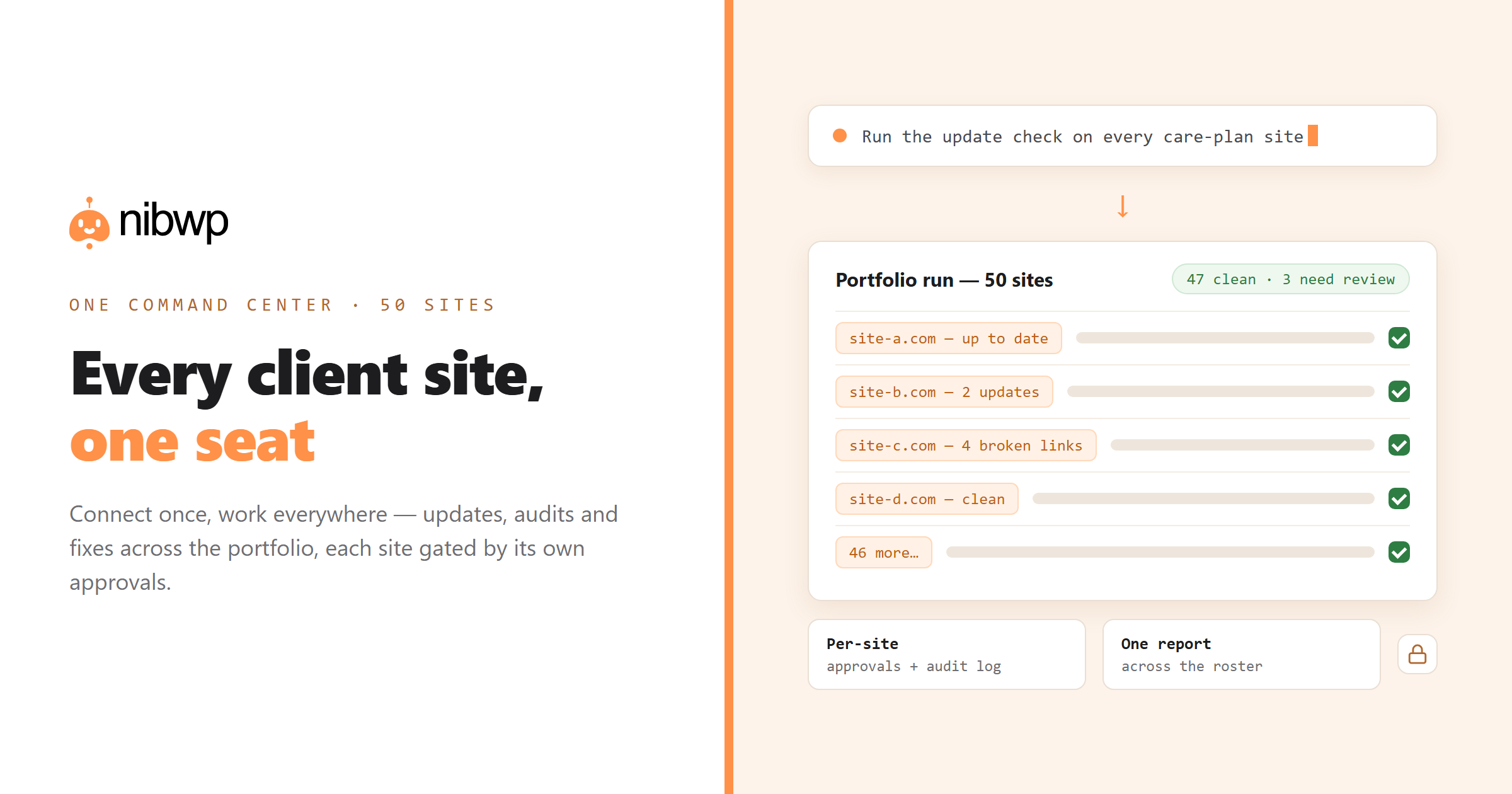
Manage 50 client WordPress sites from one AI command center
Manage multiple WordPress sites with AI: one connected assistant works across your whole portfolio — updates, audits, content and fixes, each site gated by approvals.
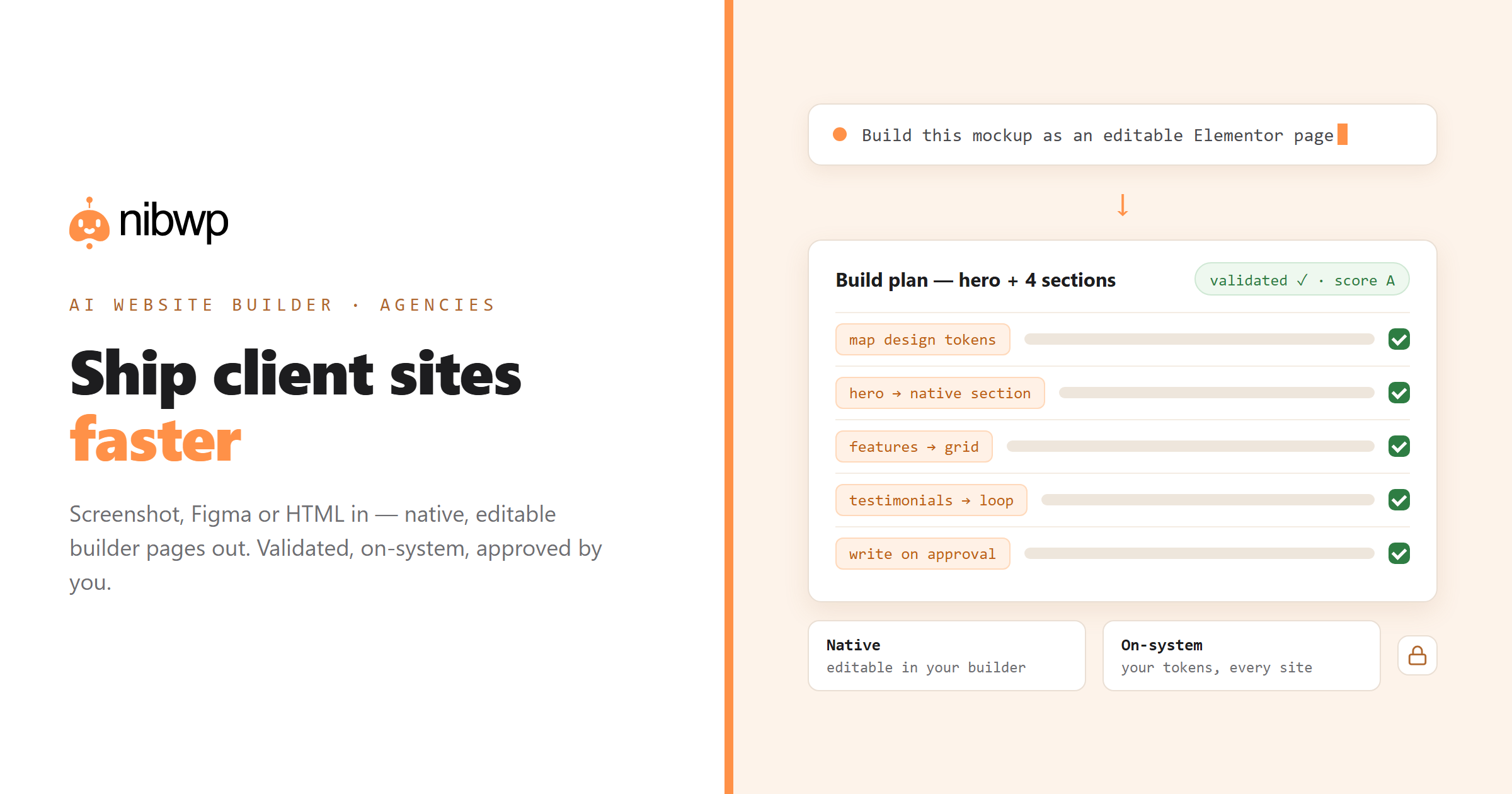
The AI website builder agencies use to ship client sites faster
NibWP is the AI website builder for agencies: screenshots, Figma files and HTML become editable pages in your client's builder — validated, approved, on your own WordPress.
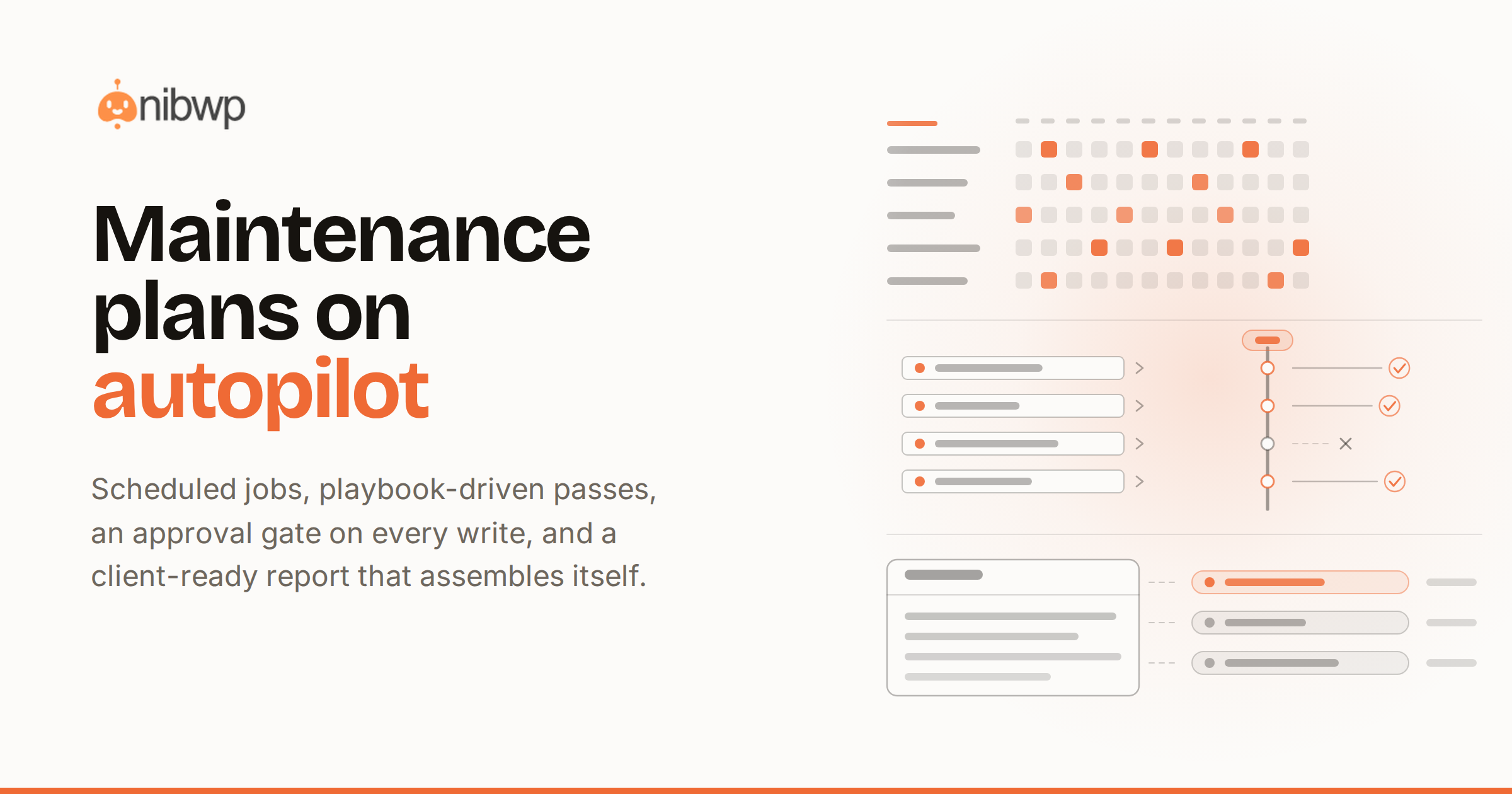
How to run WordPress maintenance plans on autopilot for client sites
Scheduled jobs, playbook-driven passes and approval gates that run the monthly care-plan checklist for you — and write the client report at the end.
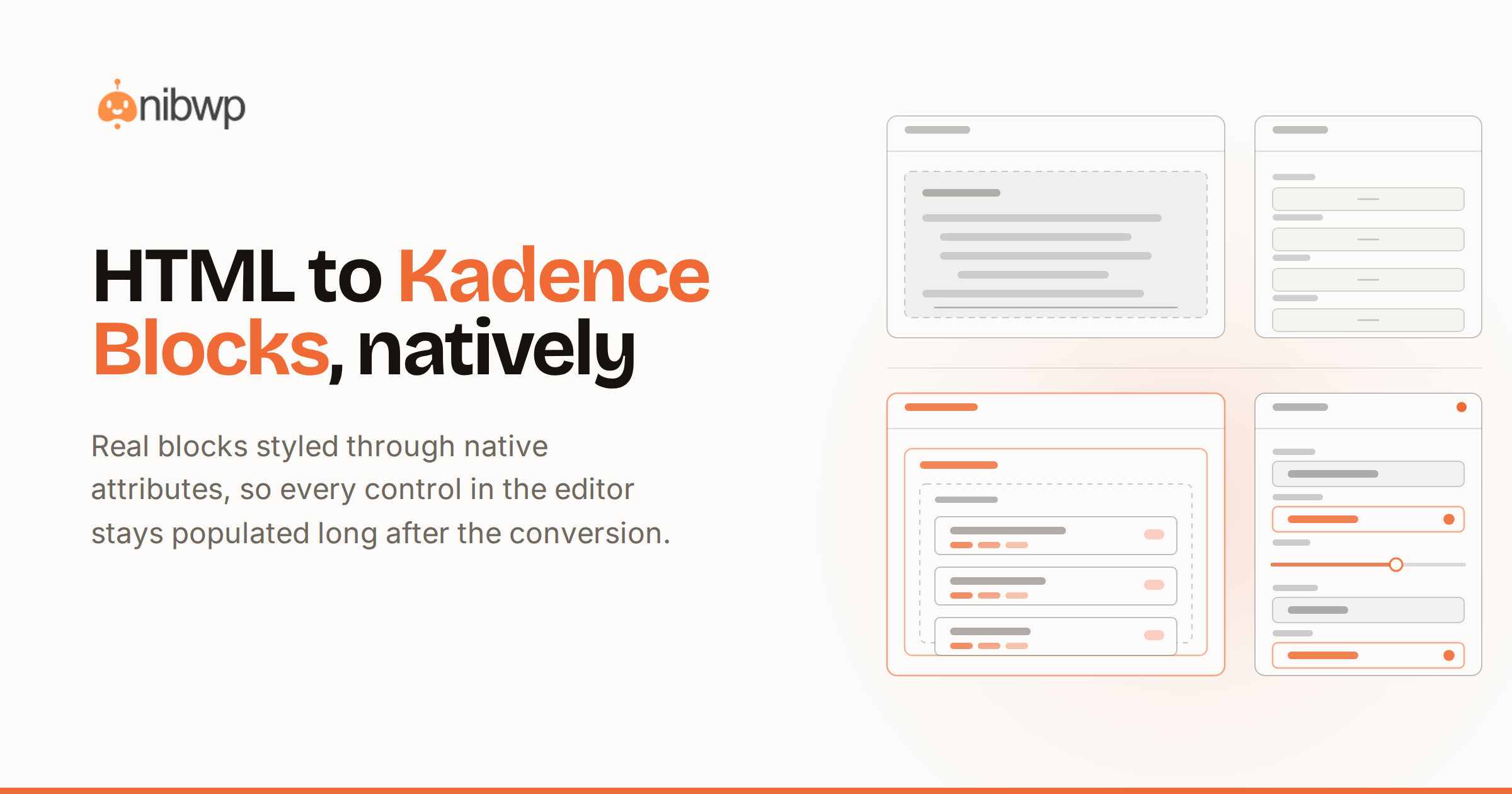
Convert HTML to Kadence Blocks with native attributes, not custom CSS
Six step-by-step walkthroughs that turn HTML, URLs, screenshots and even email markup into real, editable Kadence blocks — native attributes, no custom CSS.
What’s new in NibWP — July 2026
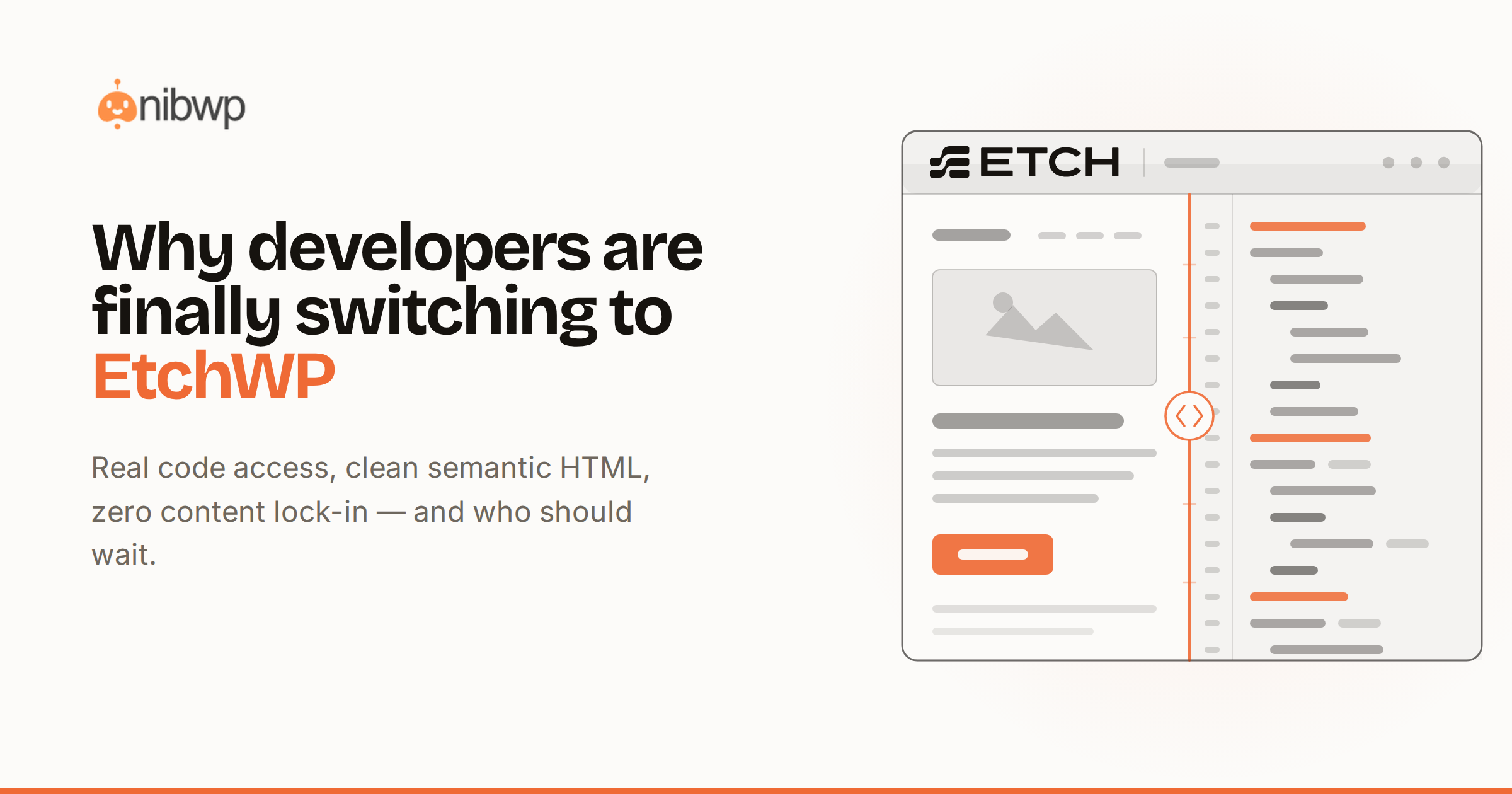
Why developers are finally switching to EtchWP
Etch hit stable 1.0 in 2026 and developers are leaving page builders behind. Real code access, clean semantic HTML, native blocks, no lock-in — here is why, plus the honest caveats.
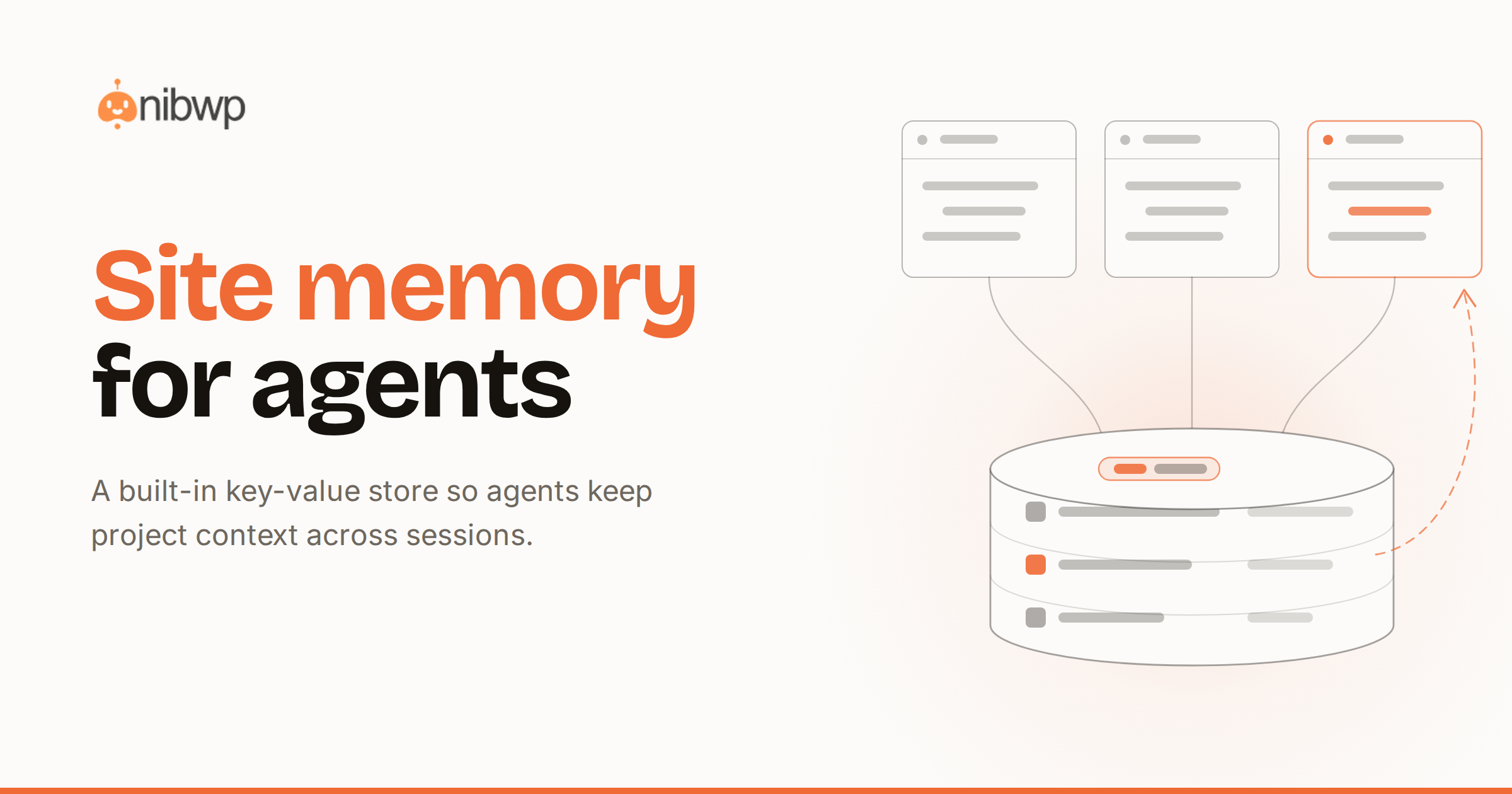
Site memory for agents
A built-in key-value store so agents keep project context across sessions.
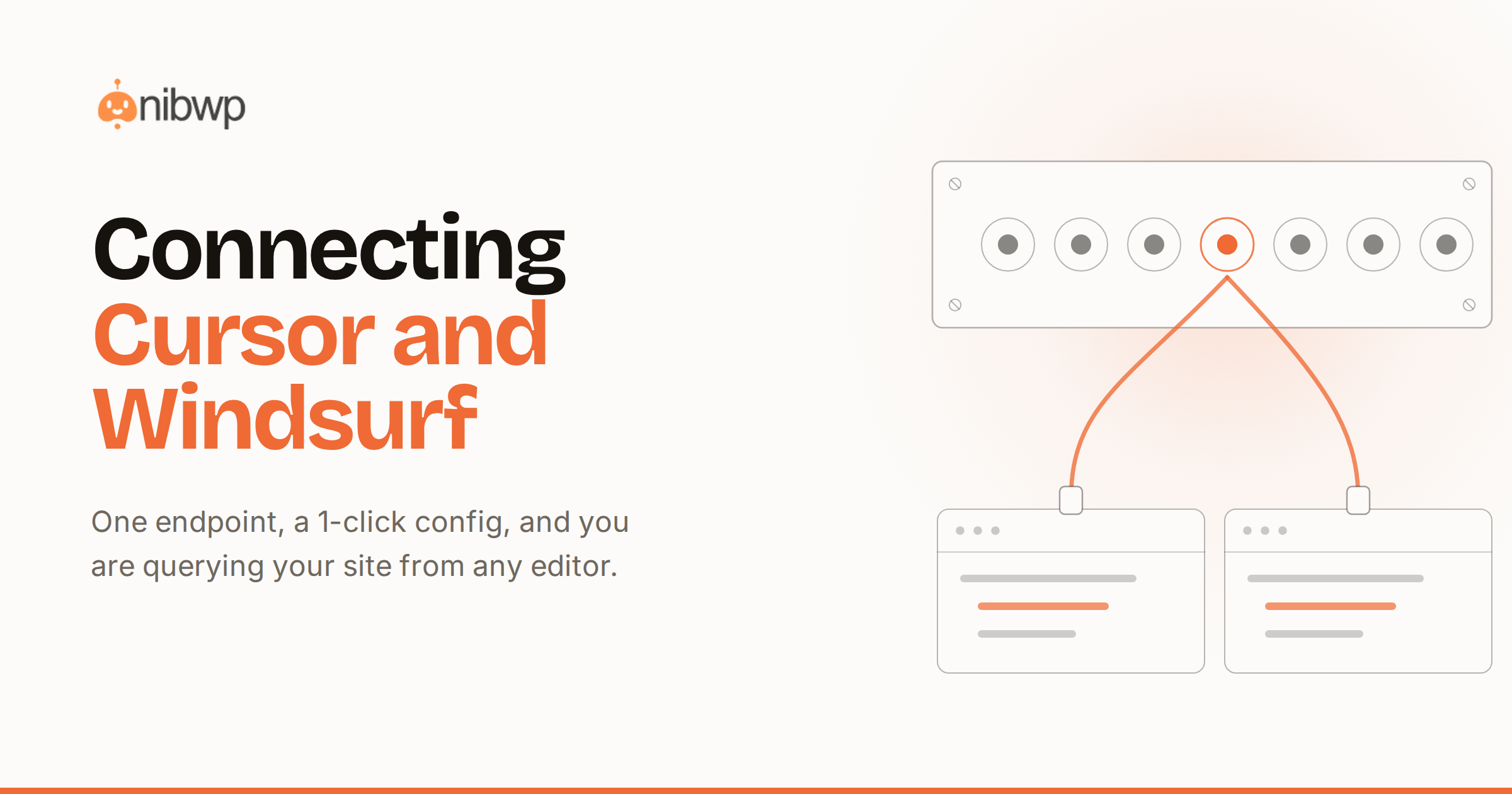
Connecting Cursor and Windsurf
One endpoint, a 1-click config, and you are querying your site from any editor.
Bricks Query Loops, automated
Detecting repeating cards in source HTML and turning them into CPT + ACF + Bricks posts element — automatically.
ACSS Pro: design systems from screenshots
Why we built a separate skill to generate the palette + type ramp + spacing scale rather than baking it into EtchWP.
Why typed tools beat scrapers
A stable, schema-typed contract instead of brittle scripts that break on update.
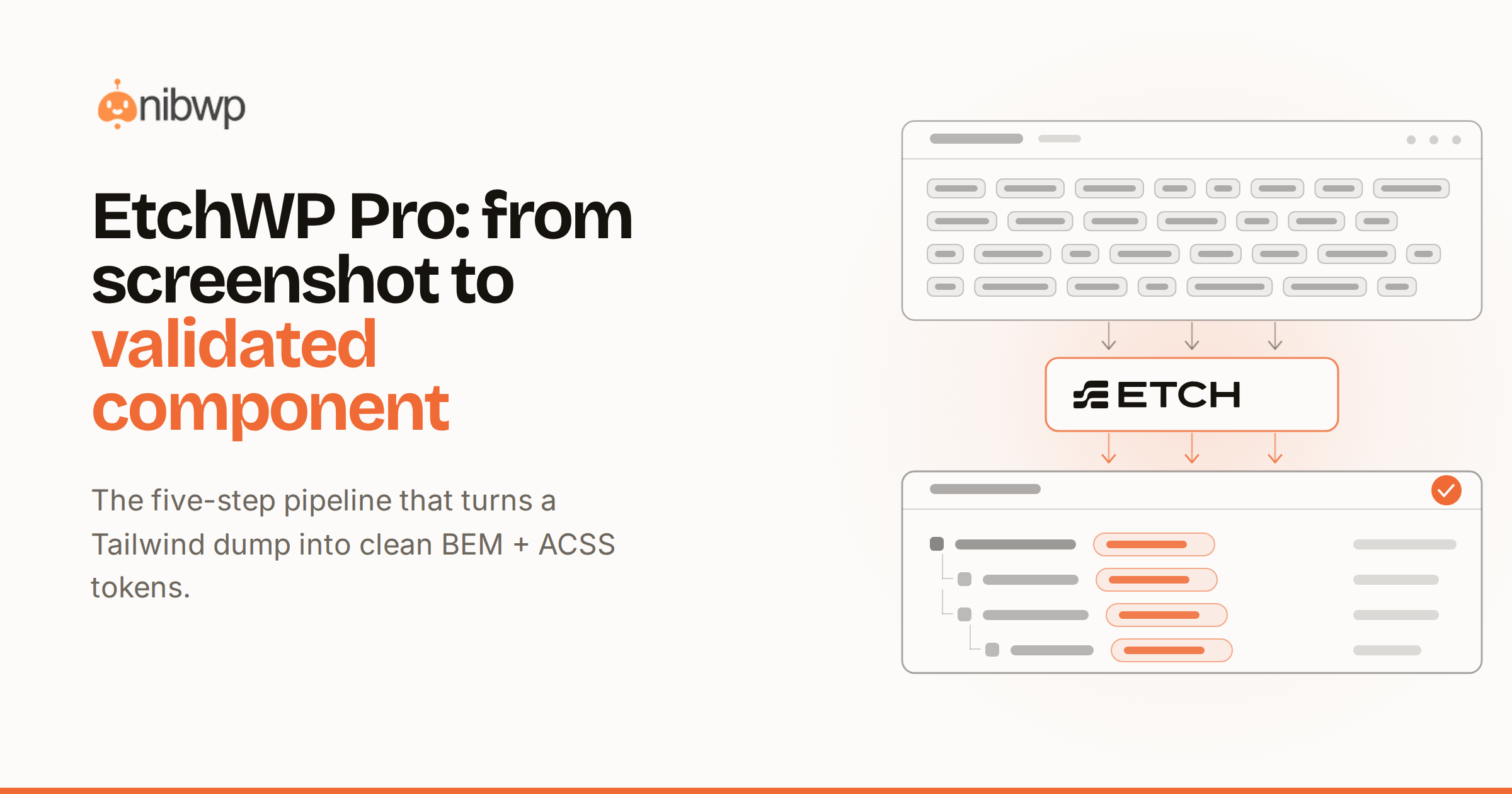
EtchWP Pro: from screenshot to validated component
Walking through the 5-step pipeline that turns a Tailwind dump into clean BEM + ACSS tokens.
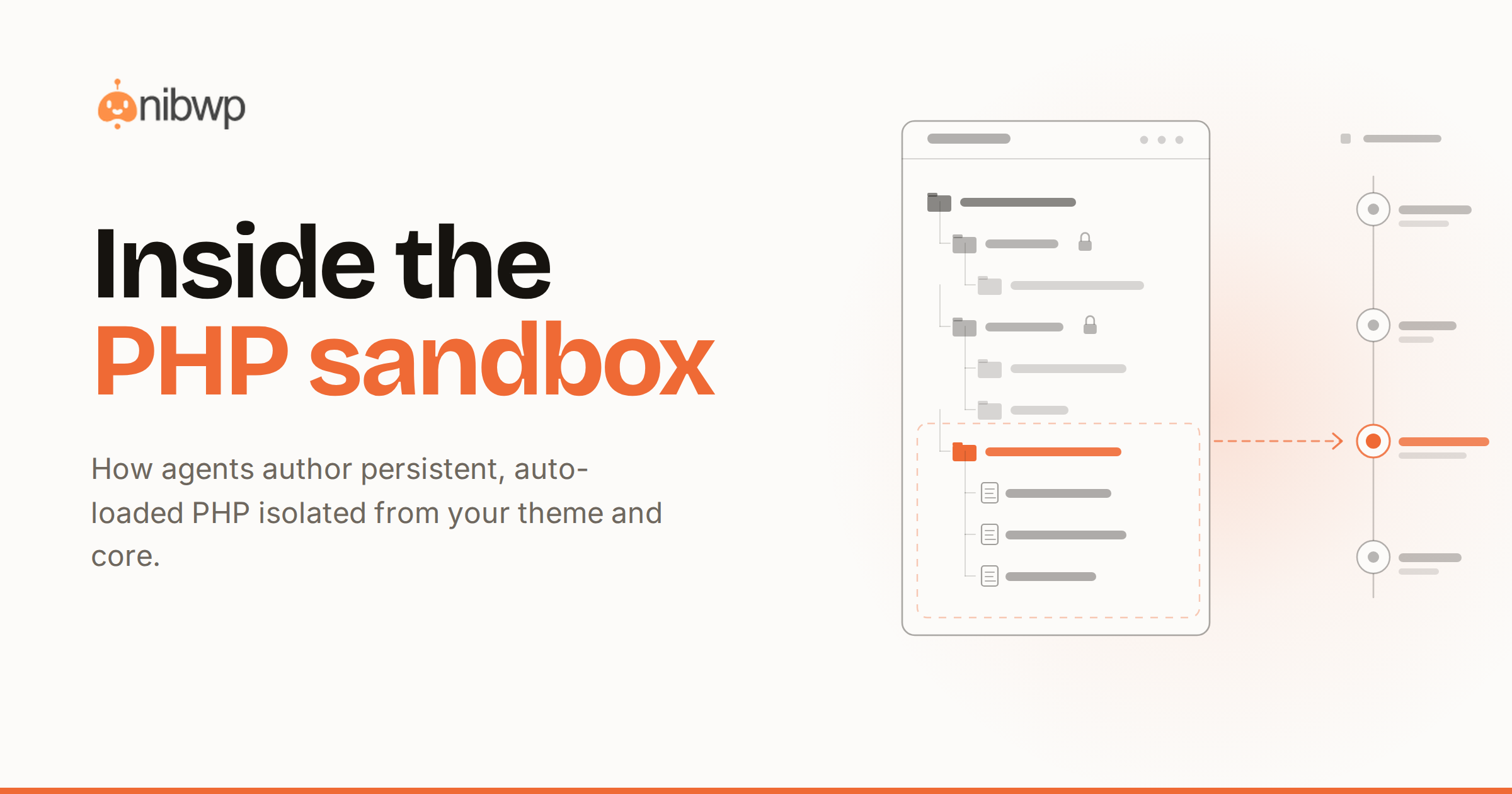
Inside the PHP sandbox
How agents author persistent, auto-loaded PHP isolated from your theme and core.
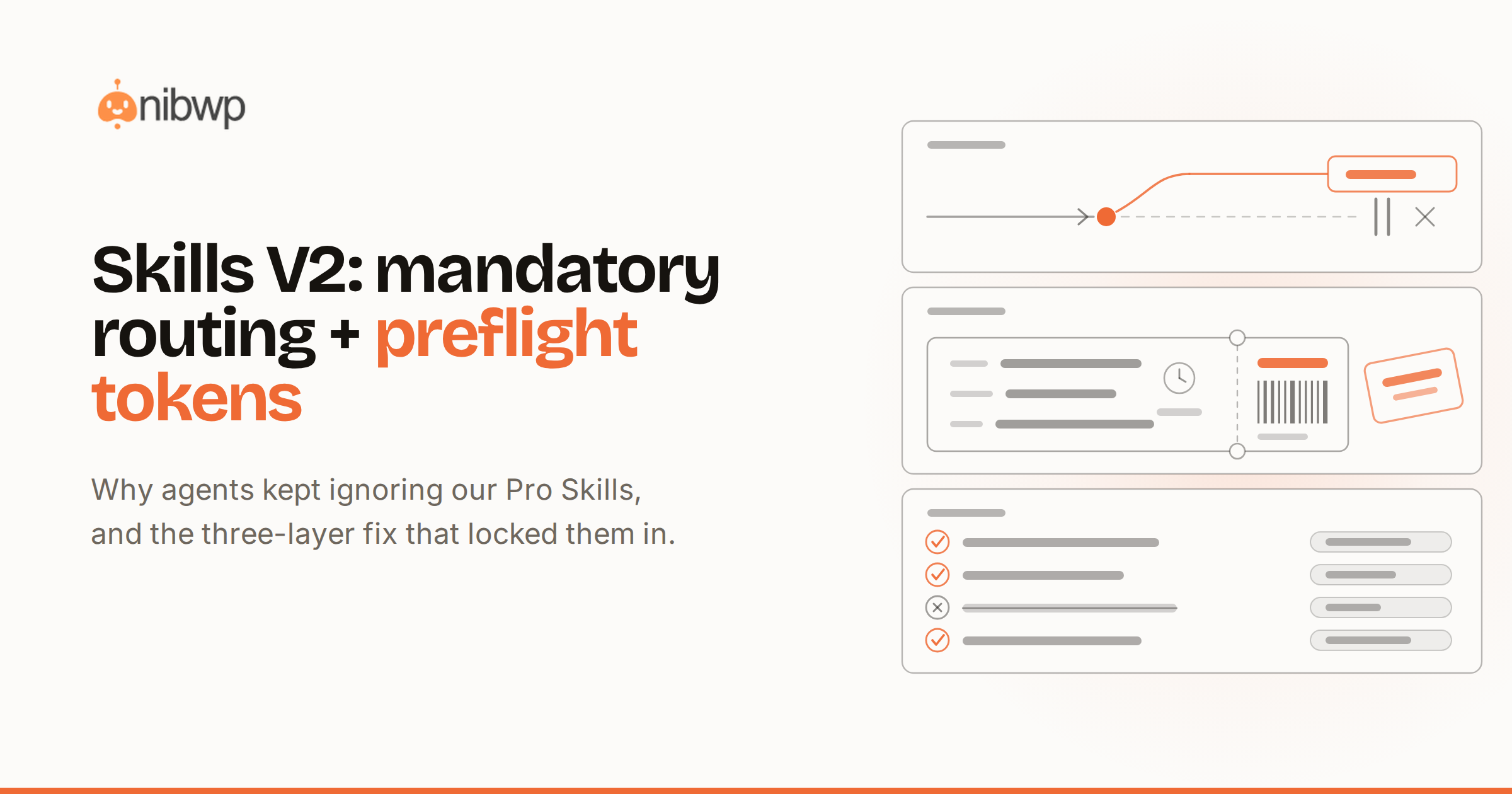
Skills v2: mandatory routing + preflight tokens
Why agents kept ignoring our Pro skills, and the 3-layer fix that finally locked them in.
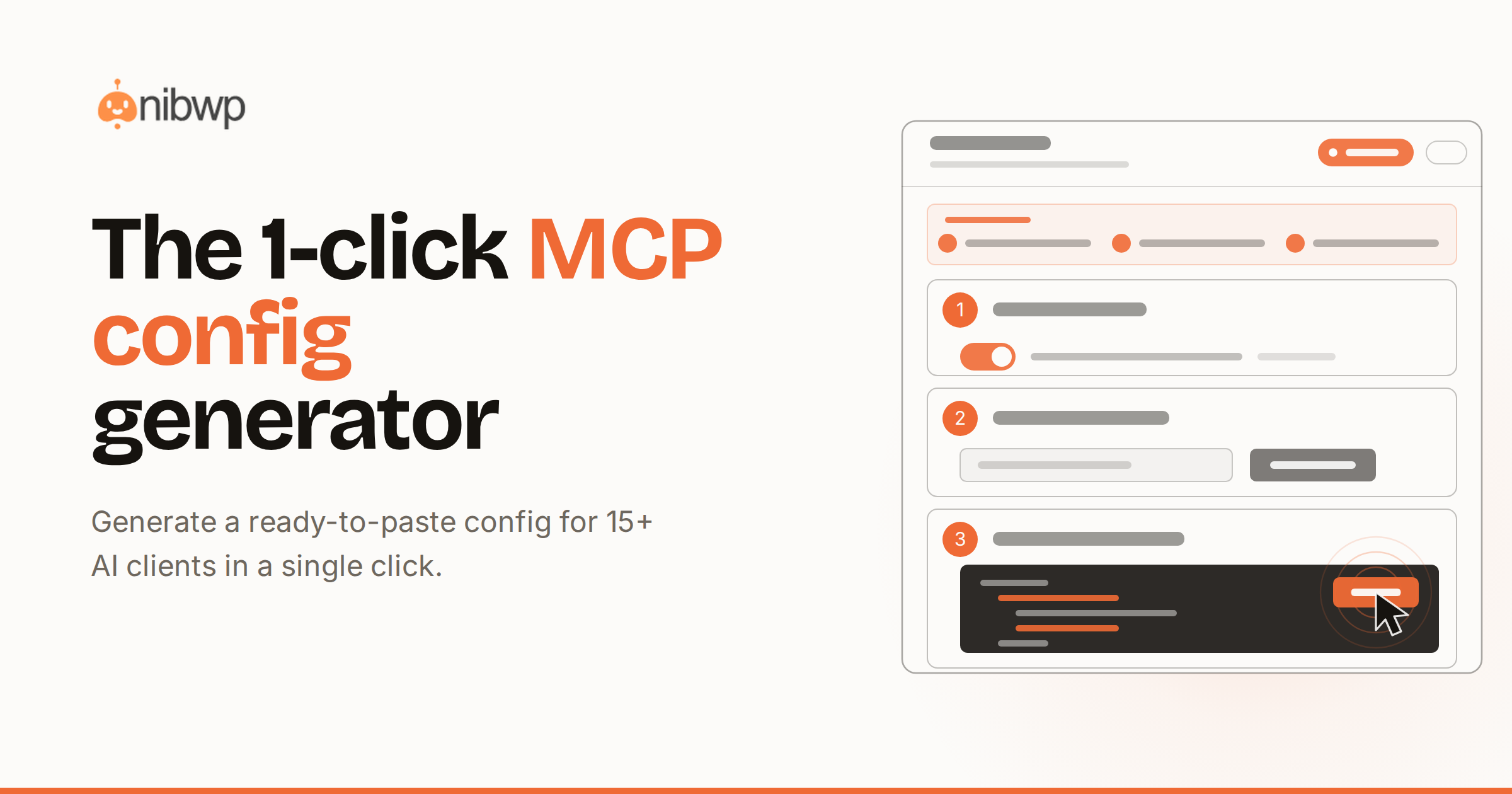
The 1-click MCP config generator
Generate a ready-to-paste config for 15+ AI clients in a single click.
Introducing NibWP
How we turned WordPress into a Model Context Protocol server in under 6 months.