How much does AI WordPress automation cost? Real numbers
The direct costs
Three line items, and only two are usually significant:
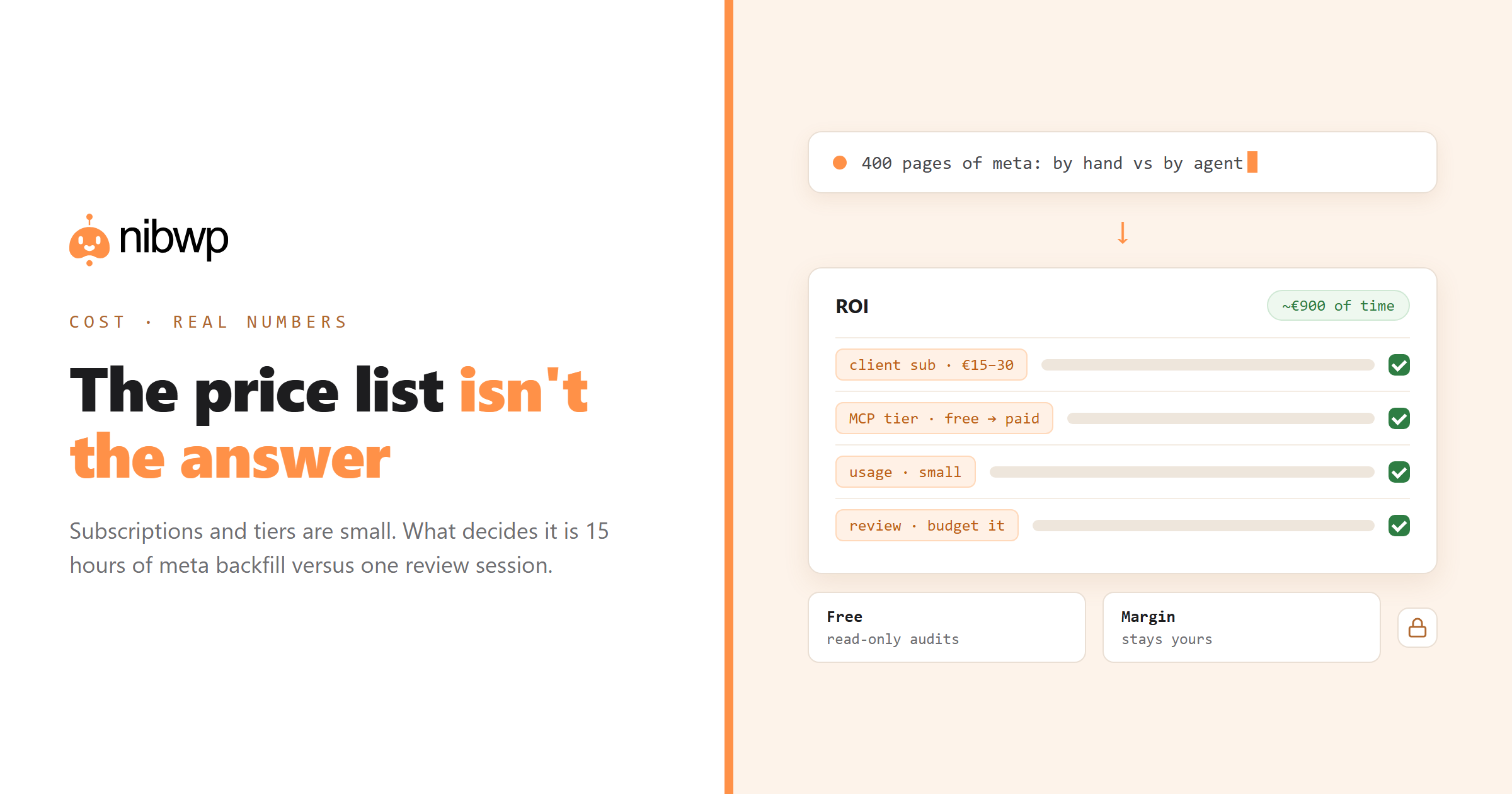
- Your AI client subscription. Claude, ChatGPT, Gemini or an editor like Cursor — typically the equivalent of €15–€30 per person per month for a paid tier, which most people working this way already have.
- The WordPress MCP layer. Free for core tools on a site or two; paid tiers for plugin integrations, validated builder output and multiple sites — commonly tens of euros a month or a lifetime option.
- Model usage, if metered. On subscription clients this is usually included. On API-based setups it is genuinely small for site work: text in, text out, no images.
For a solo freelancer the realistic total is one paid AI subscription plus one plugin licence. For a small agency it is a few seats plus a multi-site licence.
The comparison that decides it
Take your own hourly rate and the jobs you actually repeat. Four examples with conservative hours:
- Meta description backfill, 400 pages. By hand: two to three minutes each with thinking time — call it 15 hours. With an agent: a prompt, a table review, batched writes — under an hour of your attention.
- Product import, 500 SKUs with variations. By hand or by fighting a CSV importer: a day or two, plus the errors you find next week. With an agent: an afternoon, mostly reviewing.
- Monthly maintenance gathering, per site. One to two hours of collecting update states, security posture, performance and broken links. With an agent: minutes. Multiply by your site count, every month.
- Alt text for a 4,000-image library. Realistically never done. With an agent: a review session.
At a €60/hour rate, the meta backfill alone is roughly €900 of time. Any tooling in this category pays for a year in one such job — which is why the honest recommendation is to run one real job before deciding, rather than modelling it on a spreadsheet.
The costs people forget
- Learning time. Half a day to a day to get genuinely comfortable. Real, one-off, and shorter than most plugin migrations.
- Review time. Does not disappear — it replaces production time. Budget it honestly: a 400-row table still needs reading.
- Procedure writing. An hour per repeatable job to write it down properly, repaid the second time you run it.
- The occasional redo. Some outputs get rejected. Cheaper than the manual alternative, not free.
What you can do at zero cost
Genuinely useful without spending anything: connect a free-tier MCP server with a read-only credential and use it for audits and questions. Content gaps, broken links, empty meta, orphaned pages, stale posts. No write access, no risk, no subscription beyond the AI client you likely already pay for — and it is the fastest way to find out whether the paid layer would earn its keep.
What sits on each side of the free/paid line: free vs paid WordPress MCP.
Charging for it
The question behind the question, for agencies: if the work takes an hour instead of fifteen, do you invoice an hour? Almost universally not — clients buy outcomes, and the speed is your margin, earned by the tooling and process you built. The durable model is fixed-price outcomes and productised retainers, with the audit log as the proof of what was delivered.
how to bill for AI-assisted work.
A worked example: a ten-site care plan
Concrete arithmetic beats abstractions. Ten client sites on monthly maintenance, one person running them:
- Before. Gathering takes ~90 minutes per site — updates, security, performance, links, forms — so 15 hours a month before a single fix is applied. At €60/hour that is €900 of internal cost, and the fixes still have to happen.
- After. The gathering runs as a read-only sweep in minutes per site; you spend perhaps 20 minutes per site reviewing and deciding. Call it 3.5 hours a month.
- Net. Roughly 11 hours a month returned, against tooling costing a small fraction of one hour's billing.
The interesting part is not the saving. It is that the same fee now buys the client more attention on the things that matter, which is what keeps care plans renewing.
Where the numbers do not work
Honest cases where this tooling will not pay for itself:
- One simple site you update twice a year. The free tier is plenty; a paid tier is not.
- Work that is purely design judgement with no repetition — bespoke creative, one-off brand projects.
- Teams unwilling to change process. The tooling amplifies a workflow; it does not create one.
- Sites whose stack has no integration coverage. Check before buying, not after.
How costs scale
Two patterns worth knowing before you commit to a tier:
- Site count is the usual axis. Costs step with the number of connected sites rather than with usage, which is friendly to heavy users and unfriendly to portfolio sprawl. Audit your actual active-site count before choosing.
- Lifetime options change the maths. Where a lifetime licence exists, the break-even against monthly is typically 12–24 months — worth taking if the workflow has already proven itself, and not before.
Tier detail on our side: pricing. The free-versus-paid line in general: free vs paid WordPress MCP.
FAQ
How much does AI WordPress automation cost?
Realistically one paid AI client subscription (roughly €15–€30 per person per month) plus a WordPress MCP layer — free for core tools on a site or two, tens of euros a month for plugin integrations and multiple sites.
Is there a free way to use AI with WordPress?
Yes. A free-tier MCP server with a read-only credential gives you audits, gap analysis and questions about your site at no cost beyond the AI subscription you probably already have.
How do I calculate the ROI?
Take one repeated job, price it at your hourly rate, and compare. A 400-page meta backfill is roughly 15 hours by hand; at €60/hour that single job covers a year of tooling in this category.
Does model usage get expensive?
Rarely for WordPress work. It is text in and text out; the volumes are small compared to image or video generation. On subscription clients it is typically included.
Should I charge clients less because AI is faster?
No. Clients buy outcomes, not hours. Keep fixed prices, take the margin, and use the capacity to sell work that was previously unquotable — audits, backfills, migrations.
What are the hidden costs?
Learning time (half a day to a day), review time that replaces production time, an hour per procedure to write it down, and occasional rejected output. All real, all smaller than the manual alternative.