1K vs 5K vs 25K websites: what actually changes at each price
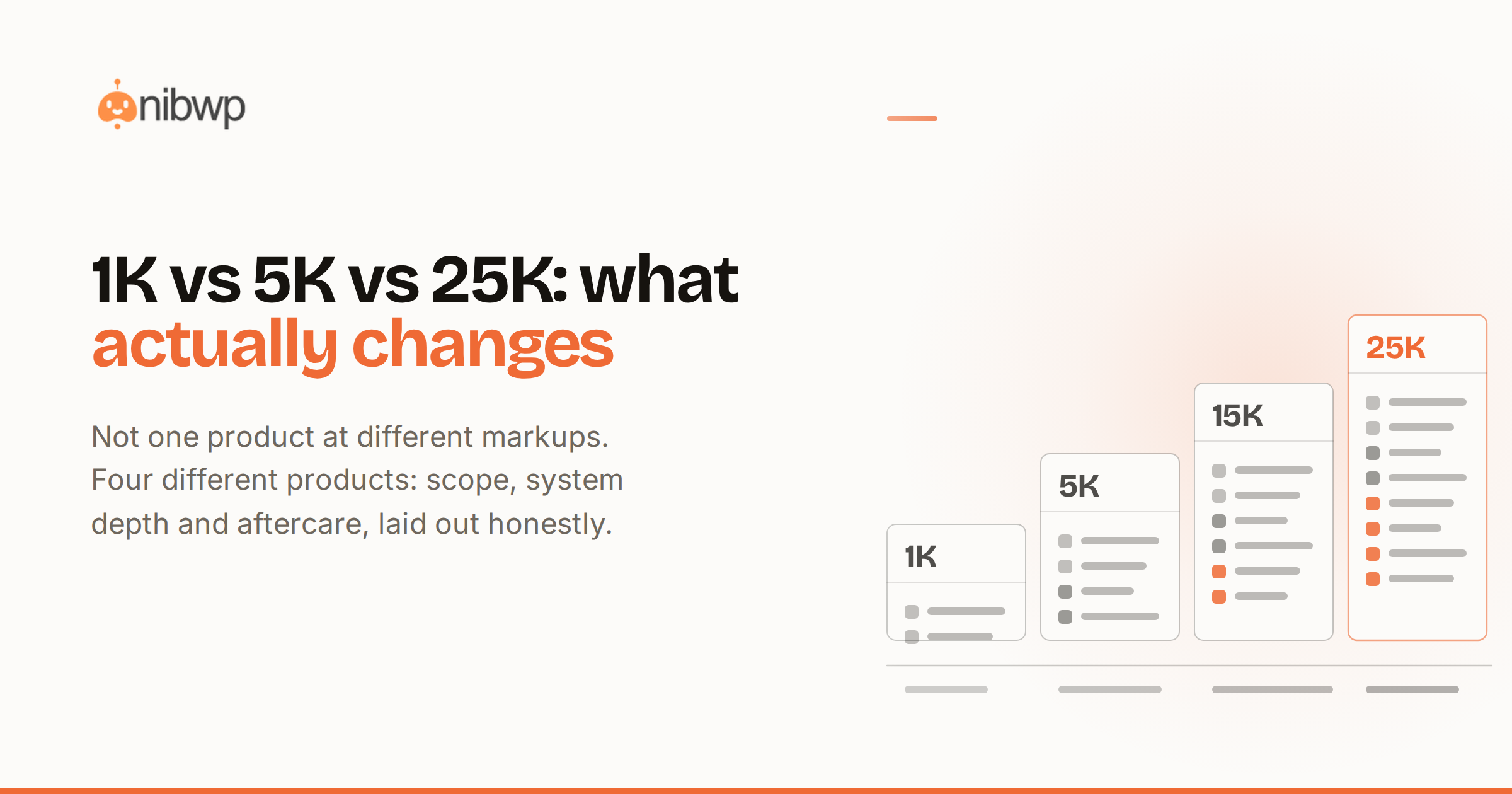
“How much does a website cost?” is the wrong question, and everyone quoting you knows it. The honest question is what changes at each price — because a 1K website, a 5K website and a 25K website are not the same product at different markups. They're different products: different scope, different system depth, different aftercare. Here's the whole ladder laid out — what each tier actually contains, what it costs to deliver in the AI era, and how to tell which one a given project genuinely needs.
One disclosure that makes this guide different: we build the tooling agencies use to deliver these projects, so the delivery-hour numbers below reflect AI-assisted pipelines — the honest modern baseline. The scopes, though, are just the market: this is what the tiers have always meant, minus the mystery.
The 1K website: presence
- What it is: three to five pages — home, about, services, contact — on a quality theme or minimal custom design. A business card that ranks for the company's own name.
- What's real at this price: clean setup, working form, correct basics: mobile, SSL, meta, analytics. What isn't: custom design language, content strategy, anything dynamic.
- Delivery reality: 4–8 hours AI-assisted. Sustainable at 1K only as a productized, fixed-scope offer — the moment it's bespoke, it's a 5K project being underquoted.
- Right for: new businesses, tradespeople, validating a venture. Wrong for anyone whose site must persuade cold traffic.
The 5K website: persuasion
The agency staple: eight to ten pages, a real design system, native builder output, forms, SEO foundations and a proper launch. The full anatomy — scope, day-by-day plan, prompts, margin — is in how to create a 5K website using NibWP. What the extra 4K buys over the 1K tier is one word: persuasion. Custom sections that sell, a system that keeps every page coherent, and the polish cold traffic notices without knowing why.
- Delivery reality: 8–11 AI-assisted hours against 40–54 by hand — which is why the 5K price now carries agency-grade margin instead of break-even heroics.
- Right for: established businesses whose site is a sales asset. The default tier for anyone buying leads with it.
The 8–15K band: transformation projects
Between the staple and the flagship sits the project band where an existing thing becomes a better thing: the 8K redesign (new design system, every page rebuilt, URLs preserved), the 10K template conversion (a premium design executed as a reusable library), and the 15K migration (full platform move with rankings protected). The common thread: the risk is continuity, so the deliverable is proof — checklists, redirect maps, before/after packs.
The 25K website: a system with a business inside
- What it is: sites that are applications wearing a website's clothes — a 20K+ directory, a store with serious catalog depth, a membership property, a multi-audience organization site with governed content workflows.
- Where the money goes: data models, template systems, search, monetization loops, integrations — and the verification those things demand. Design is maybe a quarter of it.
- Delivery reality: 45–90 AI-assisted hours against 200–350 traditional — the tier where AI collapses timelines from quarters to weeks.
- Right for: clients whose site is the business, or a revenue line of it. The build is the start of a relationship, not a handoff.
How to tell which tier a project needs
- Ask what the site must do to a stranger: be findable (1K), persuade (5K), keep persuading through a change (8–15K), or operate a business function (25K).
- Ask what breaks if it's wrong: mild embarrassment (1K), lost leads (5K), lost rankings (8–15K), lost revenue and users (25K). Budget follows blast radius.
- Ask what happens in month two: nothing (1K), content updates (5K), evolution (8–15K), operations (25K) — the aftercare tier is the tell.
- Distrust quotes that skip these questions: a 25K quote for a 5K need is padding; a 5K quote for a 25K need is a project that will die at 60% built.
The line every tier shares: aftercare
Every tier above 1K should end in a plan, because sites rot: links die, updates lag, content stales. The 500-a-month care plan is the recurring layer that keeps any of these builds worth what was paid for it — and for the agency, it's where project revenue becomes business revenue.
Three real briefs, priced through the ladder
The tiers get concrete when real briefs hit them. A physiotherapy practice wanting 'a professional site patients trust': persuasion tier — 5K, ten pages, booking form wired to their calendar; the 1K version would cost them exactly the trust they asked for. A retailer with 900 SKUs 'moving off the old system': the storefront is a 3–5K build, but the catalog is a data operation priced per hundred — the honest quote separates them, and the dishonest one discovers the difference at week six. A founder with 'an idea like Airbnb for rehearsal spaces': that's the 25K system tier wearing a 5K sentence — model, search, booking loop, corpus; the kindest thing a professional does is price it truthfully and offer the phase-one version instead of selling the 5K mirage.
The costs that live outside every quote
Whatever the tier, four costs live on the client's side of the table and belong in the budget conversation even though no agency invoices them. Content time: someone must answer briefs, supply copy or approve drafts — the calendar cost that stalls more projects than money does. Photography: stock reads as stock at every tier; real photos are the cheapest upgrade per euro on the whole ladder. Decision latency: every review round the client adds costs a working day; committees cost weeks — worth saying out loud when timelines matter. And domain-adjacent subscriptions that outlive any build: hosting, email, the booking tool, the analytics. A quote that surfaces these isn't padding — it's the difference between a project priced honestly and one that ends with a surprised client and an agency holding the blame for arithmetic nobody did.
How payment structures should follow the tiers
Payment terms are scope's shadow, and they shift up the ladder. At 1K, take it in one — invoicing a fixed-scope product in halves just doubles the admin on a thin-margin item. At 5K, the classic half up front, half at launch keeps both sides honest through the review cycles. The 8–15K transformation band earns three stages tied to gates, not dates — signature, staging approval, launch — because the client's biggest fear is paying for an unfinished migration, and gate-based payments convert that fear into structure. At 25K, monthly against milestones with the corpus and monetization phases named separately: system builds have real dependency on client-side data delivery, and the payment schedule should make the client's deadlines as binding as yours. One rule spans every tier: the aftercare plan bills separately from day one — folding the first plan months “free” into the project price teaches the client the plan is worth nothing, which is the most expensive discount an agency gives.
FAQ
Why do agencies quote the same site so differently?
Usually they're quoting different tiers at the same URL — one heard “presence,” another heard “persuasion.” The scope questions above surface the disagreement before the invoice does.
Has AI made websites cheaper?
It's made them cheaper to deliver. Market prices move slower than delivery costs, which is why this is the best moment in a decade to run an agency — and why fixed-scope productized tiers beat hourly billing.
Can I start at 1K and upgrade later?
Yes, if the 1K site is built on real foundations — a builder, clean structure, sane URLs. A 1K site built on a page-builder island or a closed platform is a rebuild, not an upgrade.
Where do content and photography fit?
Alongside, at every tier: the ladder prices structure and execution. Great content on a 1K structure beats thin content on a 25K one — budget both, weight content higher than most clients do.
Reading a quote: the six lines that should be visible
Whatever the tier, an honest quote decomposes. Ask for the split across these six lines, and learn more from the shape than the total:
- Design system and direction — near-zero at 1K, a fifth at 5K, a required line at 25K. Its absence at higher tiers means template output at custom prices.
- Build and integration — the bulk everywhere, but its ratio to the total tells you the delivery model: above 60% suggests hand-typing you're subsidizing.
- Content and data operations — placement at 5K, catalogs and corpora priced per hundred at the top. The line most often hidden, and most often the overrun.
- Verification — checklists, test orders, redirect maps. A line at every tier; a section at 15K+. If it's absent, it happens on your traffic.
- Launch and continuity — cutover, redirects, the watch window. The difference between 'live' and 'safely live.'
- Aftercare — named, priced, monthly. Its absence means the relationship ends at the invoice, which is its own information.
Red flags per tier
- At 1K: “unlimited revisions” (a fixed-scope product can't include unlimited anything — someone's lying to someone), and platform lock-in that makes the future upgrade a rebuild.
- At 5K: no design-system line (you're buying a theme with your logo), and page counts without section depth (ten thin pages ≠ ten selling pages).
- At 8–15K: no URL inventory or redirect plan in the proposal — continuity is the product at this band; a quote silent on it hasn't understood the job.
- At 25K: design mockups leading the proposal instead of a data model — pretty pictures are a fifth of a system site; a proposal that's 80% pictures will deliver 20% of a system.
Moving between tiers honestly
Budgets and needs misalign constantly; the honest moves are scope moves, not discount moves. Down-tier by cutting whole capabilities, not quality: a 5K need on a 3K budget becomes six pages instead of ten and one landing page instead of three — same system, same polish, smaller surface. Up-tier by phase, not by lump: the 25K directory on a 12K budget launches as model + templates + 100 listings, with monetization as phase two funded by the audience phase one builds. What never works: the same scope at 60% price — that money comes out of verification and aftercare, the two lines whose absence you discover at the worst possible moment. An agency that discounts scope-silently is showing you where they cut when pressed; prefer the one that says which capability leaves the quote.
What timelines the tiers honestly take
- 1K: two to four working days end to end, most of it waiting on client content.
- 5K: one to two weeks — the build is five days; the second week is review cycles.
- 8–15K: two to three weeks with staging running alongside production and a watch window after.
- 25K: three to six weeks — data modelling and corpus quality set the pace, not page production.
- The AI-era tell: quotes still saying 'eight to twelve weeks' for the middle tiers are pricing a delivery model the market has left — which is fine, but you're paying for their process, not your outcome.
Why not just get quotes and pick the middle one?
Because unscoped quotes aren't comparable — the middle of three numbers describing three different products is noise. Fix the scope with the four questions first; then quotes describe the same product, and the spread tells you about the agencies instead of the ambiguity.
Where do site builders and DIY platforms fit this ladder?
They own the tier below 1K, and honestly: a founder validating an idea should DIY. The ladder starts where a site must persuade strangers or carry operations — the point where structure, verification and aftercare begin producing returns a template can't.
The bottom line
The ladder is scope, not markup: presence, persuasion, transformation, operation. Pick the tier by what the site must do and what breaks if it's wrong — then insist on the tier's proof: a checklist at 1K, a system at 5K, a redirect map at 15K, a data model at 25K. The delivery machinery behind all of it is the agency AI stack — pricing here.