How to standardize the way your agency builds every client site
Ask three people at the same agency to build the same client site and you'll get three different sites. That's not a talent problem — it's a process problem: the standard lives in your best builder's head, and heads don't scale. To standardize a WordPress agency build process, the process has to move out of the head and into something every build is forced to run through.
This guide is the practical version: turning your senior process into a playbook, making it govern every AI-assisted build automatically, and rolling the same standard across the whole team and every client site.
Why builds drift
- Checklists are optional. A doc in Notion describes the standard; nothing enforces it at the moment of work.
- Prompts are personal. Everyone's AI gets slightly different instructions, so everyone ships slightly different sites.
- Review happens too late. Quality control at the end of a build finds the drift after the hours are spent.
- Onboarding is oral tradition. New hires absorb the standard by watching — slowly, lossily, and differently each time.
The mechanism: playbooks the AI must follow
NibWP Workflows turn a written procedure into mandatory operating instructions. A playbook has six parts — when to use, principles, ordered process, hard rules, validation, and the report it must end with — and it's injected into every matching AI request on the site. Not a suggestion in a prompt: the run is required to follow the steps, is checked against the rules, and fails loudly instead of drifting quietly. Eighteen playbooks ship by default across nine categories; the system is on the Workflows page.
Walkthrough 1: Write the standard down — once
- Start from the default full-site-build playbook and edit it toward your house standard, or write your own in plain language.
- Principles carry your taste: design-token discipline, accessibility floor, performance budget.
- Process carries your order: global styles before pages, forms before automations, SEO basics before launch.
- Rules carry your boundaries: what must never ship — inline styles, orphan pages, untested forms.
- Validation carries your definition of done — the checks a build must pass before it may finish.
Walkthrough 2: Make it govern every build
- Pin the build playbook on sites where it should always rule — exactly one pinned playbook governs a site at a time.
- Leave the rest auto-routed: every playbook lists when it applies, and the agent loads the right one when a task matches.
- The team changes nothing about how they work — they ask for a build, and the procedure is simply in force.
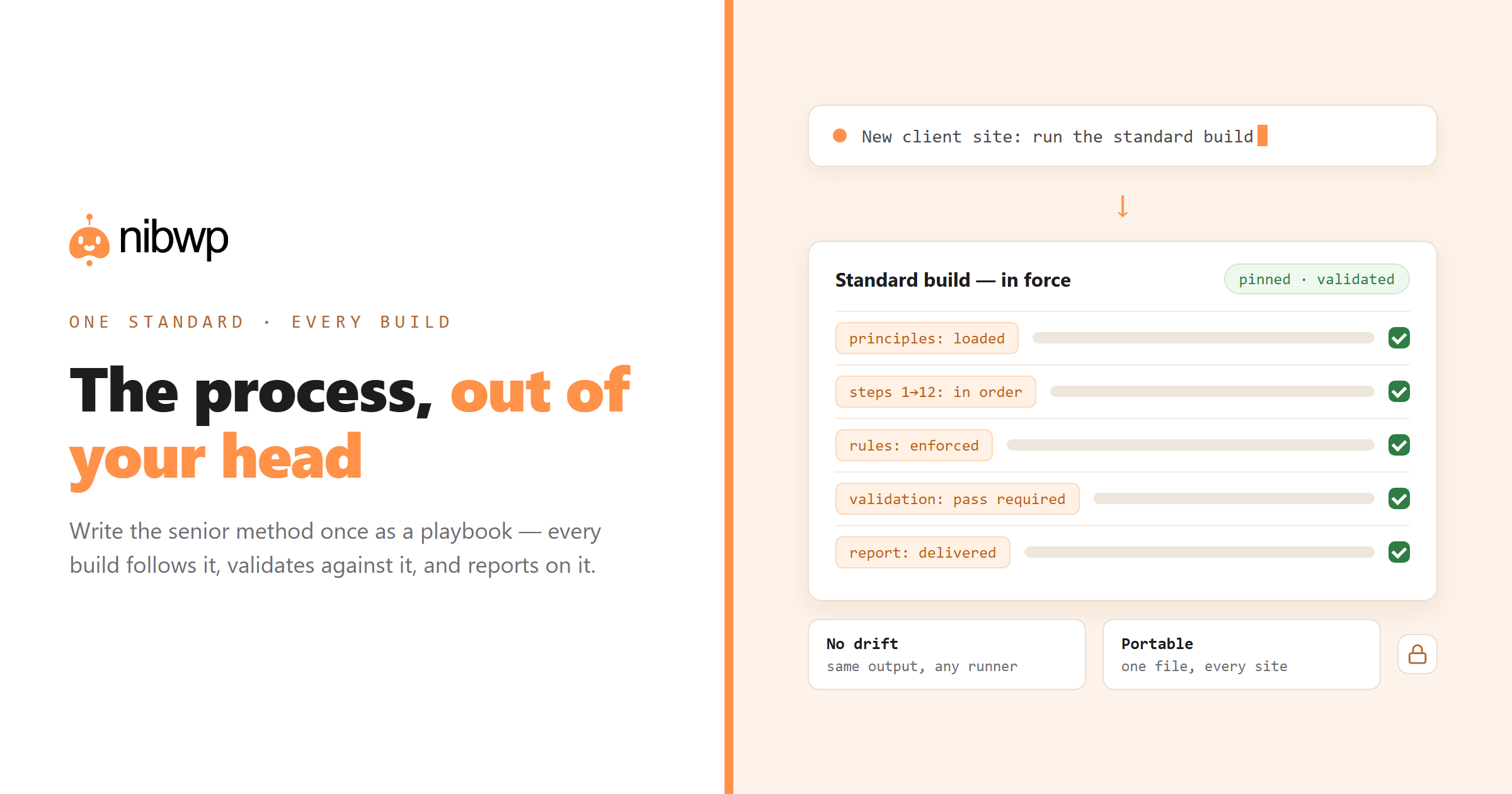
Walkthrough 3: The standard build, end to end
- A teammate asks their connected AI for a new client site build.
- The playbook loads; the agent works the ordered steps — tokens, pages, forms, SEO — through typed abilities.
- Writes queue for approval at the gates you've set; nothing lands without a yes.
- Validation runs before the build may complete: rules checked, output verified.
- The run ends with a structured report — what was built, what was checked, what to review by hand.
Walkthrough 4: Onboard by playbook
A new hire's first build follows the same procedure as the founder's, because the procedure — not the person — carries the standard. Training collapses from months of shadowing to “run the playbook, review the report together.” The standard also survives departures: expertise encoded is expertise the agency keeps.
Walkthrough 5: Capture improvements as they happen
When a run goes unusually well — a migration handled cleanly, a tricky form wired right — capture it: the agent can save a successful run as a new playbook. The library sharpens with use, and the improvement is instantly everyone's.
Walkthrough 6: One standard across every client site
A playbook is a portable file that follows your license: tighten the standard once and every site you manage runs the tighter version. Combined with the one-seat command center, the whole portfolio builds, audits and maintains to the same spec — which is what makes the output billable at scale.
The bottom line
Standardizing isn't about making people interchangeable — it's about making quality independent of who ran the build. Write the process once, let it govern every run, validate before done, and report after: the same senior procedure on site one and site fifty, by design rather than by hope.
The team-facing version of this pitch is one AI workflow for every client build. Start by connecting your AI client, browse the playbook system, and see pricing — Workflows ship with Pro.