Write blog posts with AI directly in WordPress (no copy-paste)
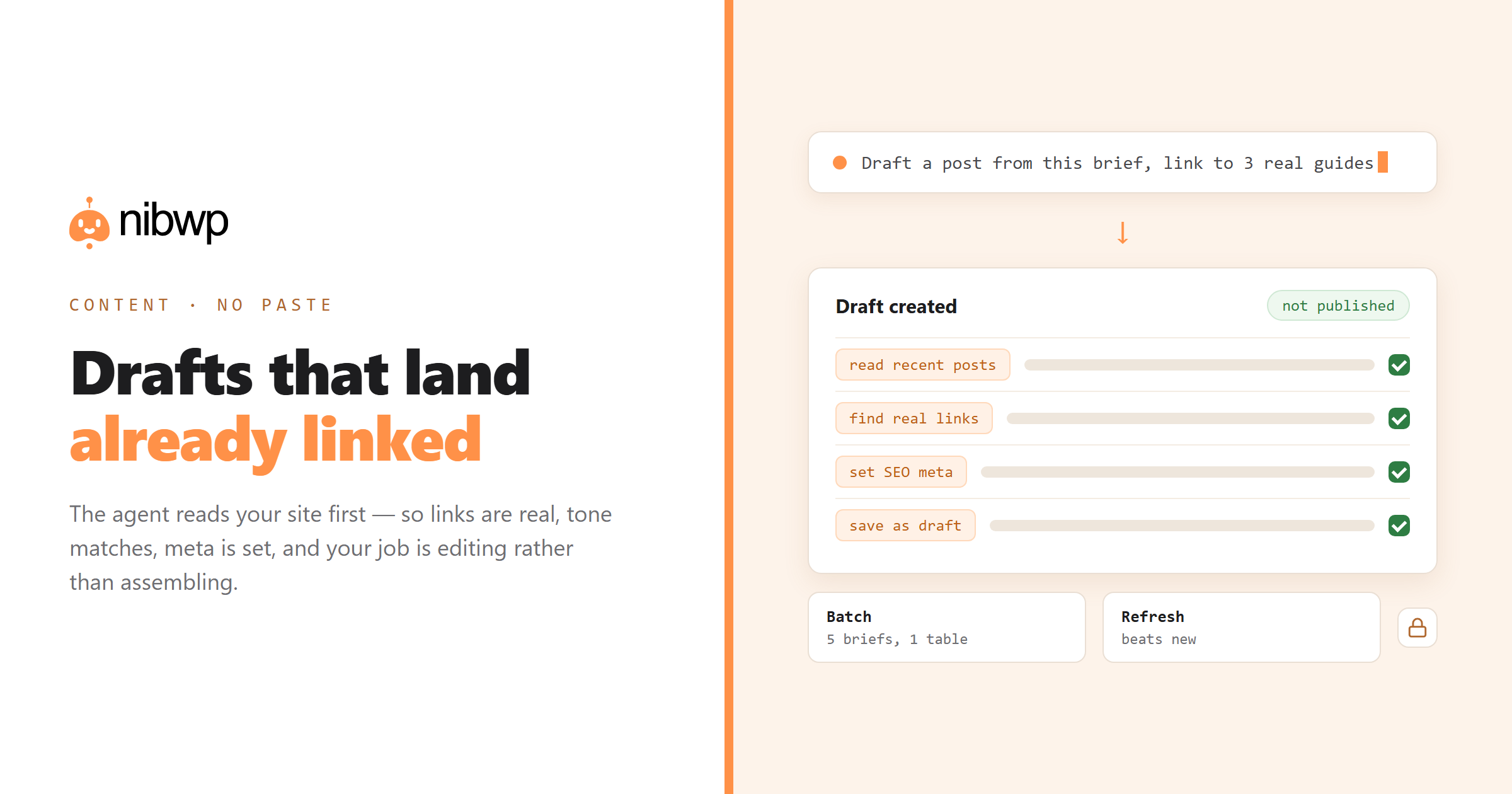
Most people writing with AI still work by copy-paste: prompt in one window, paste into WordPress, fix the formatting, hunt for internal links, write the meta description by hand. The pasting is the slow part, and it is unnecessary. With an MCP connection, the draft is created in WordPress directly — structured, linked, with meta set — and your job becomes editing rather than assembling.
Every write below goes through the same shape: the agent reads first, shows a plan, and nothing is written until you approve it — with the whole run in the audit log.
Why copy-paste produces worse posts
Not just slower — worse, for a structural reason: a chatbot does not know your site. It cannot link to your existing guides because it does not know they exist, cannot match the house style unless you paste it every time, and cannot check whether you already covered the topic. So every post arrives as an island.
An agent with read access to your site fixes all three, because it can look before it writes.
The setup
One connection, then one prompt pattern you will reuse forever:
nibwp auth login https://yoursite.com --scope read,write
nibwp agent add claude-code
The prompt that does the whole job
Draft a post from this brief: [your brief]

Before writing:
- Read our five most recent posts to match tone and structure.
- Find the three most relevant existing posts to link to. Use real URLs from the site.
- Check we haven't already covered this angle.

The post:
- 1,400+ words, H2 sections, no fluff intro.
- Link to the three posts you found, in context.
- Set the SEO title (max 60 chars) and meta description (140-155 chars).
- Assign the Guides category.
- Save as DRAFT. Do not publish.

Then tell me: what you linked to, and anything in the brief you couldn't support.
The last line matters more than it looks. Asking what it could not support is how you catch the places where it would otherwise invent something.
Doing it at series scale
Where this stops being a nicety is at volume. Five briefs, one prompt:
Here are 5 briefs. For each, draft a post following the same rules,
then give me one table: title, slug, word count, meta description,
internal links used. All drafts, nothing published.
You review a table instead of five documents, and the interlinking is coherent across the set because one pass wrote all five knowing about each other.
The other half: updating what exists
Publishing is only half the content job. The half everyone skips:
Find posts older than 18 months with: no H2 structure, under 600 words,
or zero internal links. Rank by traffic potential and propose an update
plan for the top ten. Don't change anything yet.
That single prompt usually surfaces more traffic upside than the next three new posts. The full pipeline version is in the content automation solution.
House rules worth enforcing
- Drafts only. Publishing stays human, always.
- Real links only — instruct it to use URLs it read from the site, never constructed ones.
- Meta within limits, written from the post's actual content.
- One H1, H2 structure, no invented statistics or quotes.
- Ask what it could not support, every time.
Encode those once as a Skill or a rules file and every future post inherits them — see writing a Claude Skill for WordPress.
What makes a brief the agent can actually use
The quality ceiling of the output is set by the brief, not the model. A brief that produces a genuinely useful draft has five parts:
- The reader and their moment.
- The one thing they should believe afterwards. If you cannot state it in a sentence, the post will wander.
- What you know that others do not. Your numbers, your process, your failures. This is the only part a model genuinely cannot supply.
- The shape. Comparison, walkthrough, listicle, argument. Naming it prevents the default essay shape.
- What to avoid. Claims you cannot support, competitor names, promises about results.
Getting structure right the first time
Ask for the outline before the draft. It costs one extra exchange and saves a rewrite:
From this brief, propose an outline only: H2s with one line each on what
that section will argue, plus where you'd place internal links.
Stop there. I'll approve the outline before you write.
Fixing an outline takes seconds; fixing a 1,500-word draft that is structured wrong takes as long as writing it yourself. This single habit is the difference between AI-assisted writing that saves time and AI-assisted writing that creates editing work.
The editing pass that matters
Assume the draft is 80% there and that the missing 20% is always the same things:
- Opening paragraph — models default to throat-clearing. Cut the first two sentences and see if it reads better. It usually does.
- Unsupported specifics — any number, date or claim you did not supply. Verify or remove.
- Your voice — the sentence you would never write is the one readers notice.
- The ending — ask for the last section to make one recommendation rather than summarising.
Ten minutes of that pass is the difference between content that reads like yours and content that reads like everyone's.
FAQ
Can AI write blog posts directly in WordPress?
Yes. With an MCP connection the agent creates the draft in WordPress itself — headings, internal links to posts it actually read, SEO meta, category — and you review rather than assemble.
Will AI-written posts hurt my SEO?
Unreviewed, generic posts will. Posts drafted from a real brief, linked to your existing content and edited by someone who knows the subject perform like any other good content. The review step is the difference.
How do I stop it inventing internal links?
Instruct it to read the site and use only URLs it found, then ask it to list which links it used. Fabricated links show up immediately in that list.
Should AI publish posts automatically?
No. Drafts plus human review costs minutes and prevents the one bad post that costs credibility. Publishing is a judgement call.
Can it update old posts too?
Yes, and that is often higher value than new posts: find thin, unstructured or unlinked content, rank by potential, and propose an update plan before changing anything.
How do I keep the house style consistent?
Write the rules once — as a Skill, a rules file or a bundled style guide — so every prompt inherits them instead of you re-explaining tone in each conversation.