What a 2K landing page looks like when AI builds it in a day
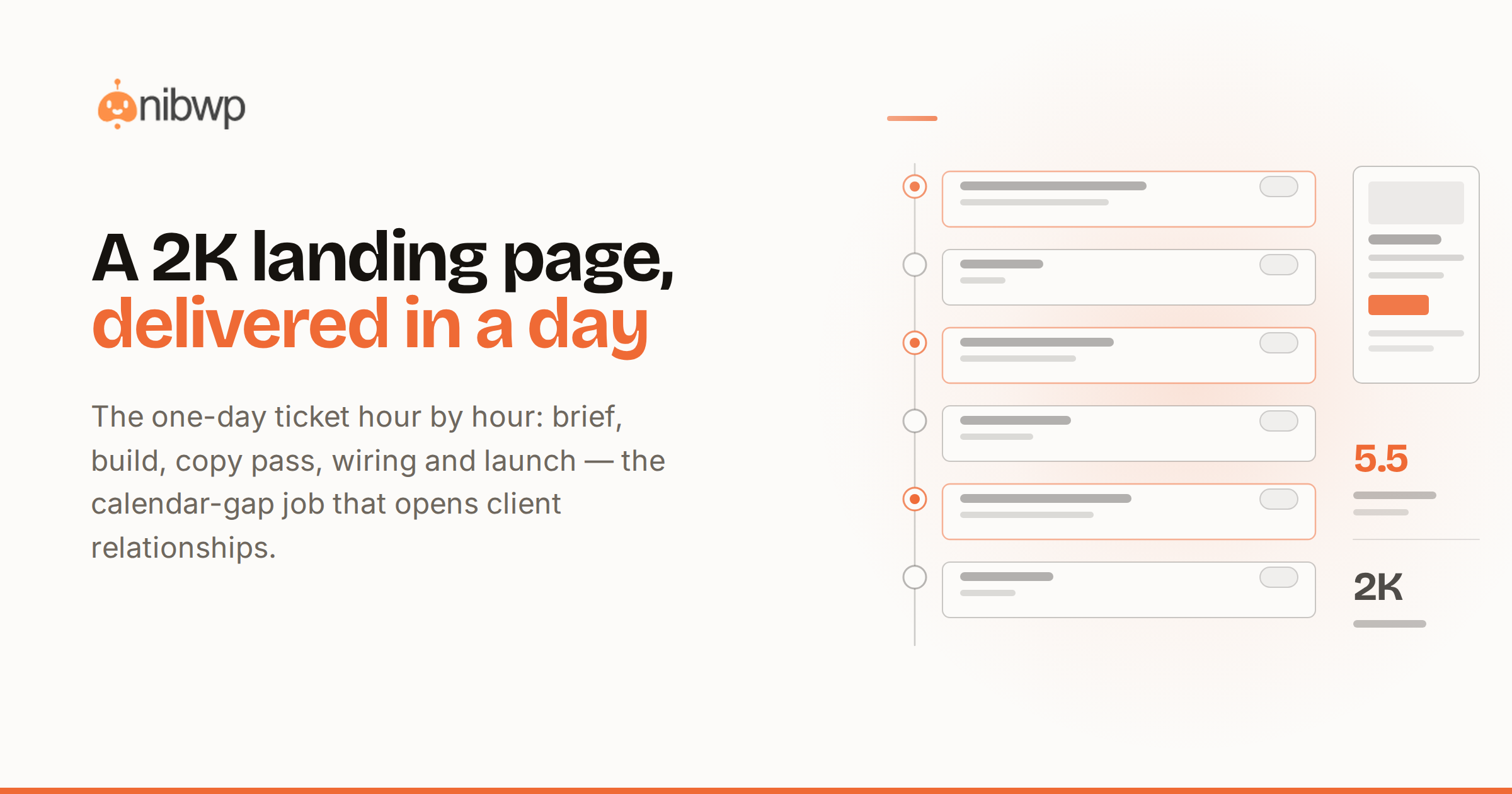
The 2K landing page is the sharpest tool in agency pricing: small enough that clients approve it without a committee, urgent enough that they'll pay for speed, and — with the right pipeline — deliverable in a single working day. Not a template with the logo swapped: a custom, on-brand, conversion-built page with a form that works and metadata that's done. This is the exact day, hour by hour, including the prompts.
Speed is the product here. A landing page request almost always has a date attached — a campaign going live, an ad budget already burning, a launch on Thursday. The agency that says “Friday” beats the agency that says “in two weeks” at almost any price. AI doesn't just make the day possible; it makes it repeatable enough to put on your rate card as a standing offer: landing page, 48 hours, 2K.
What 2K buys — and what it doesn't
- One page, one goal. A single conversion action: book, buy, download, register. Multi-purpose pages are websites; this isn't that.
- Five to seven sections. Hero with the offer, proof (logos or testimonials), the what-you-get block, objection handling or FAQ, final CTA.
- On the client's existing site and brand. Built in their builder, bound to their global styles — not a foreign artifact on a subdomain.
- A working form or checkout link. Wired, tested, notifying the right inbox.
- Metadata and speed pass. Title, description, social card, compressed media.
- Not included: copywriting from nothing (client supplies the offer; you polish), A/B infrastructure, and ad management — all sold separately.
9:00–12:00 — from brief to standing page
- 9:00 — the 20-minute brief call. You need five answers: the offer, the audience, the action, the proof you can use, the deadline. Everything else is decoration.
- 9:30 — skeleton and tokens check. The page is built on the client's site, so global styles already exist; if they don't, set the minimal token set first — ten minutes that saves the afternoon.
- 9:45 — the build prompt: “Create a draft landing page ‘Spring Audit’ — hero with headline ‘Find the leaks in your funnel’, subhead and CTA ‘Book the audit’; logos band; 3-step what-happens section; testimonial; FAQ (3 items); final CTA band. Use global styles, keep it out of the nav.” Review the section plan. Approve.
- 10:15 — the page exists as native builder sections. First polish pass by instruction: hero height, section rhythm, CTA color, mobile spacing. Three or four instructions, each re-validated.
- 11:00 — reference matching if the client sent one: “Make the proof section feel like this screenshot” — converted to native elements on their tokens, not copied markup.
- 11:30 — form: create it, wire the notification to the campaign owner, set the thank-you state, submit a test.
13:00–17:00 — content, checks, live
- 13:00 — real copy in. Paste the client's offer copy; have it placed and tightened per section — sentence case, one voice, CTAs consistent.
- 14:00 — media: compress the hero image, alt text, favicon and social card set.
- 14:30 — metadata: “Title ‘Spring Funnel Audit — [Brand]’, description 150 chars selling the audit, OG image the hero card.”
- 15:00 — the checklist run: links, form, meta, headings, mobile, performance basics — it ends in a report you'll forward.
- 15:30 — client review on staging. Batch their tweaks into one instruction list; apply; re-check.
- 16:30 — publish, smoke-test the form on production, send the launch email with the report attached and the ad-ready URL.
The ledger and the math
- Hand-built honest estimate for the same page: 12–18 hours across build, styling, form, QA — a two-to-three-day turnaround at best.
- This pipeline: 5–6 hands-on hours, one calendar day, most of it review and polish.
- At 2K per page: roughly €350–400/hour effective rate on delivery day — and the speed itself is why the price holds.
The compounding part: your second landing page for the same client reuses their tokens, their form patterns and your section instincts — closer to four hours than six. Standing offer, standing margin.
What breaks the one-day promise
- Starting without the offer nailed — you can build a page in a day; you can't extract a value proposition from a client in a day. The brief call gates the start.
- Building off the client's site (on a staging island) — you lose their styles, their forms, their analytics, and add a migration step.
- Accepting copy “by end of day” — placeholder copy means a second day. Copy at the brief, or the clock starts when it arrives.
- Skipping the checklist because it's one page — one page with a dead form is a refund, not a project.
The one-day checklist, printable
- Brief call done — five answers written, contract sentence read back.
- Copy in hand before the build prompt (or the clock formally starts when it arrives).
- Client's global styles confirmed, or the minimal token set created first.
- Page built out of the nav, on the client's site, from one structured prompt.
- Form wired to the campaign owner's inbox and test-submitted.
- Real copy placed and tightened; one voice, one CTA verb throughout.
- Media compressed, alt text set, social card rendered and checked.
- Metadata written; page excluded from nav but included in sitemap deliberately or not, per campaign.
- Checklist run, report saved; client review batched into one round.
- Live smoke test of the form on production; launch email with URL + report sent.
Copy polish: the 20% that moves conversions
The pipeline builds the page; these editorial habits make it convert. Headlines state outcomes, not activities (“Find the leaks in your funnel” beats “Marketing Audit Services”). The CTA verb matches the commitment level — “Book the audit” for a call, “Get the checklist” for a download; mismatched verbs (Buy on a discovery-call page) cost real percentage points. Numbers beat adjectives everywhere they exist: “412 audits delivered” outsells “extensive experience” and always will. And the FAQ section is sales copy wearing a helpful hat — source its questions from what prospects actually ask on calls, and answer the price question honestly there; pages that dodge price get bounced by exactly the visitors who were ready to pay it.
Matching the page to its traffic source
A landing page inherits its temperature from the click that brought the visitor, and the one-day pipeline should adjust three dials accordingly. Search traffic arrives warm and specific — the headline can assume intent (“Funnel audits for B2B SaaS”) and the page can be shorter, because the visitor pre-qualified themselves. Social traffic arrives cold and curious — the hero has to earn the next scroll with the outcome stated plainly, the proof band moves up, and the FAQ carries more weight because objections arrive earlier. Email traffic arrives pre-sold — the page's job is confirmation and friction removal, so the form moves up and the persuasion sections compress. Ask the traffic question in the brief (it's question two for a reason) and build the variant that matches; the same offer converts at visibly different rates when the page respects where the click was born. When a campaign spans sources, that's the batch conversation — three variants of one page is a natural 4.5K, not three separate projects.
FAQ
Can I really deliver same-day?
If the brief call happens in the morning and the copy exists: yes, routinely. The build itself is two to three hours of directed work; the rest is checks and client review. Quote 48 hours and deliver in one — margin for the client who's slow with copy.
Is 2K defensible for one page?
The client is buying a campaign asset on a deadline, not hours. Speed, brand-fit and a working funnel are the value; the ad spend it supports usually dwarfs the fee.
What if the client has no design system on their site?
Set a minimal one first — palette, type, spacing from their brand assets. It adds an hour and makes every future page for them faster; charge accordingly or absorb it as onboarding.
Does this work on any builder?
Elementor, Kadence, Bricks and EtchWP all get native output via Pro Skills; core blocks cover builder-free sites. The pipeline is identical — describe, review, approve, refine.
The 20-minute brief, question by question
The brief call is the project's real foundation, so run it as a script, not a chat. The five questions, and what each is protecting against:
- “What exactly is the offer?” — one sentence, with the number in it if there is one. Protects against: building a page for a fog. If they can't say it, the page can't either — and that discovery at 9:00 costs nothing.
- “Who lands here, coming from where?” — cold ad traffic reads differently than a newsletter click. Protects against: the right page for the wrong temperature.
- “What's the one action?” — book, buy, download, register. One. Protects against: the three-CTA page that converts at a third of a one-CTA page.
- “What proof can we use today?” — logos, numbers, quotes, with permission. Protects against: the proof section that stalls the project in legal on day two.
- “When does traffic start?” — the real deadline, which sets the review window. Protects against: the client review that arrives after the ads do.
Everything else — colors, vibes, a competitor they admire — gets thirty seconds and a note. The call ends with one sentence read back: “A page for [audience] offering [offer], asking them to [action], live by [date].” That sentence is the contract.
The five-section skeleton and why it converts
The 2K page earns its keep with a skeleton that's boring on purpose — every section answers the visitor's next silent question in order:
- Hero: what is this and is it for me? Headline states the offer's outcome, subhead names the audience, CTA above the fold. No carousel, ever.
- Proof band: can I trust you? Logos or one number that matters (“412 audits delivered”). Borrowed credibility beats adjectives.
- What-you-get: what happens if I act? Three to five concrete items or steps — the offer made tangible, icons earning their pixels.
- Objections: what's stopping me? The FAQ block, written from real sales conversations — price context, time required, “what if it's not for us.”
- Final CTA: the ask again, for the reader who scrolled — with one line of risk-reversal if the offer has one.
Sections beyond these five need a reason. Every addition costs scroll depth, and scroll depth costs conversions — the discipline is the design.
Rush, batch and retainer: the offer's three gears
- The rush gear: same-day at a premium (2.5K) when the brief lands before 10:00 with copy attached. You're not charging more for the same work — you're selling the queue jump, which is real inventory.
- The batch gear: three pages for a campaign (search, social, partner traffic) at 4.5K — the second and third pages reuse tokens, form and skeleton; your cost per page halves while the price per page drops only a quarter. Everyone wins visibly.
- The retainer gear: a landing page a month inside a marketing retainer — the same pipeline as a standing appointment, and the reason the care-plan client never leaves.
After launch: the 15 minutes that earn the next order
The page going live is the deliverable; what you send a week later is the relationship. Fifteen minutes: pull the form-submission count and the basic analytics, one paragraph — “214 visits, 19 submissions, 8.9% — strong for cold traffic; the FAQ section holds attention, worth testing a shorter hero next round.” No dashboard, no meeting. This note does two jobs: proves the page works, and plants the next project inside the observation. Landing-page clients rarely buy pages; they buy the feeling that someone competent watches the funnel.
Should the landing page be on the client's domain or a subdomain?
Their main domain, in almost every case: it inherits trust, analytics and pixel setups, and the page benefits from the domain while the domain benefits from the campaign's links. Subdomains are for genuinely separate properties, not campaigns.
Do I A/B test at this price?
Not inside the 2K — one strong page, shipped fast, beats two mediocre variants. Offer testing as the follow-up: after two weeks of data, a variant of the weakest section at a small fixed price. That sequencing turns testing into a retainer rhythm instead of a launch delay.
The bottom line
The 2K one-day landing page is a scope promise plus a pipeline: five answers at 9:00, native sections by lunch, live by 17:00 with a report. It's the smallest unit of the agency AI build system — and the easiest one to sell first. See where it sits on the price ladder in 1K vs 5K vs 25K; the machinery for reference-matching lives in screenshot to WordPress page. Toolset: pricing.