One person, 100K a year in websites: the AI-era solo agency
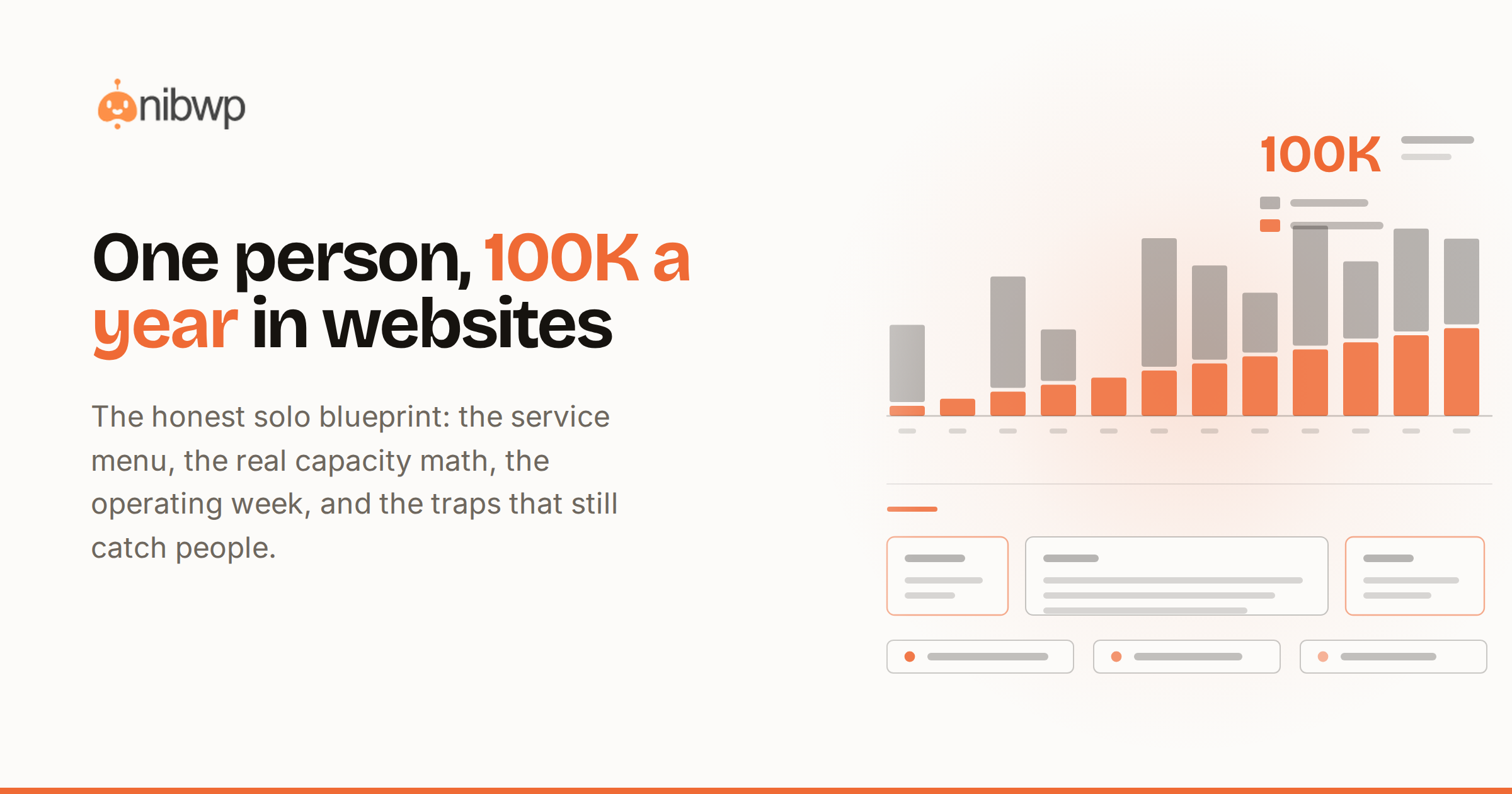
One person, a hundred thousand a year in websites: for two decades that sentence required either luxury positioning or seventy-hour weeks. The constraint was never demand — small businesses generate endless website work — it was throughput. One good builder could deliver maybe one 5K site a month by hand while servicing existing clients, and the ceiling followed from arithmetic. The arithmetic changed. Here's the honest blueprint of the AI-era solo agency: the service menu, the capacity math, the weekly operating rhythm, and the traps that still catch people.
A promise about what this isn't: not a passive-income fantasy, not “AI does everything.” The solo agency still runs on judgment, taste and client trust — you're the director of every project and the name on every invoice. What's different is that the typing, clicking and checking that used to consume the week now runs through directed, approval-gated pipelines. You keep the decisions; you shed the labor between them.
The service menu that adds to 100K
A workable year, mixing the tickets this series has anatomized:
- Ten 5K websites (50K): the staple, one to two per month in season — the 5K playbook at 8–11 hours each.
- Six 2K landing pages (12K): the one-day ticket that fills calendar gaps and often opens client relationships.
- One transformation project (8–15K): a redesign or migration — the quarter's anchor.
- Care plans compounding underneath (24K+ by year-end): every build converts to the 500-a-month plan; twelve plans by December is conservative if you attach it to every launch.
Notice the structure: roughly 75K of project work at AI-era hours, and a recurring layer that starts near zero and exits the year at 4K-plus per month — which means year two starts a third sold out.
The capacity math, honestly
- Project hours at the pipeline rates: ten 5Ks (≈100h) + six landing pages (≈33h) + one migration (≈30h) ≈ 165 delivery hours across the year — four focused hours a week.
- Care plans at an hour a month each: growing from 2 to 12 sites ≈ 80 hours across the year.
- The real budget lines nobody counts: sales conversations, briefs, client review cycles, invoicing — comfortably double the delivery hours. That's the honest 12–18 hour week, not the fantasy four.
- Ceiling check: this menu uses maybe half of a disciplined solo capacity — the constraint has moved from delivery to demand, which is the trade you wanted.
The operating week
- Monday morning — the fleet pass: approvals inboxes across every care-plan site, one sweep; anything odd becomes a queued fix.
- Tuesday to Thursday — project blocks: one build in flight at a time, delivered in the day-by-day rhythms this series lays out; briefs and reviews batched to mornings.
- Friday — the business: proposals, pipeline, invoices, and the month-end reports in report weeks.
- Always-on but async: client email twice a day, not continuously — the pipelines don't need babysitting, so neither does the inbox.
The system that makes one person enough
Three layers carry the whole model. The build layer: native-output site building across every builder your clients use. The operations layer: one seat across the whole roster, every site with its own approvals and audit log. The standards layer: playbooks that encode your way of building — which is what makes month nine's site as good as month one's when you're moving fast. Approval gates everywhere mean speed never spends trust.
The traps that still catch solo operators
- Selling hours out of habit. Hourly billing converts your new efficiency into client discounts. Fixed-scope tiers — the ladder from 1K to 25K — are the model; the pricing playbook handles the conversation.
- Skipping the care-plan attach. Projects pay the year; plans buy the future. An agency that launches without attaching the plan is rebuilding its revenue every January.
- Parallel project sprawl. The pipelines make two builds at once possible — and reviews, briefs and client latency make it miserable. One in flight, one in brief.
- Quality drift at speed. Checklists and playbooks aren't bureaucracy; at solo velocity they're the substitute for the colleague who would have caught it.
- Becoming the bottleneck on purpose. Some week you'll hand-polish something the refine loop would have done in a line. Taste applied at the right altitude is the job; typing isn't.
The solo operating checklist
- Every offer fixed-scope and written — the tier ladder is the rate card.
- One project in flight, one in brief; the third one waits, whatever it pays.
- The plan attached to every launch, first month framed as the watch window.
- Playbooks capture your way of building — updated when a project teaches something.
- Monday fleet pass and Friday business block, held like client meetings.
- Proposals answer risk explicitly: scope, checklist, report, aftercare, one name behind it all.
- The referral slot held open monthly; happy clients told it exists.
- Approvals read, never rubber-stamped — the day they're clicks, quality is already leaving.
- Quarterly: prices, roster and capacity reviewed against the year's plan.
- The boring layer funded: contracts, insurance, backups of your own house.
Solo credibility: the assets that answer 'is this a real business?'
Context for why this matters commercially: the solo operator's close rate on equal proposals is decided almost entirely here — pricing objections are usually risk objections wearing a budget costume. Answer the risk directly and the price conversation shrinks; leave it unanswered and no discount fixes it.
One more habit belongs on the list because it costs nothing and compounds: publish a short annual notes post — what you shipped, what you changed about your process, what you're raising prices on and why. Clients and referrers read it; competitors won't write one. Transparency at that cadence is the solo operator's substitute for a brand department, and it makes every following January's price letter land as a continuation instead of a surprise.
The solo operator's sales objection is rarely spoken and always present: what happens if you get hit by a bus? The answer isn't pretending to be bigger — clients smell the royal “we” — it's a visible operating system that makes one person legible as an institution. The asset list: a public process page (the day-by-day rhythms from this series, on your own site — it converts because competitors won't show theirs), the before/after packs as a portfolio of proof rather than screenshots of prettiness, a real contract with a continuity clause (what happens to credentials, backups and the plan roster if you're incapacitated — the paragraph nobody else's proposal has), and reports that arrive on schedule for months, which is the only credibility that compounds. The playbook layer quietly serves here too: documented procedure is the honest answer to the bus question, because it means your operation is transferable in an emergency instead of trapped in your head. Solo isn't the risk clients fear — opacity is.
FAQ
Is 100K realiztic in year one?
With an existing network or local reputation, yes — the menu above is ten real clients and some repeatables. From absolute zero, the delivery capacity is ready before the demand is; budget the year for pipeline building and let plans compound into year two.
Do clients care that you're solo?
They care about risk. The answers that settle it: fixed scopes, visible checklists and reports, an audit log, and aftercare with a number on it. A documented solo operation reads as lower risk than an opaque studio.
What do I outsource first?
Content and photography — they were never the structural work. Then bookkeeping. The delivery pipeline itself is the last thing to hand off, because it's where your margin and your standards live.
What actually breaks this model?
Unbounded scope and unbounded availability. Every failure story is one of those two sentences — 'while you're at it' and 'always reachable.' The contracts and the operating rhythm above are the fences.
The year in quarters: how the 100K actually lands
- Q1 (12–18K): two 5K builds from the network, a landing page, the first three care plans converted from past clients via the health-check letter. Feels slow; the machine is warming.
- Q2 (22–28K): the transformation project anchors the quarter (a redesign sold by its audit), two more builds, plans reaching seven. The first referral from a Q1 before/after pack arrives.
- Q3 (25–30K): peak season — three builds, the landing-page batches for everyone's autumn campaigns, plans at ten. The week is genuinely full; this is the quarter that tests the fences.
- Q4 (28–35K): two builds plus the seasonal commerce work, plans at twelve-plus turning December — historically the dead month — into the month recurring revenue carries. Year total: 95–110K, with 4K+ monthly walking into January.
What the machine costs to run
The solo agency's entire toolchain, priced honestly: the NibWP license covering the roster, an AI client subscription or two, hosting for your own properties, accounting software, and a proposal tool if you like — the stack lands between 150 and 300 a month all-in. Against 8K+ of monthly revenue at cruising speed, tooling is 2–4% of gross — the arithmetic that used to require an employee's salary now fits in a phone bill. The real costs are elsewhere: the insurance and legal setup done properly once (~1K), and the sales time no tool absorbs. Budget those and the model has no hidden line items.
Choosing clients when the constraint is demand
Capacity abundance changes selection: the question stops being “can I fit this?” and becomes “does this compound?” The clients that compound: businesses with recurring campaign needs (their landing pages become your rhythm), businesses adjacent to other businesses (accountants, printers, fair organizers — referral hubs), and businesses whose sites carry operations (stores, directories — plan-tier clients by nature). The clients that don't: the one-off passion project (fine, price it fairly, expect nothing after), and the client whose budget fits but whose decision process doesn't — the committee that took six weeks to approve a landing page will take six months to approve a site, and calendar is the one thing the model still spends. One vacancy rule keeps quality honest: hold one project slot open per month for referrals from happy clients — the compounding channel deserves reserved inventory.
Year two: the three roads from 100K
- Deepen (the lifestyle road): same volume, better clients, prices up 20% on the strength of a year's before/after packs — 120K at the same hours, and the calendar breathes.
- Productize (the leverage road): one vertical, one template library, one repeatable offer — the library model pointed at a niche you now know. Margin grows faster than hours.
- Hire (the agency road): the playbooks that kept your solo quality consistent are, unchanged, the training manual for the first hire — the transition that breaks most solo shops is pre-solved by the standards layer if you built it honestly.
- The common thread: all three roads run on the recurring base — the plans are what make year two a choice instead of a restart.
How do I handle vacations and sick weeks solo?
The recurring layer is built for absence: jobs run, changes queue, nothing writes without you — a week's inbox is an hour's catch-up, not a fire. Projects are calendar work: don't start builds that straddle planned absence, and hold the rush gear for the return week. Clients accept 'next slot is the 14th' from a documented operation far better than agencies fear.
When do I know it's time to raise prices?
When two of these are true for a quarter: the referral slot fills the day it opens, projects book three-plus weeks out, and plan conversions stop needing the sales letter. Raise the project tiers 15–20% for new clients first; the recurring base makes the experiment safe.
The bottom line
The solo 100K agency is a menu, a rhythm and three layers of system: builds with native output, operations from one seat, standards in playbooks — all behind approval gates that keep speed from spending trust. The projects are anatomized across this series; the ladder that organizes them is 1K vs 5K vs 25K. The toolset underneath is one license — pricing — and the first move is attaching the plan to whatever you launch next.